Food Storage and Kitchen Organisation
Tea and Coffee Canisters for Indian Kitchens
Choose a canister for the tea or coffee you actually keep and the way you retrieve it. A matching set is useful only if its individual volumes suit your quantities and its opening and cleaning routine suit your kitchen. A printed label or a closure name does not establish those things.
3 products · Compare before you buy
Product comparison at a glance
| Product or documented lead | Capacity and use | Care and mechanism | Main purchase consideration |
|---|---|---|---|
IKEA BLOMNING 106.111.56 | 1.8 L; 10 × 10 × 20 cm; coffee/tea tin | Tinplated steel with coatings; handwash only; lidded stacking described | Opening size, closure performance and loaded tier limit unresolved |
Fellow manual Atmos — whole-bean lead | Whole beans; exclude ground coffee, fine powders and liquids | Twist mechanism and release button; no dishwasher; keep liquid out of lid mechanism | Select Manual Atmos on the maker’s product page; size, finish and India offer require separate selection |
InstaCuppa 500 g coffee canister | Current specification SKU InstaCuppa_CoffeeCanister_Steel; Steel/Black listed | Component washing and gasket handling need clarification | 500 g appears as weight and size; empty mass unclear; FAQ dimensions are generic |
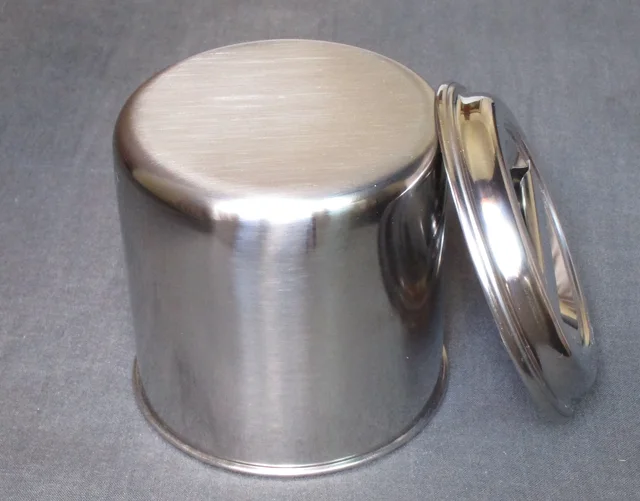

For a simple tea or coffee tin, compare BLOMNING’s documented footprint and hand-washing routine. For whole beans, manual Atmos adds a twist-and-release mechanism with more detailed lid care. InstaCuppa adds a date dial and vent, but its generic fit guidance leaves exact shelf fit unresolved. Neither a vacuum mechanism nor a date dial establishes a tested freshness advantage here.
Record each ingredient separately
List loose tea, tea bags, whole beans, ground coffee and instant coffee separately where you use them. Record your usual purchase quantity and how much remains when you refill. Do not assume that tea and coffee need equal-sized containers because a set supplies identical pieces.
For each ingredient, note whether you intend to keep the original inner packet or transfer its contents. If keeping a packet, check the packet's dimensions and the opening needed to insert it. A canister's nominal litres do not prove that a particular bag fits through its neck or below its lid.
Retain the producer's identification, date and storage instructions. This guide does not replace ingredient-specific instructions or establish a universal storage duration.
Use a quantity and access worksheet
Make one row per ingredient, with columns for working quantity, measured volume, candidate capacity, intended location, opening requirement and cleaning instructions. Leave missing information marked as unknown. A buying decision becomes clearer when the same fields are compared for every candidate.
Keep mass and volume distinct. A maker's approximate ground-coffee capacity should not be transferred to whole beans, instant coffee or every tea. Measure your own working quantity where practical and allow for any fill guidance, scoop or retained packet. A litre figure alone cannot settle the choice.
The monthly grocery container sizing guide explains the broader sizing method. If your purchase quantities vary, record the range you actually encounter rather than selecting a container around an assumed household average.
IKEA BLOMNING: a simple lidded tin
The official IKEA India page identifies the off-white tin with lid as 106.111.56. It describes a nominal 1.8 L volume and lists product length 10 cm, width 10 cm and height 20 cm. Materials include tinplated steel, polyester lacquers and paint. Care is handwash only. IKEA describes stacking with the lids on, without giving a verified loaded tier limit here.
Consider this exact model when its footprint, volume and hand-washing requirement suit your plan. Choose another candidate if dishwasher care, documented vacuum operation or a different capacity is essential. Opening dimensions, measured closure performance and empty product weight remain unresolved; the packaging weight is not used as product weight. No freshness-duration claim or exact Amazon match has been established.
An older overseas BLOMNING model has a different code and footprint. Do not combine that model's measurements with this India article number merely because both carry the same range name.
Manual Fellow Atmos: for whole beans
Fellow’s manual Atmos guidance and ground-coffee support article recommend whole-bean coffee and warn that ground coffee or fine substances may clog the intake valve. This excludes it from a ground-coffee shortlist even though it is marketed as a coffee canister. The manual assembly is not dishwasher-safe, and its lid requires care that prevents liquid entering the mechanism.
Consider the manual version only for an ingredient its instructions permit. Exact size, finish, India offer, supplied components and dimensions remain unverified. Electric Atmos is a separate mechanism; its care directions must not substitute for the manual version. No vacuum-duration or freshness benefit has been tested here.
The manual Atmos safety guide permits removing and washing the gasket and filter separately. That is not dishwasher permission for those parts or a complete reassembly procedure. It instructs users to seat the lid, twist until the green indicator appears and press the middle button before removing it. Liquids, fine powders and storing a filled canister upside down are excluded. Include these operating steps when deciding whether the manual mechanism suits your routine.
InstaCuppa: date dial and vent, with fit questions
The InstaCuppa manufacturer page now lists SKU InstaCuppa_CoffeeCanister_Steel and Steel/Black colours. Its 500 g wording appears under both weight and size, so we do not treat it as a verified empty-product mass. The generic FAQ gives a range for typical canisters rather than exact dimensions for this unit.
Its cleaning guidance recommends hand washing and avoiding forced water through the valve. Other FAQ wording discusses occasional dishwasher use and what “most” removable gaskets permit; that does not clearly identify a component-by-component procedure for the selected unit. Compare the date dial and vent only after confirming the opening, size and supplied care instructions. No freshness duration has been independently established.
Measure the space needed to use it
Measure the shelf or counter position and the route into it. Include shelf lips, hinges and anything that intrudes into the clear space. Then determine where you will remove the lid and scoop or refill. Closed dimensions and operating space are separate requirements.
Use the scoop you actually intend to use as the access requirement. A product photograph showing a spoon does not establish that your scoop fits or that your hand can reach the bottom comfortably. If the opening measurement is missing, keep that fit check pending.
For a set, lay out all proposed containers using verified product dimensions. Include space to lift each one without moving the others. Confirm whether the quoted dimensions describe one canister, the whole set or its packaging before using them in your layout.
Compare closure instructions, not just labels
Record the exact closure design and the steps required to open and close it. A simple lid, clip closure and pump mechanism create different routines. Check the manufacturer's instructions for the exact ingredient form you intend to store, especially where a mechanism has specific restrictions.
Do not infer a vacuum from the word airtight or infer measured seal performance from a seller's general description. If a closure needs maintenance or repeated operation, include those steps in your comparison only after verifying the exact model's instructions.
The airtight versus regular container guide explains how to separate documented construction from unverified outcomes. Neither this guide nor the linked guide proves a particular canister preserves a food for a fixed period.
Check body, lid and seal care separately
Create separate care entries for the body, lid, seal and any mechanism. A body-only dishwasher statement does not permit putting the assembled lid in a dishwasher. Where disassembly is required, establish the correct instructions before deciding whether that routine suits you.
Material labels also need component context. A steel-labelled product may include other materials in its lid or mechanism. Use exact documentation rather than treating the range name as a complete material specification. The glass versus stainless-steel comparison provides related questions for comparing bodies and closures.
Choose by ingredient and daily routine
Choose the simple tin when its size and cleaning requirements suit your tea or coffee quantity. Compare manual Atmos for whole beans when you want its documented operating mechanism and can follow its lid care. Keep InstaCuppa’s exact dimensions and component care unresolved until the selected unit is identified clearly. Match capacity, colour, lid type and included pieces before ordering; current Indian availability is not established here.
Common questions
Should tea and coffee use equal-sized jars? Compare your quantities separately. A matching set's equal volumes may not suit your actual refill pattern.
Can a nominal litre capacity prove a packet fits? No. Check the packet, opening and interior clearance.
Can every part be washed like the body? Follow the exact component instructions. Unknown lid or seal care remains unresolved.
Manufacturer product pages and the manual Atmos safety guide were rechecked on 11 October 2026.
Sources
Read how we choose or report a correction.
Disclosure
Some product links are affiliate links. As an Amazon Associate I earn from qualifying purchases. This does not change the price you pay.
We compare published product specifications and instructions. We have not hands-on tested these products. Prices, stock and delivery can change; check the selected model and current terms before buying.