Food Storage and Kitchen Organisation
Glass vs Stainless Steel Food Containers for Indian Homes
Choose a food container by following the meal through storage, transport, reheating and cleaning. Check the body, lid and seal separately at each step. A glass or stainless-steel label does not establish that the complete container can follow your intended routine.
2 products · Compare before you buy
Product comparison at a glance
| Documented product family | Component arrangement | Heating and cleaning distinction | Main purchase consideration |
|---|---|---|---|
Borosil Smile glass lunchbox, round tall set | Three 400 ml glass containers, three plastic lids and bag listed separately | Dish microwave permission; plastic lid excluded from microwave and conventional oven; gasket-care directions supplied | Match exact supplied model and component instructions; no tested transport or temperature-change performance |
Borosil Hot n Fresh steel lunchbox family | Steel-container family with conflicting pack/code text | Containers excluded from microwave use; mild detergent and brush; no strong detergents, bleach or steel scrubbers | Two-container packing and four-container feature text conflict; numerical specifications excluded until exact variant clarified |
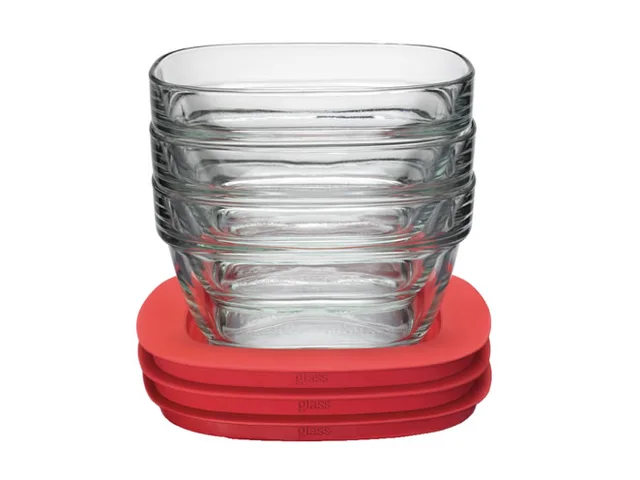

Start with the Smile glass option if reheating in its glass dish, with the plastic lid removed, fits your routine. Consider the Hot n Fresh steel family only if you can accept its microwave restriction; settle the conflicting pack description before ordering. Neither option has been tested here for leaks, drops or temperature retention.
Write down the complete routine
Start with one real use: storing a portion at home, carrying lunch to work, or packing ingredients for later preparation. Record the amount, available shelf space, whether you carry the container upright, and whether food is reheated in the same vessel.
Separate essential requirements from preferences. Seeing the contents may be convenient, while confirmed compatibility with your intended reheating method may be essential. If you are willing to transfer food to another vessel, include that vessel and its cleaning in the comparison.
Read heating permission for every component
Borosil's Smile glass-lunchbox page lists glass containers, plastic lids and a bag separately. Its care section permits microwave use for the dish but expressly excludes the plastic lid from microwave and conventional-oven use. It also gives separate gasket-cleaning directions. A broad microwave-safe headline should therefore be read with the component exclusions. Smile usage and care.
The Borosil Hot n Fresh steel-lunchbox family page expressly excludes its containers from microwave use. Its cleaning directions call for mild detergent and a brush, avoiding strong detergents, bleach and steel scrubbers. This is a restriction for that documented family, not a conclusion about every engineered steel container. Hot n Fresh usage and care.
Before reheating, require instructions for the exact container and follow the appliance manual as well. Mark lid removal, venting, temperature limits and any transfer step explicitly. Do not infer oven or microwave permission from material alone.
Check fit and carrying without guessing from capacity
Record complete external dimensions with the lid and clips closed. A volume figure does not show whether the container fits your refrigerator shelf or lunch bag. Check access around it, including room to lift it out and operate its closure.
The fridge-organiser fit worksheet explains how to record usable shelf space. Apply the measurements to the whole container rather than its bowl alone.
For handling, ask for the mass of one complete empty container, not a multi-container set or shipping package. Consider the meal and any bag you will carry. Leave comfort unverified until you can handle a comparable load.
A sealed, airtight or leak-proof description is not a transport test by this site. Read the maker's conditions and placement instructions. Confirm the lid and gasket correspond to the exact body and that the closure operates as intended.
Include cleaning and replacement parts
Ask which parts can be removed, how they should be washed, and how to reassemble them. Record dishwasher permission separately for the body, lid and seal. An accessible gasket-cleaning instruction is more useful than assuming that a material-wide easy-clean claim covers the closure.
Check whether replacement lids or seals are identified for the model. General spare-part availability does not prove that a particular part will fit. For a set, count the actual containers and lids rather than treating a bag or accessory as another storage vessel.
Compare the routine before choosing a material
| Requirement | Glass option | Steel option |
|---|---|---|
| Meal and amount | Record your usual portion | Compare the same portion |
| Storage location | Complete dimensions and access | Complete dimensions and access |
| Reheating | Exact body, lid and seal instructions | Exact body, lid and seal instructions |
| Carrying | Closure conditions and complete mass | Closure conditions and complete mass |
| Washing | Instructions for each component | Instructions for each component |
| Replacement parts | Confirm matching lid or seal | Confirm matching lid or seal |
| Unknowns | Keep missing evidence visible | Keep missing evidence visible |
Consider glass when the exact item's permissions and handling suit the routine. Consider steel on the same basis. If food must be transferred for reheating, decide whether the extra step is acceptable before buying.
For a larger storage collection, start with the kitchen inventory worksheet. Buy around actual portions and space rather than replacing every container with one material.
Evidence limits
The steel source mixes two-container packing information with four-container feature text on a personalised product page. We have excluded those numerical specifications from this comparison. Family care illustrates what to verify; the exact purchased model's instructions remain necessary.
This evidence does not establish a material-wide winner for health, shelf life, weight, leaks or durability. It also does not prescribe food-storage times or temperatures. Choose a documented container that meets your complete routine and keep untested outcomes unproven.
Product documentation rechecked on 11 October 2026.
Sources
Read how we choose or report a correction.
Disclosure
Some product links are affiliate links. As an Amazon Associate I earn from qualifying purchases. This does not change the price you pay.
We compare published product specifications and instructions. We have not hands-on tested these products. Prices, stock and delivery can change; check the selected model and current terms before buying.