Food Storage and Kitchen Organisation
How to Choose Container Sizes for Monthly Indian Grocery Shopping
Choose grocery containers from the maximum quantity you expect to store and the space you can use comfortably. Measure your shelves before buying a matching set. A container labelled in litres does not automatically hold the same numerical quantity in kilograms of every ingredient.
2 products · Compare before you buy
Product comparison at a glance
| Product | Documented capacity | Choose it for | Main limitation |
|---|---|---|---|
Tupperware Rice Keeper 5Kg, one piece | 6 L; maker describes up to 5 kg of rice; 320 × 194 × 168 mm | Comparing a bulk-rice container against your usual purchase | Rice-specific claim is not a conversion for atta or dal; dimension axes and component care unresolved |
IKEA 365+ dry-food jar, 101.340.23 | 1.3 L; 17 × 8 × 18 cm | Smaller working quantities and a partly opening pouring lid | Ingredient mass capacity and scoop clearance are not established |
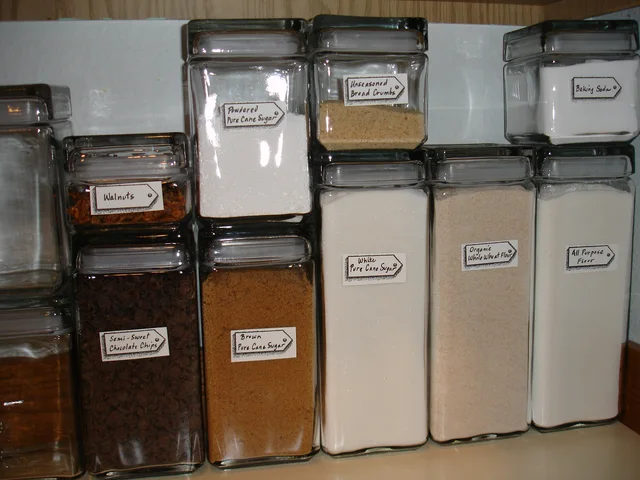

Compare the Rice Keeper for a bulk-rice purchase using its maker’s rice-specific capacity claim. Compare the narrower IKEA jar for a smaller working quantity you want to pour regularly. A reserve container plus a daily-use jar may suit you, but check the total footprint before buying both.
Make an ingredient inventory first
List rice, atta, the dals you actually use, sugar and other dry groceries separately. Record your normal purchase quantity, how often you shop and how much remains when the next packet arrives. The quantity you need to accommodate may be larger than a single packet if you replenish before the old supply is finished.
For each ingredient, ask whether one large container is practical or whether you prefer a reserve container and a smaller daily-use one. Neither arrangement is automatically better. Compare your cupboard space, access and willingness to refill.
Do not buy a container for every item in a generic pantry list. Start with the ingredients that already create clutter or do not fit the storage you use.
Separate weight from volume
Kilograms describe mass. Litres describe volume. The relationship depends on the ingredient and how it occupies the container. A rice-capacity claim should not become an equal-capacity claim for atta, poha or every dal.
Tupperware's India listing for its Rice Keeper gives a 6 litre volume and a 5 kilogram rice-capacity description. It also lists external dimensions of 320 × 194 × 168 mm. This manufacturer description applies to the named container; it is not a universal conversion rule. Tupperware Rice Keeper specifications.
Ask a manufacturer for ingredient-specific capacity information where necessary. If none is available, use a measured reference from your own existing storage and retain some practical room for the lid and access. Do not turn an approximate kitchen measurement into a claim about every grain variety.
Measure a quantity you already store
You can make a planning reference without buying a new set. Identify an existing food-storage vessel of known capacity that handles the same ingredient. Record how much of your normal purchase it holds without forcing the lid or packing unusually tightly.
If you use a marked measuring vessel, use the same filling method consistently. Treat the result as an estimate for your own ingredient and routine. Do not wash dry groceries or perform a water-displacement experiment on them. If the measuring vessel's markings are uncertain, avoid reporting a precise conversion.
The useful output is a note such as: this quantity needs more space than my current two-litre container. That may be enough to eliminate unsuitable candidates before you seek exact manufacturer information.
Measure the shelf opening and access space
Record the narrowest clear width, usable depth and height. Include obstructions such as hinges, shelf lips and door hardware. A container that fits inside the cupboard may still be awkward to remove through its opening.
Compare the complete external dimensions, including the lid and any handles. Internal capacity alone cannot establish fit. A tall narrow container may suit one shelf and fail another with the same total volume.
Check how you intend to use it: remove the whole box, lift the lid in place or pour from a spout. Each action needs different clearance. Do not use a closed-container dimension as proof that the lid opens beneath the next shelf.
Use this grocery planning sheet
| Item | Record before shopping | Check on the candidate |
|---|---|---|
| Purchase pattern | Ingredient, packet quantity and remaining stock | Ingredient-specific capacity evidence |
| Daily access | Scoop, pour or remove the whole container | Opening, lid movement and handling |
| Shelf | Clear width, depth and height | Full external dimensions |
| Arrangement | Single box or reserve plus daily-use box | Total footprint and number of lids |
| Care | How often you empty and clean it | Exact cleaning and drying instructions |
| Replacement | Which parts you may need | Documented spare-lid or seal support |
Fill this out for two or three problem ingredients first. Once their fit is settled, extend the arrangement to the rest of the pantry. That avoids committing to a large matching set with the wrong mix of sizes.
Do not let matching appearances decide capacity
A set can look orderly and still contain more small boxes than your routine needs. Count the useful sizes rather than the total pieces. Distinguish containers from spare lids or accessories in a pack description.
For stackable candidates, ask which sizes are designed to stack together. Similar-looking lids are not evidence of compatibility. Keep routinely used items accessible without dismantling the whole arrangement. Any decision about a shelf's load capacity must come from its documentation, not this fit worksheet.
Read material and seal claims carefully
The right dimensions do not establish an airtight seal, food-contact suitability or a storage-life guarantee. Check the maker's intended use and care instructions for the exact variant. Do not assume that a pantry container is suitable for heating or freezing simply because another container from the same brand is.
Avoid treating a promotional freshness claim as measured performance. This article makes no pest-proofing or food-safety guarantee. Follow applicable food-storage instructions and seek qualified advice where a food-safety question arises.
Make the final shortlist
Keep only candidates whose capacity information and external dimensions answer your recorded needs. Mark missing information as unverified and ask before purchase. You should be able to explain why each size is needed without relying on a universal family-size chart.
Will a five-litre container hold five kilograms of rice?
Do not assume that conversion. Check ingredient-specific information for the exact container or use an honest reference measurement.
Should all pantry containers have the same footprint?
Only if that footprint works for your shelves and quantities. Different ingredients can justify different sizes.
Is one large container better than two smaller ones?
Compare access, total footprint and your refill routine. There is no single best arrangement for every kitchen.
Manufacturer specifications rechecked on 11 October 2026. No hands-on ingredient-fit or loaded-stack test was performed.
Sources
Read how we choose or report a correction.
Disclosure
Some product links are affiliate links. As an Amazon Associate I earn from qualifying purchases. This does not change the price you pay.
We compare published product specifications and instructions. We have not hands-on tested these products. Prices, stock and delivery can change; check the selected model and current terms before buying.