Kitchen Tools and Food Preparation
How to Choose a Chopping Board Size for a Small Counter
Choose a chopping board by the preparation space you can use, not just the largest rectangle that fits on the counter. Leave room for ingredients, a receiving bowl and your intended cutting movement. Then check that the board can be washed, dried and stored using its instructions.
3 products · Compare before you buy
Product comparison at a glance
| Product | Listed product footprint | Care requirement | Main purchase consideration |
|---|---|---|---|
IKEA LEGITIM 302.022.66 | 34 × 24 cm; 8 mm thick | Dishwasher permission with 70°C limit; do not use heat-deformed board | Product dimensions differ from package size; usable cutting area still needs checking |
IKEA LEGITIM 505.567.04, two-board set | 17 × 12 × 0.5 cm and 24 × 17 × 0.5 cm | Dishwasher permission with 70°C limit; wash before first use; do not use heat-deformed board | Smaller options for sequential tasks; include both boards in storage planning |
IKEA FASCINERA 805.033.61 | 28 × 19 × 1.8 cm; shaped acacia board | Handwash; food-approved oil before use and regularly | Outside dimensions do not establish a full rectangular cutting area; account for drying and maintenance |
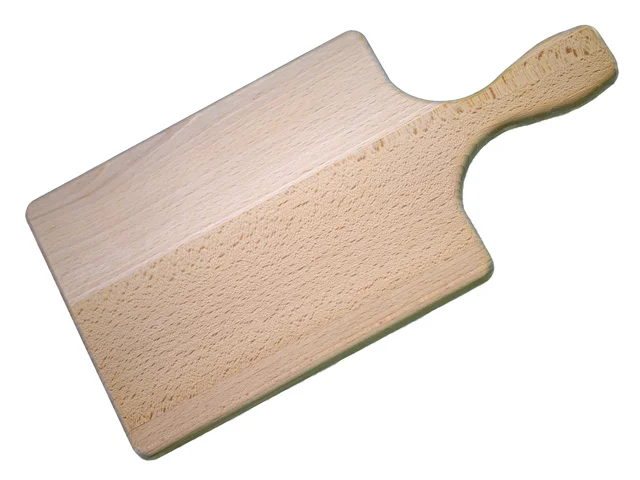

The 34 × 24 cm LEGITIM offers the largest listed footprint in this shortlist. The two-board set offers smaller sizes for separate tasks, while FASCINERA pairs a shaped wooden surface with handwashing and oil maintenance. Compare the supported working area and cleanup space before choosing.
Compare three documented footprints
The table adds the smaller LEGITIM set and shaped FASCINERA wooden board documented in our wood-versus-plastic guide. These choices illustrate how size, shape and care change together. They are not interchangeable surfaces with a tested performance ranking. Apply the same preparation, washing and storage checks to each.
Measure a clear working rectangle
Start with the counter section where you actually prepare food. Measure usable length and depth after accounting for fixtures and items that remain in place. A counter's full depth may include a raised edge, tap fitting or another obstruction; do not count that space as part of the board's support.
Record the board position you intend to use. Leave the position of any nearby heat source, socket, appliance or sink unchanged in your drawing so the arrangement reflects your kitchen. Follow the relevant equipment and board instructions rather than treating the sketch as approval for placement close to a hazard.
A board should be assessed in its intended supported arrangement. This guide does not suggest balancing an ordinary board over a sink or extending it beyond its supported area to gain space. Products designed for a particular sink need their own compatibility instructions.
Add the other items in the preparation
Draw the receiving bowl, unprepared ingredients and waste container next to the board. Use their real dimensions where available. Decide which items can move during the sequence and which must remain within reach. This is more informative than asking whether the board alone fits.
For example, a hypothetical clear rectangle is 60 cm wide and 45 cm deep. A board measuring 34 × 24 cm, placed with its longer side across the counter, leaves an arithmetic remainder of 26 cm across and 21 cm in depth. Those remainders are not guaranteed working clearance. They still have to accommodate the actual arrangement and instructions.
The calculation is simply subtraction of outside dimensions. It does not establish usable cutting area, grip, stability or a comfortable knife movement. Do not interpret it as a rule that every kitchen needs the same margin.
Keep listed dimensions separate from cutting area
IKEA's India LEGITIM 302.022.66 page identifies the white board as 34 × 24 cm and 8 mm thick. Its packaging section instead lists 35 × 24 × 1 cm. Use the product measurements for the initial footprint and thickness comparison; use the package measurements when planning parcel transport. Neither set establishes usable cutting area, and we have not tested the board on a counter.
A groove, handle opening or shaped edge may mean the outside rectangle is not all available for cutting. Obtain the actual layout for the model you are considering. If a large ingredient is the reason for replacing your board, compare it with usable cutting dimensions rather than package length.
Do not calculate a capacity in servings from board area. The size of the ingredients, preparation sequence and way you transfer them affect the space needed. A board that works for one small sequential task may not hold every prepared ingredient for a full meal at once.
Test the proposed sequence on paper
Describe one familiar preparation in stages: place the ingredient, prepare it, move it to the receiving vessel, clear the board and begin the next item. Note when the counter has the most objects on it. Choose dimensions around that stage rather than an empty-counter photograph.
Use paper outlines to compare candidate footprints on an unused, cool counter. This is a space-planning exercise only: do not cut on the paper or use it as an improvised support. The outline cannot test stability, surface quality or how the actual product behaves when wet.
Try both permitted orientations in the drawing. If rotating the board helps the layout, check that the handle, edge and intended use permit that arrangement. Do not assume a shaped or purpose-specific board functions identically in every orientation.
Check washing before buying
Measure the sink opening and the space available to move and rinse the actual board. A board can fit a counter while being awkward to wash in the available basin. Consider its full length and thickness, not just one face dimension.
If dishwasher use is important, match the exact care directions to your dishwasher's available space and programmes. For the LEGITIM example, the maker permits dishwasher cleaning, specifies a 70°C limit and says not to use the board if heat has warped, softened or deformed it. A dishwasher label should be read with those restrictions, not separated from them. The wood versus plastic comparison covers the wider care decision.
This article does not provide sanitation chemicals, soaking times or a raw-food handling procedure. Those require appropriate instructions and authoritative hygiene guidance beyond a footprint comparison.
Measure the drying and storage route
Decide where the board will dry in accordance with its instructions. Check the height and depth of that position and whether surrounding items would obstruct it. Do not count an inaccessible gap as a useful drying space.
For a drawer, measure its clear opening as well as the inside. For a cupboard, include the path past hinges and stored items. A board's nominal face dimensions do not include every constraint on getting it into and out of storage.
If you plan to keep multiple boards, record the space for the actual group. Buying an extra size is useful when it serves a distinct preparation or handling requirement. A multipack does not become convenient simply because each individual board fits.
Use the multipack checklist to assign each proposed board a task before adding the set to your list. If the difficulty is a crowded preparation sequence, the weekly meal-prep worksheet can help identify which transfers and nearby utensils to include in your layout.
A purchase worksheet
| Requirement | Record before ordering |
|---|---|
| Preparation position | Clear supported counter rectangle |
| Cutting task | Largest relevant ingredient and intended movement |
| Adjacent items | Bowl, unprepared food and waste-container footprints |
| Product geometry | Outside size, thickness and usable cutting area |
| Washing | Sink access or permitted dishwasher arrangement |
| Drying | Documented method and available space |
| Storage | Opening, internal space and retrieval route |
Choose the smallest candidate that genuinely satisfies your intended tasks and instructions, or a larger one where a real preparation need justifies it. This is a conditional purchasing approach, not a universal minimum-size rule.
Read how we choose for the research method. If a listed measurement or instruction changes, report a correction with the exact article number and source.
Sources
Read how we choose or report a correction.
Disclosure
Some product links are affiliate links. As an Amazon Associate I earn from qualifying purchases. This does not change the price you pay.
We compare published product specifications and instructions. We have not hands-on tested these products. Prices, stock and delivery can change; check the selected model and current terms before buying.