Kitchen Tools and Food Preparation
Digital vs Mechanical Kitchen Scales for Indian Homes
Choose between digital and mechanical kitchen scales by the amounts you weigh, how you read the result and how you subtract the bowl. A digital display is useful only if the particular scale covers your recipe's load range. A mechanical dial is useful only if its markings and controls let you make the decisions that recipe requires.
3 products · Compare before you buy
Product comparison at a glance
| Product | Mechanism and documented range | Bowl handling and care | Main purchase consideration |
|---|---|---|---|
HealthSense Chef-Mate KS33 | Digital; support specifies 3 g minimum and 5,000 g maximum | Tare instructions require bowl of at least 200 g; not waterproof; no hot items | Overload guidance says below 5 kg; 2 g fresh load unsupported; no measured error bound |
Salter Timeless SA00562 series | Battery-free mechanical dial; up to 5 kg in 25 g divisions | Add and Weigh listed; removable bowl dishwasher-safe | Dial divisions are not an accuracy guarantee; exact colour variant and India offer unverified |
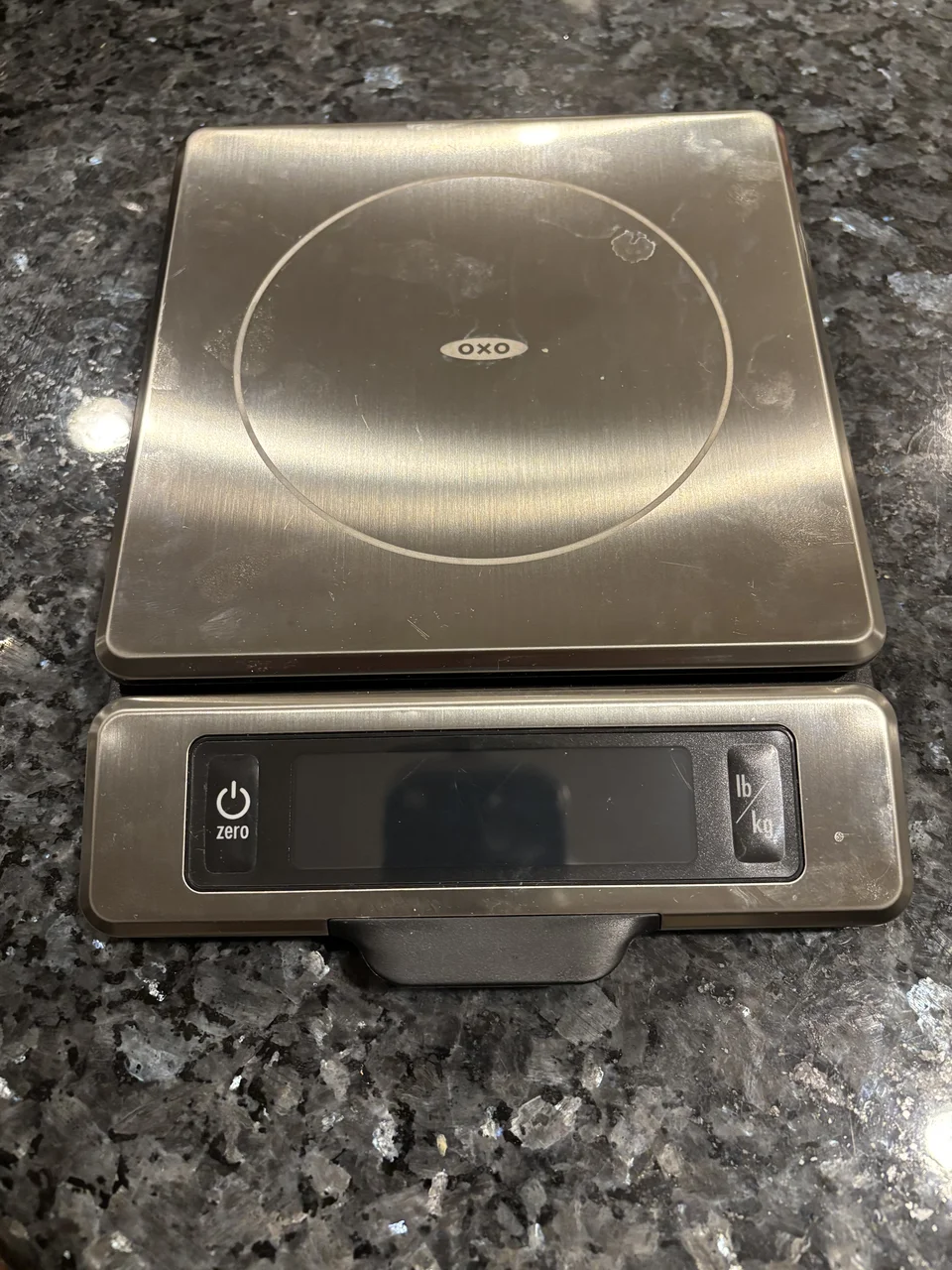
OXO 11 lb stainless-steel food scale | Digital; 1 g / 0.1 oz steps | Pull-out display; zero function | Minimum load, measured error and Indian variant unverified |
.jpg)
Compare the documented controls, load range and bowl arrangement below. No hands-on accuracy ranking is claimed.
Compare digital layouts as well as mechanisms
The OXO option introduces a second digital arrangement. A wide bowl can hide a fixed display, so assess where the reading and zero control will sit with your usual vessel in place. That layout question is separate from the choice between an electronic readout and a mechanical dial.
The documented display steps in the table are not measured error tolerances. Neither they nor the photographed OXO design establish suitability for the hypothetical 2 g task below. Keep minimum-load evidence and repeatable performance separate from appearance; the photograph does not show an exact model number.
Give both types the same three jobs
Write down one small ingredient quantity, one ordinary batch and the heaviest bowl-plus-ingredients combination you actually use. Choose these from your own recipes rather than a product advertisement. For example, a household that weighs flour for chapatis may have different requirements from one dividing a cake recipe into a small batch.
For each job, record the unit, the intended amount and whether you add several ingredients into one bowl. Then check both candidate scales against that identical list. A scale that covers the large batch but cannot resolve the smallest necessary addition does not cover the whole job. Conversely, buying a small-capacity instrument solely for a fine display may leave the mixing bowl outside its useful range.
Do not turn an example into a universal threshold. The acceptable measurement error depends on the recipe and ingredient. This guide cannot establish that an untested scale is suitable for a particular tiny quantity.
Compare these controls before choosing
| Decision | Digital candidate | Mechanical candidate |
|---|---|---|
| Reading the result | Check displayed units, increments and visibility with your bowl in place | Check dial units, divisions and pointer visibility with your bowl in place |
| Subtracting the bowl | Read the exact tare sequence and any bowl restrictions | Look for documented zero adjustment and its usable range |
| Adding ingredients | Check whether repeated tare is supported and whether the display times out | Check whether re-zeroing under load is permitted; do not assume it from an empty-pan adjustment |
| Small quantities | Confirm minimum load and accuracy information, not merely decimal places | Confirm useful graduations and accuracy information, not merely a large dial |
| Power and upkeep | Check the specified battery or charging arrangement | Confirm that the candidate is fully mechanical and review its care instructions |
| Counter and storage fit | Measure platform, controls and the complete bowl arrangement | Measure base, dial, pan and removal space |
The table is a list of checks, not a claim that every product in either column has those features. If a required field is absent, keep it unresolved rather than assigning the whole category a favourable score.
A three-job example
Suppose your recipe notes include a 2 g addition, a 300 g flour quantity and a bowl-plus-ingredients load of 2 kg. These are hypothetical requirements, not a tested recipe or recommended quantities.
| Job | What the specification must establish |
|---|---|
| 2 g addition | A supported small-load measurement, including whether this is a fresh load or an addition after zeroing |
| 300 g flour quantity | A suitable range and readable indication for that quantity |
| 2 kg combined load | Permitted total load including the bowl, plus a platform and display arrangement that fits |
The KS33's documented 3 g minimum leaves the first job unsupported. Its headline maximum does not solve that gap. The Timeless page documents a 5 kg range and 25 g dial divisions; it does not establish a supported 2 g reading or a measured error bound. Its Add and Weigh feature requires the supplied instructions for the correct sequence. Neither mechanism wins this worksheet from its name alone.
If only the small addition fails, first check whether the recipe supplies an appropriate spoon measure or another documented method. You may be able to keep a suitable scale for the larger quantities without buying a replacement that duplicates its strengths and retains the same limitation.
The mechanical model
Salter’s Timeless product page identifies the SA00562 series, a battery-free dial with a 5 kg capacity and 25 g divisions, plus a removable dishwasher-safe bowl. That care permission applies to the bowl, not immersion or dishwasher cleaning of the scale body. The page lists an Add and Weigh feature; use the supplied instructions for the actual sequence and load limits. Neither dial divisions nor this feature establish measured accuracy. Indian supply and the selected colour variant remain unverified.
Mechanical does not mean no zero adjustment
Salter's Timeless scale setup guide describes placing the supplied empty bowl on the scale and using the knob on top to bring the pointer to zero. It also directs users to place ingredients in the centre of the bowl. This is a documented example of a mechanical scale with an empty-bowl zero adjustment.
That is a documented counterexample to the claim that mechanical scales cannot account for a bowl at all. It does not establish unrestricted additive weighing, compatibility with every replacement bowl or the accuracy of a current India-market model. Ask for the manual that belongs to the actual scale you are considering.
For a household measuring one ingredient at a time, the ability to set the empty pan to zero may meet the intended workflow. For someone repeatedly adding ingredients to a mixing bowl, verify each step under load. An empty-pan instruction alone is insufficient evidence for that second use.
Digital does not mean every small amount is measurable
HealthSense's KS33 support page specifies a 3 g minimum and 5000 g maximum. Its tare instructions call for a bowl weighing at least 200 g. These are model-specific constraints, not rules for all digital scales.
If your recipe needs a quantity below a candidate's stated minimum, a digital readout does not remove that limitation. Nor does pressing tare create extra physical capacity: keep the bowl and all additions within the applicable load instructions. The KS33 support page also says to keep loads below 5 kg in its overload guidance, so do not design a batch around the exact boundary without clarification.
For the difference between displayed increments and demonstrated accuracy, use the scale specifications explainer. This comparison does not rank measurement performance from appearance.
Match the scale to your working position
Make a paper outline of the candidate's complete footprint and place your usual bowl over it without loading or testing a product you do not own. Mark where the display or dial would sit. Can you see it from your normal standing position? Is there room to reach the zero control? Does a tall vessel hide the markings?
This is a layout exercise, not a measurement test. It can rule out an awkward arrangement before you spend time comparing secondary features. Measure the storage arrangement separately; a removable bowl is useful only if you have somewhere to keep both parts.
For cleaning, follow the component-specific instructions supplied with the exact scale. The KS33 support page says that model is not waterproof and excludes hot items. Those restrictions do not describe every digital scale, and the mechanical zeroing example above does not establish a cleaning method. Check the body and bowl separately before deciding whether the care routine suits your kitchen.
Which type fits your household?
Consider a digital candidate when its documented range covers your recipes and its tare, unit controls and display suit the way you add ingredients. Accept its power requirements and check how interruptions or automatic shut-off affect a multi-step recipe.
Consider a mechanical candidate when avoiding electrical power is useful and the actual dial, load range and zeroing instructions cover your tasks. Do not infer durability, higher capacity or lower ownership cost just from the mechanism.
Choose neither candidate if the essential small quantity, loaded bowl, readable display or care requirement remains unsupported. Another model, or separate equipment for genuinely different measurement tasks, may be more suitable than forcing one tool to cover everything.
For further reading, see digital scale selection and cups versus scales. Our methodology explains the research basis; send factual corrections through corrections.
Sources
Read how we choose or report a correction.
Disclosure
Some product links are affiliate links. As an Amazon Associate I earn from qualifying purchases. This does not change the price you pay.
We compare published product specifications and instructions. We have not hands-on tested these products. Prices, stock and delivery can change; check the selected model and current terms before buying.