Kitchen Tools and Food Preparation
Measuring Cups vs Kitchen Scales for Indian Home Baking
Use the recipe's stated measurement method first. If it gives ingredient weights, use a suitable scale in the specified unit. If it gives volumes, establish the cup or spoon convention and follow its filling instructions. A scale and a measuring cup describe different quantities; changing the number's unit without an ingredient-specific basis does not reproduce the recipe.
4 products · Compare before you buy
Product comparison at a glance
| Product | What it measures | Documented arrangement | Main purchase consideration |
|---|---|---|---|
OXO Good Grips 11180500 | Volume in cup and spoon fractions | Quarter, third, half and whole cups plus four spoon measures | Match recipe's cup convention; India pack and measurement tolerance unverified |
IKEA VARDAGEN 403.247.24 | Small metric volumes and spoon measures | 1 ml, teaspoon, tablespoon, half-decilitre and decilitre measures | Does not supply a full quarter/third/half/whole-cup sequence; volume is not ingredient mass |
HealthSense Chef-Mate KS33 | Digital mass measurement; tare and unit switching | Support: 3 g minimum, 5,000 g maximum; bowl supplied | Overload guidance says below 5 kg; no measured error bound; volume modes are water-only |
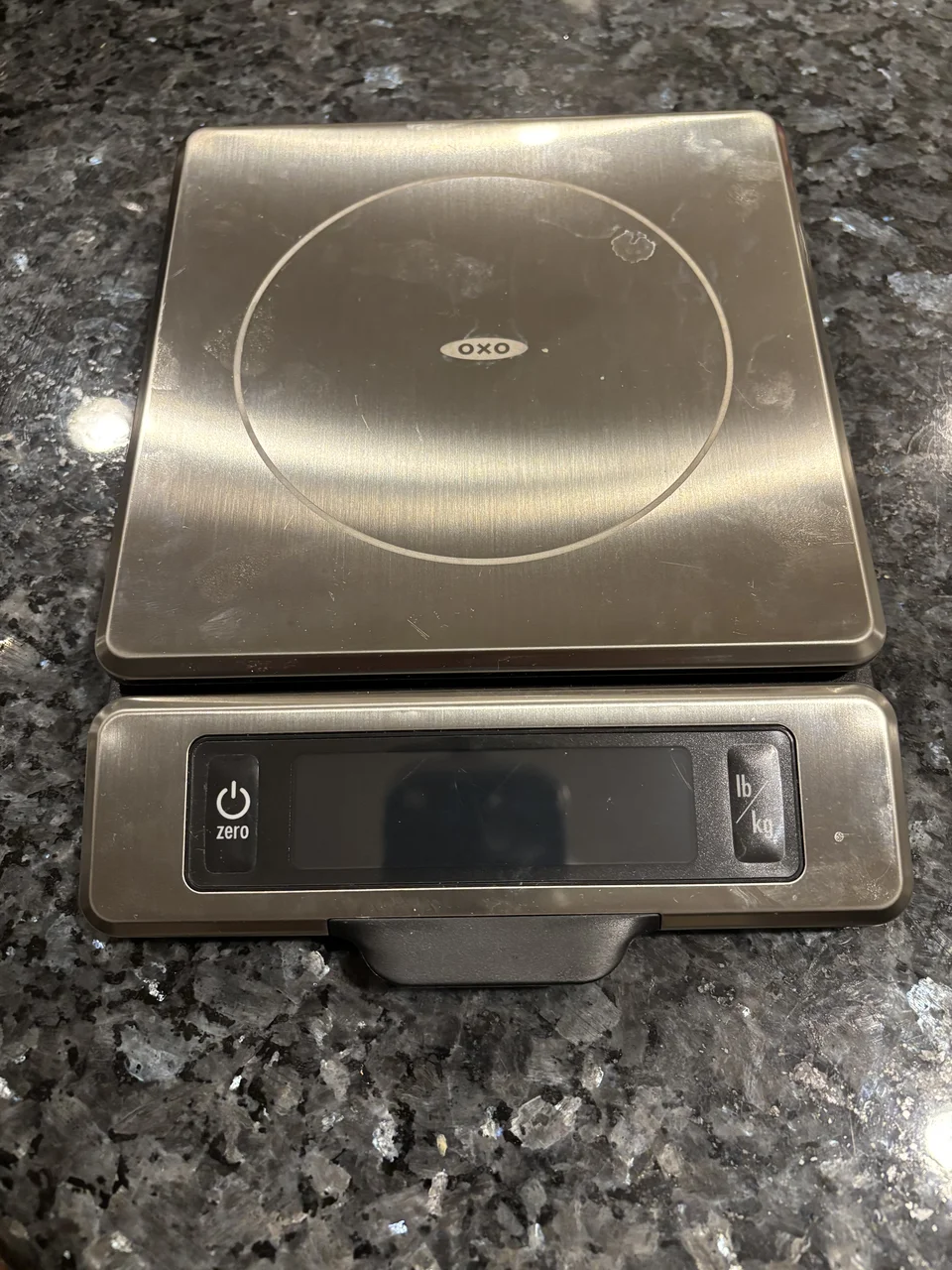
OXO 11 lb stainless-steel food scale | Digital; 1 g / 0.1 oz steps | Pull-out display; zero function | Minimum load, measured error and Indian variant unverified |
.jpg)
This is a research-based explanation, not a baking test or a scale accuracy review. It helps you decide which equipment a recipe requires and when an apparent conversion needs more information.
A second scale layout for wide bowls
The OXO scale is another mass-measuring option alongside KS33. Consider display position if you add ingredients to a broad mixing bowl: you need room to read the value and reach the controls throughout the recipe. Verify the complete installed arrangement before deciding that a particular vessel fits.
This design choice does not convert cup measures into grams or remove the need for appropriate spoon fractions. It also does not establish accuracy at your smallest ingredient quantity. The OXO photograph illustrates the brand’s food-scale design without identifying an exact current model; use the linked specifications for the option being compared.
Compare the measuring equipment
The cup and spoon sets in our measuring-cup guide cover different sequences: OXO 11180500 includes cup fractions, while VARDAGEN 403.247.24 includes decilitre and smaller measures. Choose against the actual recipe units. The KS33 scale guide records a 3 g minimum and conflicting upper-bound wording, so it does not establish measurement of every small ingredient. These are equipment examples, not measured accuracy results.
Distinguish mass from volume
Grams describe mass; millilitres describe volume. A cup occupies a volume, but the mass of its contents depends on the ingredient and its preparation. Flour, chopped ingredients and liquids should not all be assigned the same grams-per-cup value.
Even an ingredient name can be insufficient for a conversion. Record the variety or product, preparation and filling method stated by the recipe. Do not use an internet conversion for a differently prepared ingredient simply because the headline name matches.
The King Arthur Baking Recipe Success Guide recommends its stated recipe weights where available and distinguishes dry and liquid measuring methods. Its conventions belong with its recipes and ingredients; they are not a universal density table for every Indian flour or household cup.
When a scale is the direct choice
A recipe expressed in grams gives a direct weighing target. Check that the scale's documented working range and measurement capability cover the ingredients, including the smallest quantity. A high maximum capacity does not establish suitability for a very small addition.
Include the receiving bowl in your equipment planning. Verify the exact tare behaviour, platform fit and loading instructions. The display should remain readable in the arrangement you intend to use. Do not assume a bowl supplied with one scale is compatible with another.
Weighing can remove the need to convert that recipe's mass into volume, but it does not make every scale accurate. NIST's measurement discussion relates accuracy to agreement with a reference. Extra display digits or a seller's precision slogan do not establish that agreement for your device.
When cups and spoons remain useful
A volume-based recipe can be followed with measures matching its convention and method. Check whether the instruction calls for a level measure, a graduated liquid reading or another specified preparation. An ordinary drinking cup with an unknown capacity is a different tool from a defined measuring cup.
Small spoon quantities also need their own assessment. A recipe can legitimately mix larger ingredients in grams with smaller ones in spoon units. Do not force every quantity onto a scale whose suitable lower range has not been established.
The practical choice may therefore be a scale plus a small set of measures. It need not be one method for every ingredient. Buy the combination your recipes actually require instead of duplicating complete sets without a use.
Compare the methods on the same jobs
| Decision factor | Cups and spoons | Kitchen scale |
|---|---|---|
| Recipe written in grams | Needs an ingredient-specific conversion before use | Follows the stated mass directly if the quantity is within the supported range |
| Recipe written in cup fractions | Follows the recipe when cup convention and filling method match | Needs a suitable recipe-specific weight equivalent |
| Small additions | Requires the stated spoon fraction and method | Requires evidence that the small load or addition can be measured suitably |
| Several ingredients in one bowl | Each volume is measured and transferred | Tare may support successive additions, subject to total load and restart behaviour |
| Equipment upkeep | Follow each measure's care instructions | Follow surface, power, loading and cleaning instructions |
A mixed-unit recipe does not require a single tool
Imagine an ingredient list specifying 200 g of flour, 100 ml of milk and half a teaspoon of baking powder. These quantities are a hypothetical equipment exercise, not a cake formula. Weigh the flour with a suitable scale, measure the milk with the matching volume measure and use the recipe's defined half-teaspoon measure. No conversion is needed merely to make all three entries look alike.
If you want to weigh the milk or baking powder instead, obtain the recipe publisher's applicable weight equivalent and check the scale's capability at that quantity. The milk's 100 ml does not, by itself, specify a 100 g target. Likewise, a gram display does not establish that a tiny spoon quantity can be weighed reliably.
A recipe-unit audit
| What the recipe provides | What to establish | What to avoid |
|---|---|---|
| Grams | Suitable scale and supported range | Replacing grams with the same number of ml |
| Millilitres | Appropriate marked volume measure | Using a gram display without the required basis |
| Cup fractions | Recipe's cup convention and filling method | An unidentified drinking cup |
| Spoon fractions | Matching convention and marked fraction | Estimating an unmarked partial spoon |
| Both weights and volumes | Publisher's intended measurement guidance | Combining inconsistent quantities from different sources |
Use the audit before shopping. If every selected recipe already provides weights and your current equipment covers them, a larger cup set may add little. If recipes rely on specific spoon fractions, a scale purchase may leave that requirement unresolved.
Keep preparation wording attached to the quantity
Read the whole ingredient line. The publisher may expect the ingredient to be prepared before measurement or measured before preparation. That sequence can change what the quantity describes. Keep it in your notes when comparing recipes or recording a household method.
Do not turn a product's advertised bowl capacity into a recipe yield. A litre-marked vessel does not establish the mass of dough it can measure accurately, or the permitted working load of the scale underneath it. Those are separate specifications.
If you are converting a family recipe, first record its existing method precisely. Changing ingredient preparation, cup size and measuring method all at once makes the result harder to interpret. This guide does not supply a tested conversion for that recipe; a suitable recipe-specific source or properly documented development work is still needed.
Check the whole measuring routine
Consider setup, reading, transfer and cleanup. Confirm the surface and operating conditions specified for a scale. For cups and spoons, confirm their care and the intended filling method. Neither type should be chosen on an unsupported promise of zero error or effortless cleanup.
Where a recipe requires several additions to one vessel, check whether the tool supports that workflow. Do not assume that a scale's tare function increases its physical capacity. Follow its maximum loading and auto-off instructions so the process does not depend on an unverified feature.
Questions before buying
Can I use a scale's ml mode for any liquid? Only within the exact mode's documented scope. A volume display may depend on an assumed substance; it is not permission to convert every liquid or dry ingredient.
Does a measured cup of flour always have one weight? A useful value needs the ingredient, preparation and measurement convention specified. Do not promote a publisher's particular convention into a universal value.
Which method guarantees a successful bake? Neither does. Measuring is one part of following the recipe, alongside ingredients, technique and equipment. No baking outcome is guaranteed by the research here.
Continue with reading kitchen-scale specifications or the measuring-cup selection guide. Read how we choose and report a correction if a cited source changes.
Sources
Read how we choose or report a correction.
Disclosure
Some product links are affiliate links. As an Amazon Associate I earn from qualifying purchases. This does not change the price you pay.
We compare published product specifications and instructions. We have not hands-on tested these products. Prices, stock and delivery can change; check the selected model and current terms before buying.