Kitchen Tools and Food Preparation
Stainless Steel Measuring Cups for Indian Kitchens: Units and Set Contents
Choose measuring cups by the units in your recipes and the capacities supplied in the set. A pack described as five pieces may contain several small measures rather than the quarter, third, half and whole cups you expect. Stainless steel identifies a material; it does not establish a capacity convention or a measurement tolerance.
2 products · Compare before you buy
Product comparison at a glance
| Documented example | Supplied measurement sequence | Main check |
|---|---|---|
IKEA VARDAGEN 403.247.24 | 1 ml, teaspoon, tablespoon, half decilitre, decilitre | Does a small metric-volume set cover your actual recipes? |
OXO Good Grips 11180500 | Quarter, third, half and whole cup, plus four spoon measures | What cup convention and exact India pack apply? |
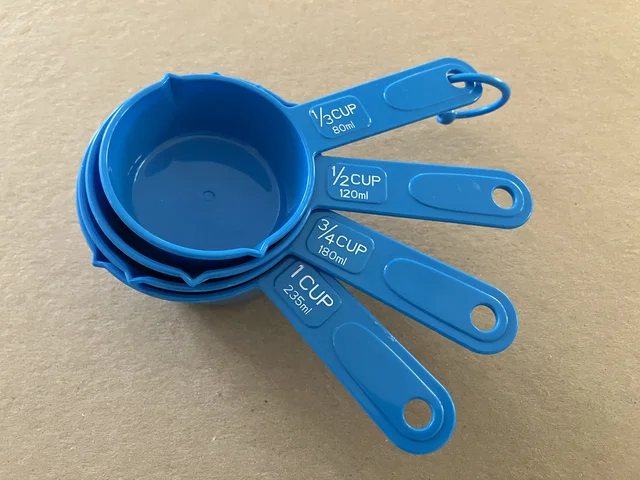

VARDAGEN suits recipes using the supplied small metric measures; the OXO set adds quarter, third, half and whole-cup measures plus spoons. Match the recipe’s cup definition before choosing. Neither set has been independently tested here for volume accuracy or durability.
Copy the recipe units before shopping
Make a short list from recipes you actually intend to repeat. Record the ingredient, quantity, unit and any filling instruction. Keep grams separate from millilitres and cup fractions. A household drinking cup does not supply an established recipe measure simply because you use it consistently.
When a recipe names cups, find its definition or measurement guidance. Do not assign a millilitre value merely from the country named in the recipe title. When it specifies grams, choose an appropriate weighing method instead of treating the same number of millilitres as equivalent.
Two different sets, not a like-for-like count
IKEA's India page describes stainless steel, nesting storage and dishwasher care. A decilitre is 100 ml, so the two decilitre measures correspond to 50 and 100 ml. This is unit conversion, not an independently measured capacity result. It is not a conventional four-cup fraction set.
OXO's US page identifies SKU 11180500, magnetic storage and etched markings. Exact Indian package correspondence and the cup's millilitre definition still need confirmation. The overseas page does not establish Indian seller support or delivery.
Consider VARDAGEN for recipes expressed in the supplied small-volume units. Consider OXO where its confirmed cup convention and fractions match your recipes. Choose neither solely because its piece count is larger.
Compare the measuring sequence
For each regular quantity, write which measure would be used and how many fills it requires. This reveals whether the set is convenient without claiming a measured accuracy advantage. If a hypothetical recipe requests 200 ml, a confirmed 100 ml measure would require two complete fills. The arithmetic does not assess filling error or whether the particular ingredient should be measured by volume.
Keep fractional requests explicit. If the recipe calls for a third of its defined cup, a set without that measure may require a different supported combination. Do not estimate an unmarked fraction inside a larger cup and describe it as an exact measurement.
Repeated fills can also complicate your own tracking. Decide whether a single measure for a frequent quantity is worth having. Do not assume that every rarely used fraction justifies another tool.
Inspect the rim and the markings
A screened Indian listing illustrates the problem. JoyGlobal's CH-2524 four-cup set lists a full cup as 250 ml, a half cup as 120 ml, a third as 80 ml and a quarter as 60 ml. Two listed halves total 240 ml, while the listed full cup is 250 ml. That is an inconsistency in the published figures, not evidence from a physical capacity test.
We have not added this set to the recommendation shortlist. Ask the supplier to confirm the markings and intended convention for the actual set before treating its fractions as interchangeable. Do not silently change 250 to 240 in a comparison table or assume that the smaller cups are the incorrect entries.
For filling technique, King Arthur's dry-versus-liquid measuring guide distinguishes levelling dry ingredients at the rim from reading liquid graduations. Match the tool to the recipe's method as well as its unit; buying steel cups does not remove that distinction.
Find out whether a capacity refers to a level fill or a graduation. Check the recipe's ingredient preparation and filling method alongside the tool instructions. A rounded heap, a packed ingredient and a level fill should not be silently treated as the same method.
Ask for readable markings for every piece. A product image of the largest cup does not establish what appears on the smaller ones. Where a listing provides both a fraction and millilitres, confirm that those marks belong to the exact supplied variant.
Etched markings may be a documented design feature, but this research has not tested their readability under flour, oil or wear. Avoid turning the feature into a lifetime guarantee.
Include access, handling and care
Measure the container opening if you plan to scoop directly from it. Compare the actual cup body and handle arrangement, not the shipping carton. If the cup cannot enter the container, decide whether a permitted transfer method fits your routine before buying a larger pack.
Check how the set separates for use, how it reconnects and what its complete nested footprint is. A storage mechanism is useful only if you can use and clean it comfortably. We have not compared grip force, handle bending or the effort of separating these examples.
Read care directions for the whole assembly. A metal cup can include other handle materials or joining parts. Follow model-specific washing and drying directions, and do not infer heating or direct-flame permission from steel construction.
A compact purchase checklist
- Recipe convention: identified units and any defined cup volume.
- Set contents: every capacity, including small fractions you actually use.
- Filling method: level, graduated or another specified method.
- Container access: cup body, handle and ingredient-storage opening.
- Care and storage: complete assembly and nested dimensions.
- Offer identity: exact product code, variant, package and current terms.
If your existing measures already cover those requirements, another set may add duplication rather than solve a problem. For small quantities, continue with the measuring-spoon guide. For recipes written in grams, read cups versus scales.
Read how we choose for the research method or report a correction with an updated manufacturer specification.
Sources
Read how we choose or report a correction.
Disclosure
Some product links are affiliate links. As an Amazon Associate I earn from qualifying purchases. This does not change the price you pay.
We compare published product specifications and instructions. We have not hands-on tested these products. Prices, stock and delivery can change; check the selected model and current terms before buying.