Kitchen Tools and Food Preparation
Measuring Spoon Sets for Indian Home Bakers: Fractions and Jar Fit
Choose a measuring-spoon set around the smallest quantities in the recipes you bake. Check the actual fractions, their marked units and the spoon shape. A large pack is not automatically more useful, and a kitchen eating spoon is not an established substitute for a marked recipe measure.
3 products · Compare before you buy
Product comparison at a glance
| Product | Documented small measures | Storage and care | Main purchase consideration |
|---|---|---|---|
OXO 11180500 combined set | Quarter, half and whole teaspoon; tablespoon, alongside measuring cups | Magnetic storage, etched markings and dishwasher suitability | No marked eighth teaspoon in stated contents; exact India pack unresolved |
IKEA VARDAGEN 403.247.24 | 1 ml, teaspoon and tablespoon, alongside two decilitre measures | Nesting stainless-steel set; dishwasher care | A 1 ml measure is not automatically a quarter teaspoon |
OXO 11132100 spoon-only set | Quarter, half and whole teaspoon; tablespoon | Magnetic stacking, etched markings and dishwasher care | Same stated spoon fractions as 11180500 without its cups; no marked eighth teaspoon |
.jpg)
This guide compares documented set contents and provides a selection worksheet. We have not calibrated spoon volumes, baked with these sets or tested access to spice jars. Compare the supplied fractions first, then choose whether you need spoons alone or a larger mixed set.
Start with the smallest repeated quantity
Read several recipes you intend to use and write down their spoon quantities. Keep teaspoon and tablespoon requests separate, including fractions. Also record whether an ingredient is levelled, heaped, packed or otherwise prepared according to the recipe. An unclear instruction needs clarification; buying more spoons does not resolve it.
Identify the recipe's measurement convention before comparing labels. A set sold internationally should not be assumed to use exactly the same convention as every recipe. Ask for the exact millilitre capacity where the convention matters and is not clear from the supplied markings or documentation.
Check the contents rather than the pack name
OXO's 11180500 combined set includes quarter, half and whole teaspoon measures plus a tablespoon. Its manufacturer describes magnetic storage, etched markings and dishwasher suitability. The reviewed page is for the US market; exact Indian pack correspondence remains unverified.
IKEA VARDAGEN 403.247.24 instead lists a 1 ml measure, teaspoon, tablespoon and two larger decilitre measures. The 1 ml piece should not be treated as a quarter teaspoon merely because it is the smallest piece in that set.
These examples show why counting pieces is inadequate. One package mixes small spoons and larger measures; another provides common spoon fractions alongside cups. Select by recipe coverage, not the number printed on the box.
OXO spoon-only set: avoid duplicating cups you already own
The 11132100 spoon set supplies the four fractions shown in the table without the cups included with 11180500. Consider this arrangement when your existing cup measures already cover your recipes. Buying the larger pack does not add a smaller spoon fraction to the documented selection.
OXO lists magnetic stacking, etched markings and dishwasher permission for this current set. The published dimensions are 1.625 × 5.25 × 2.625 inches; these do not specify each spoon bowl's width. Do not use them to promise that the tablespoon will enter a particular spice jar. Ask for the individual working dimensions if direct jar access matters.
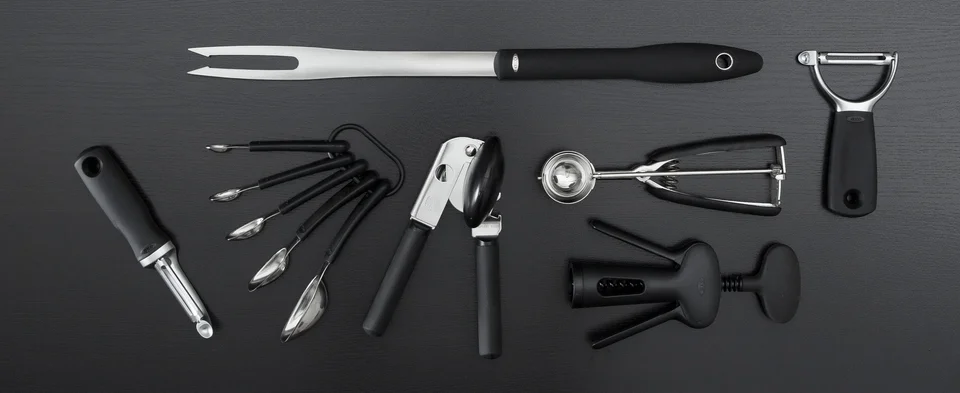
The historical photograph shows a different, ring-connected OXO arrangement. Use it only to understand that joining mechanisms vary between generations; the photo does not establish what arrives with either current magnetic set. Match the model number and listed contents when choosing an offer.
Make a fraction-coverage table
| Recipe request | Direct marked measure present? | Action if absent |
|---|---|---|
| Whole teaspoon | Check exact unit convention | Confirm an equivalent documented measure |
| Half teaspoon | Check the supplied fraction | Avoid an estimated half-fill of an unmarked spoon |
| Quarter teaspoon | Check this small fraction explicitly | Select suitable equipment or a supported recipe method |
| Eighth teaspoon | Check whether this smaller measure is supplied | Do not treat an estimated half of a quarter spoon as a marked eighth |
| Tablespoon | Keep distinct from teaspoon | Confirm the intended unit before conversion |
This table is a shopping check, not a conversion chart. Do not fill missing unit definitions with assumptions. If you regularly use a fraction that a set omits, give that gap more weight than additional pieces that none of your recipes requires.
A hypothetical request for three quarters of the same defined teaspoon could be assembled from a half and a quarter measure. That is arithmetic using matching units, not a measurement-accuracy claim for any product. Whether multiple fills are convenient is a separate consideration for your routine.
Apply the table to a hypothetical recipe list containing a quarter teaspoon, three quarters of a teaspoon and an eighth teaspoon. OXO's documented quarter and half spoons cover the first two requests directly or by addition; the stated set contents do not provide a marked eighth. IKEA's 1 ml piece does not resolve that missing fraction without the recipe's unit definition. This exercise identifies an equipment gap, without proving the accuracy of either set.
Check jar access before choosing a shape
Record the narrowest container opening you expect to use. Compare it with the bowl width and relevant depth of each spoon, particularly the tablespoon. Overall handle length cannot establish whether the bowl enters a jar.
If direct access is awkward, decide whether transferring an ingredient to another suitable vessel is an acceptable part of your preparation. Do not force a spoon into a container or infer that a long handle resolves a narrow opening. The shape and access question is distinct from nominal capacity.
Where the manufacturer provides only a set photograph, request dimensions rather than calculating them from image perspective. A picture showing one spoon beside a jar does not establish the fit of every piece in your set.
Assess reading and filling in your own routine
Check whether the markings will be readable from the angle you normally use. Look for unambiguous fractions rather than relying on size or colour alone. We have not measured readability with flour-coated hands or after repeated washing, so no design is ranked on those outcomes here.
Keep a clear route from the ingredient container to the receiving bowl. Consider whether the joining mechanism leaves unused spoons attached and whether the set can be separated as intended. A ring or magnet is a storage feature, not proof that a loaded spoon will stay level.
Follow the recipe's filling and levelling method. Different ingredient preparation can change what occupies the same volume. This guide does not supply substitute yeast, baking-powder or other ingredient weights from a guessed spoon density.
King Arthur's measuring-spoon guide discusses levelling, separating linked spoons and checking quantities against one another. Relative consistency within a set is a different question from independently verified capacity: agreement between two half measures and one whole measure does not by itself establish their absolute volumes. No calibration result is claimed for the examples here.
Include washing and storage
Read the exact care directions for all materials in the assembly. A stainless-steel description need not cover every handle component. Confirm how any removable parts should be washed and dried, and avoid borrowing care instructions from another range.
Compare the nested or joined set with the drawer space you actually have. If you keep spoons on a hook, confirm the intended hanging arrangement. A pack that stores neatly but omits your most-used fraction may still be the wrong choice.
When a new set is unnecessary
Keep an existing set if its units, condition and required fractions suit the recipes and its care instructions can be followed. Buy an additional measure to solve a specific missing quantity or access problem, rather than assuming that a matching large set is essential for baking.
Read the measuring-cup comparison for larger volumes and cups versus scales for choosing a measurement method. Our research method and corrections channel explain how source changes are handled.
Sources
Read how we choose or report a correction.
Disclosure
Some product links are affiliate links. As an Amazon Associate I earn from qualifying purchases. This does not change the price you pay.
We compare published product specifications and instructions. We have not hands-on tested these products. Prices, stock and delivery can change; check the selected model and current terms before buying.