Kitchen Tools and Food Preparation
Spatulas for Non-Stick Cookware: Function, Heat Limits and Pan Fit
Choose a spatula for non-stick cookware by checking two things separately: whether its working surface is permitted by your cookware's instructions, and whether the complete utensil is suitable for the task and temperature. A silicone head alone does not establish hot-pan suitability.
3 products · Compare before you buy
Product comparison at a glance
| Product | Intended job and construction | Published care limit | Main purchase consideration |
|---|---|---|---|
IKEA BESINNING 104.947.94 | Cooking turner; silicone-rubber head, reinforced-polyamide body | 180°C; dishwasher care; 35 cm length | Head width and load capacity not established |
OXO Silicone Flexible Turner 1071536 | Turning eggs and sautéing; silicone outer layer over steel | Dishwasher care; numeric heat limit unverified | Thin flexible edges; dimensions lack axis labels; India offer unverified |
IKEA GUBBRÖRA 205.273.55 | Bowl scraper and spreader; silicone-rubber blade, ABS handle | 70°C; dishwasher care; 25 cm length | Choose for scraping and spreading within its instructions, not as a hot-pan turner |
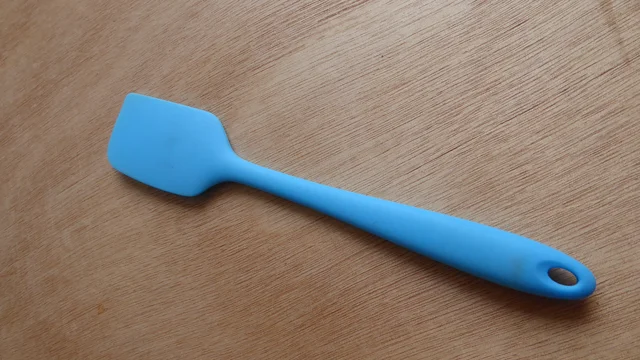

For lifting and turning food, look at turners. For scraping batter from a bowl or spreading a mixture, look at scraping spatulas. Product names overlap, so use the documented purpose rather than the word “spatula” as your guide.
Consider BESINNING for cooking tasks within its stated 180°C limit and your cookware instructions. Compare the OXO for its flexible steel-backed design, with its numerical heat limit still unresolved. Choose GUBBRÖRA for bowl scraping and spreading within its 70°C limit. These documented differences matter more than the shared silicone label; flexibility and coating wear have not been independently tested.
Begin with your cookware's instructions
Find the exact pan or tawa model and read its permitted utensil materials and care restrictions. Then check the utensil's own instructions. Both need to support your intended use; a broad seller description should not override a specific restriction from either manufacturer.
Record the cookware model beside the utensil on your shortlist. “For our coated dosa tawa” is a clearer requirement than “for non-stick.” If the original pan instructions are missing, ask its manufacturer for the relevant guidance before assuming compatibility.
Compare function before comparing material
| Task | What the tool must help you do | Details to request |
|---|---|---|
| Turn a cutlet or egg | Get underneath and support the food | Working-head shape, width and documented turning use |
| Lift food from a tawa | Reach the food within the intended cookware arrangement | Head geometry, handle arrangement and cookware permission |
| Scrape a mixing bowl | Follow the bowl's inside shape | Scraping purpose and relevant edge shape |
| Stir or fold a mixture | Work within the intended vessel | Documented task, use limits and care |
| Spread icing or filling | Distribute a mixture over a surface | Spreading purpose and suitable dimensions |
These are requirements to investigate, not guarantees that any one shape will perform perfectly. A manufacturer's description of a flexible edge does not quantify how much weight it will support or how easily it will slide under your particular food.
Three documented examples
IKEA BESINNING 104.947.94: a cooking turner
The BESINNING India page lists a reinforced-polyamide body and silicone-rubber head and ring. It gives a 35 cm product length, a care limit of 180°C and dishwasher permission, and describes the shape as suitable for non-stick cookware.
This is a documented turner example, with a stated temperature ceiling to check against your intended use. The 7 cm width in the packaging section is not a verified head-width measurement. Neither the head's load capacity nor a measured flexibility value is established. Do not interpret the heat limit as an instruction to leave it resting in a hot pan or expose it to flame.
OXO Silicone Flexible Turner 1071536: a coated steel construction
The OXO manufacturer page describes stainless steel with a silicone outer layer, thin flexible edges, non-stick suitability and dishwasher care. Its examples include turning eggs and sautéing.
The specification table gives 11.25 × 3.12 × 3.25 inches without labelling the axes. Do not convert one of those values into a confirmed head width. The reviewed official page describes heat resistance without providing a numerical limit, so that remains a question for the exact variant. The US page does not establish Indian availability or local warranty support.
IKEA GUBBRÖRA 205.273.55: a useful counterexample
The GUBBRÖRA India page lists an ABS handle and silicone-rubber blade, a 25 cm length, dishwasher care and a 70°C limit. Its documented jobs include scraping batter or dough from bowls and spreading mixtures.
That is a materially different use proposition from a hot-pan turner despite the silicone working part. Keep this example in the bowl-scraping and spreading part of your shortlist within its instructions. Do not select it for frying simply because another silicone utensil has a higher rating. This example explains a selection mistake; it is not a recommendation to use a low-temperature scraper on a hot cooking surface.
Make a cold-pan fit worksheet
With the cookware cold and empty, record the accessible inner area, the height of any rim and the space around the vessel. Note the typical size of the food you want to turn. Keep the pan's advertised diameter separate from its usable flat cooking area.
Next ask for the utensil's actual working-head dimensions and its overall dimensions. The first set helps assess food support and access; the second helps assess storage. If a seller only supplies package measurements, mark the working dimensions as unknown.
For a hypothetical 10 cm cutlet, a 10 cm head is not automatically required and a narrower head is not automatically adequate. Shape, support and how the tool is intended to be used still matter. Use the food measurement to ask a more precise question, rather than applying an invented size ratio.
If you can inspect a display item with permission, compare its head shape with your recorded needs. Avoid claiming a performance result from appearance alone. Hands-on cooking would be needed to establish outcomes such as clean release, food remaining intact or comfortable handling over repeated use.
Read the heat figure in context
Record the quoted limit exactly, including whether it applies to the head, a component or the complete utensil. Look for any duration, contact or resting restrictions alongside it. If those conditions are unclear, ask the manufacturer instead of inventing an allowable contact time.
A pan's heat setting is not a measured utensil temperature. Likewise, a high number on an accessory does not change the cookware's own operating limits. Keep the two instruction sets together when deciding whether the combination suits the intended task.
Finish with care and storage
Check how every component should be cleaned and whether the manufacturer permits removal of a head or other part. Do not assume a joint is designed to come apart. Reserve storage for the whole utensil and inspect it according to its care instructions before use.
If a bundle mixes scrapers, spoons and turners, evaluate each item individually. Use the multipack checklist to avoid buying several shapes without a job for them. The materials guide explains component-level claims, while the tongs guide covers gripping rather than supporting food from underneath.
Choose once the task, cookware permission, temperature conditions and relevant dimensions agree. Claims such as “never scratches” or “lasts for years” would need stronger evidence than the product descriptions reviewed here. Our research method and corrections policy explain how we handle evidence and errors.
Sources
Read how we choose or report a correction.
Disclosure
Some product links are affiliate links. As an Amazon Associate I earn from qualifying purchases. This does not change the price you pay.
We compare published product specifications and instructions. We have not hands-on tested these products. Prices, stock and delivery can change; check the selected model and current terms before buying.