Kitchen Tools and Food Preparation
Kitchen Tongs for Rotis, Snacks and Serving: Fit, Materials and Care
Choose kitchen tongs by the food you need to support, the cookware they will touch and the kind of heat exposure involved. Serving a finished roti, turning food on a pan and holding food over a flame are separate requirements. A general cooking-tong description does not establish permission for every one of them.
2 products · Compare before you buy
Product comparison at a glance
| Product | Contact surface and use | Care and dimensions | Main purchase consideration |
|---|---|---|---|
OXO Good Grips 1101980 | Silicone heads; manufacturer states non-stick suitability | Locking storage; dishwasher care | 12-inch name conflicts with 14-inch specification; numeric heat limit unverified |
Joseph Joseph Turner Tongs 10142 | Broad, flat silicone tips; non-stick suitability stated | 270°C tip limit; dishwasher care; locking storage | Do not leave in cookware during cooking; maker advises avoiding turmeric and other strong colourants; India offer unverified |
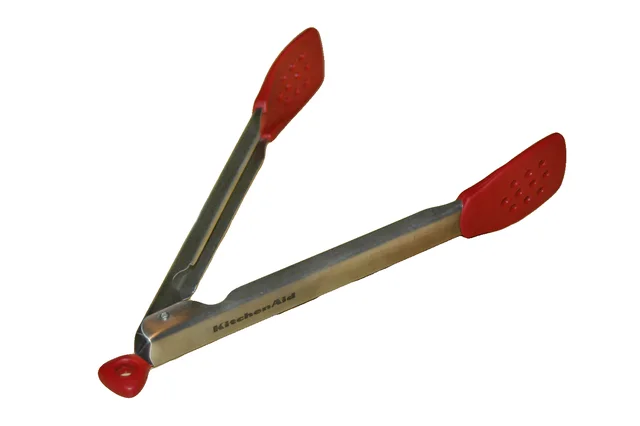

Compare OXO for its silicone heads and locking storage with Joseph Joseph for its broader, flat turning tips. Resolve the OXO length discrepancy before judging drawer fit, and consider the Joseph Joseph restriction on strong colourants such as turmeric. Grip, spring tension and food damage have not been independently tested; Indian offers remain unverified.
Start with the job you need done
Write down the main task before choosing a shape. For finished rotis, identify the serving basket or plate and the size of the food. For snacks, distinguish picking up a single firm piece from supporting a broad or delicate item. For cooking, record the pan and its permitted utensil materials.
Also separate food handling from lifting a vessel. The examples researched here do not establish a load rating or permission to lift hot pans. Do not treat a tong's ability to grip food as evidence that it can carry cookware.
| Your main task | First question to settle | Next fit check |
|---|---|---|
| Serving rotis or snacks | Is serving food a documented use? | Tips fit the food and receiving dish |
| Turning food in coated cookware | Do both cookware and tong instructions permit contact? | Head shape can reach the intended area |
| Supporting a broad piece of food | Does the working end provide the support you need? | Actual tip dimensions, not the package width |
| Cooking near a heat source | What use and restrictions does the exact model document? | Handling position under those instructions |
| Direct-flame preparation | Is that use explicitly supported? | Leave unresolved when permission is absent |
OXO versus Joseph Joseph: tip shape and care
OXO Good Grips 1101980: silicone heads and a storage lock
The OXO US page documents silicone heads, stainless steel, locking storage and dishwasher care. It describes the heads as suitable for non-stick finishes. Check your cookware's instructions alongside that statement.
There is a measurement question worth resolving: the product name says 12 inches, while its specification table gives 14 × 1 × 2 inches. The reviewed page does not explain that difference. Do not silently choose one value when checking drawer fit or reach. It also describes heat resistance without a numerical limit in the official text reviewed; this guide does not import a number from retailer listings.
Joseph Joseph Turner Tongs 10142: broad, flat working ends
The manufacturer's US page documents angled arms, broad flat silicone tips and locking storage. It states a 270°C tip heat limit, non-stick suitability and dishwasher care. Its listed dimensions are H4.7 × W30 × D6 cm; these are not a separate measurement of the tips.
The care restrictions matter for Indian cooking: the maker says not to leave the utensil in cookware during cooking and advises avoiding strong colourants such as turmeric to prevent staining. If turmeric-rich preparations are your main use, consider that instruction before selecting this design. These overseas specifications do not establish an available Indian offer or local support.
Measure against cold cookware and serving dishes
Make a simple sketch of the pan or dish you intend to use. Record its clear opening, relevant depth and any rim that restricts access. Keep those values separate from the outside diameter. The aim is to identify which measurements to request, not to devise a universal safe distance from heat.
Ask for overall utensil length, the working-end dimensions and the opening range where available. One overall length cannot answer all three questions. A long handle may still end in tips too broad for a narrow serving bowl; a compact pair may fit the drawer but not the documented cooking arrangement you need.
For a hypothetical example, suppose your drawer has 32 cm of unobstructed internal length. A nominal “12-inch” name alone is insufficient evidence of fit, especially when the same listing contains another dimension. Obtain the actual stored length, including any projecting lock, before treating the drawer as suitable. Allow retrieval space based on your layout rather than assuming an exact-length fit is practical.
Assess the mechanism without inventing a comfort score
A lock is a storage feature to inspect. Find out how it opens, how it closes and how the manufacturer expects it to be stored. Confirm whether its position changes the stored dimensions. Do not infer that a locking pair has a stronger food grip than an unlocked design.
Likewise, photographs cannot establish the squeeze force, balance or comfort you will experience. If you can handle a display sample with permission, assess its movement according to the retailer's instructions. Otherwise, treat personal grip comfort as unverified and check the actual seller's applicable return terms before purchase.
For food support, consider whether the meal calls for gripping at the edges or supporting a larger surface. That is a requirement to compare with the head geometry, not a claim that a particular tong will never tear a roti or break a snack. Those outcomes were not tested here.
Check the whole ownership routine
Read care information for the complete utensil, including joints, grips and tips. A headline material such as “steel” does not describe every component. The materials checklist helps separate those claims.
Before ordering, record the exact model, supplied quantity, documented task, cookware permission, relevant dimensions and care restrictions. Leave unanswered fields visible. If a set contains several lengths, use the multipack checklist to decide whether each pair has a distinct job.
The best fit for your kitchen is the pair whose documented use matches the task and whose unresolved details have been answered. This research does not establish a safest model, an injury-proof design or an independently tested winner. See how we choose for the evidence approach and corrections policy to report an error.
Sources
Read how we choose or report a correction.
Disclosure
Some product links are affiliate links. As an Amazon Associate I earn from qualifying purchases. This does not change the price you pay.
We compare published product specifications and instructions. We have not hands-on tested these products. Prices, stock and delivery can change; check the selected model and current terms before buying.