Kitchen Tools and Food Preparation
Stainless Steel vs Plastic Colanders: Fit and Care for Indian Kitchens
Choose between complete colanders, not between the words steel and plastic. The useful comparison is whether each exact design retains your food, fits its support, can be handled as instructed and suits your washing routine. Material alone cannot answer those questions.
3 products · Compare before you buy
Product comparison at a glance
| Product | Materials and support | Product dimensions and care | Main purchase consideration |
|---|---|---|---|
IKEA IDEALISK 901.919.34 | Stainless steel and polyethylene; adjustable handles rest on sink edge | 34 cm length × 23 cm width; dishwasher care; wash before first use | Exact supported sink span and food-retention opening size unresolved |
IKEA UPPFYLLD 205.219.47 | Polypropylene; side handles and bottom edge; designed for VISPAD bowl | 24 cm diameter, 12 cm height, 30 cm overall width; dishwasher care | Pasta-water draining and berry rinsing described, but no numeric heat/load limit; other bowl fits unverified |
IKEA IDEALISK strainer 901.659.68 | Stainless-steel mesh strainer with handle | 20 cm diameter; dishwasher care; wash before first use | A different geometry from either colander; confirm food retention and receiving-vessel fit |

This research-based comparison uses three IKEA India designs to show how to build that decision. It is not a hands-on test, a chemical-safety assessment or a claim that one material is universally better. Product buttons link to the manufacturer specifications for each design.
Separate the material from the mechanism
A colander may contain more than one material. The IDEALISK 901.919.34 page identifies stainless steel and polyethylene plastic and describes adjustable handles. Calling the whole product steel would hide part of its construction. Its dishwasher statement applies to that product; it is not evidence for every steel colander.
The UPPFYLLD 205.219.47 page instead identifies polypropylene and lists a 24 cm diameter, 12 cm height and 30 cm width. It permits dishwasher cleaning and describes compatibility with the VISPAD mixing bowl. The reviewed page does not establish a numeric heat or load limit.
The maker explicitly describes UPPFYLLD for draining water from a pasta pot as well as rinsing berries. That written use is stronger evidence than a photograph alone, but it still does not supply a temperature rating or permission for every hot-liquid task.
These are also different shapes and support arrangements. If one fits your sink and the other does not, that result concerns the complete design. It cannot be generalised into a verdict about all plastic or all steel tools.
These are the product measurements on the linked pages, not the separately listed package dimensions. IDEALISK's length entry does not establish its minimum-to-maximum handle span. UPPFYLLD's diameter does not replace its larger overall width when checking cupboard space.
Compare the mesh alternative separately
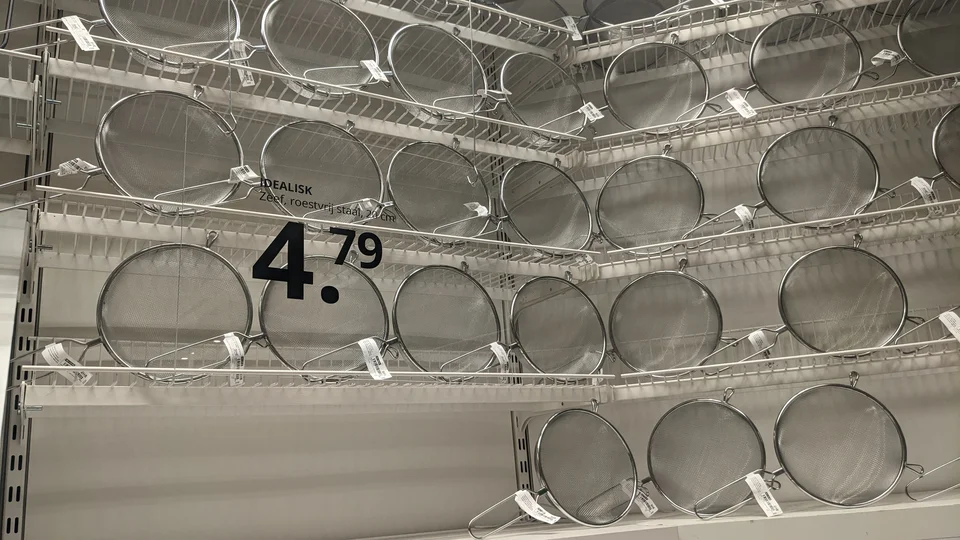
The 20 cm IDEALISK strainer, article 901.659.68, provides a third configuration: a handled mesh strainer whose material specification lists stainless steel. IKEA permits dishwasher washing and asks users to wash it before first use. The photograph shows this named 20 cm design in a historical store display, not the adjustable colander or the plastic UPPFYLLD.
Compare it when a mesh strainer matches the food and receiving vessel you use. It is not an equivalent-capacity replacement for either colander: the published diameter does not establish working volume, mesh aperture or handle-inclusive storage space. Confirm those details when they determine whether the tool will fit your routine.
For bowl-based preparation, start with UPPFYLLD and its documented VISPAD pairing. For sink-edge support, investigate the adjustable IDEALISK and its actual contact range. For a handled mesh arrangement, compare the 20 cm strainer. This is a choice between configurations, not a tested ranking of steel against plastic.
Decide what the tool must do
List your recurring preparations before comparing products. You might need to rinse whole vegetables, drain a small ingredient batch or collect rinse water in another vessel. Record whether you need the tool to hold water temporarily, let it pass continuously or nest in a separate bowl.
A colander that drains continuously does not become a soaking bowl because its advertised volume is large. If you need both functions, verify a compatible bowl arrangement or choose a product explicitly designed for the task. Keep collection, rinsing and draining requirements separate in your notes.
Record your smallest intended ingredient too. Material does not specify the size of the drainage holes. A metal colander with large openings and a plastic colander with smaller openings would present a geometry question, not a material rule. Obtain model-specific retention evidence rather than inferring rice or dal suitability from a photograph of vegetables.
Use a comparison matrix without a material winner
| Decision | Evidence to obtain for each exact product |
|---|---|
| Ingredient retention | Opening dimensions or documented suitability for the food |
| Working batch | Permitted loading and usable space for the intended operation |
| Support | Base or handle arrangement and its permitted contact conditions |
| Handling | Bare weight, complete grip geometry and loaded-use instructions |
| Hot use | Explicit permission, limits and handling directions |
| Cleaning | Whole-assembly care and any component restrictions |
| Storage | Overall dimensions in the stored configuration |
Apply the same questions to both materials. An unanswered field is not automatically an advantage for the better-described product: first decide whether that field is essential for your task. If it is essential and remains unknown, keep the candidate unresolved.
Compare your washing routine with the stated care
All three examples carry dishwasher statements, which illustrates why a material-wide cleaning assumption would be unhelpful. Check the actual product instructions, including any rack, cycle or temperature restrictions. Do not turn a brief dishwasher label into permission for every washing condition.
If you wash by hand, examine the full arrangement you will need to reach and rinse. An adjustable mechanism, a rim or a separate component can introduce a different cleaning task. We have not measured residue removal or cleaning time for these tools and cannot rank them for either outcome.
After washing, allow for the drying and storage method specified for the exact item. Check whether nesting obscures areas that need to dry, and whether the proposed storage position is supported by the instructions. Avoid inventing a routine from a general material preference.
Distinguish weight from handling
Packaging mass includes more than the bare tool, so it is not a reliable comparison of what you lift during use. Ask for net mass when this affects your choice. Add the intended contents only within the product's documented loading conditions; do not use a guessed batch weight to establish a safe carrying limit.
Grip shape and the path between the sink and receiving vessel also matter to your own selection. A lightweight label is not evidence of comfortable loaded handling. A stainless-steel label does not establish that a handle stays cool. Appropriate instructions and an actual assessment of your needs remain necessary.
Choose the arrangement that resolves your main constraint
If your main constraint is sink space, compare the complete supported footprint. If it is keeping small ingredients inside, resolve opening geometry first. If it is cleanup, compare the stated whole-product care against the method you actually use. If it is storage, measure the cupboard or drawer before comparing nominal bowl diameter.
You may find that an existing tool already satisfies the required tasks. A change of material alone is not a demonstrated upgrade. Replace or add a tool to solve a specific documented problem, not simply to complete a matching collection.
Questions buyers ask
Is steel always more durable? This comparison contains no common durability test. Construction, joints and use conditions cannot be reduced to a material name, and no service-life ranking is established here.
Is plastic automatically unsuitable for hot draining? Obtain the exact product's intended-use and handling instructions. Neither a general plastic warning nor a photograph of hot food provides a complete model-specific limit.
Can either material be called healthier? No health comparison is supported by the evidence used here. Keep material identification separate from claims that would require a different kind of evidence.
For exact steel-containing configurations, continue with the colander fit guide. Read how we choose and report a correction if the manufacturer's instructions change.
Sources
Read how we choose or report a correction.
Disclosure
Some product links are affiliate links. As an Amazon Associate I earn from qualifying purchases. This does not change the price you pay.
We compare published product specifications and instructions. We have not hands-on tested these products. Prices, stock and delivery can change; check the selected model and current terms before buying.