Kitchen Tools and Food Preparation
Stainless Steel Colanders for Indian Kitchens: Sink Fit and Draining Checks
Choose a colander by where it will be supported and the food it must retain. A round bowl, an adjustable sink-spanning basket and a mesh strainer solve different problems. The stainless-steel label alone does not tell you which arrangement suits your sink or your meal preparation.
4 products · Compare before you buy
Product comparison at a glance
| Example | Maker-listed size | Documented construction | Main question |
|---|---|---|---|
IDEALISK 601.919.35 | 25 cm diameter | Stainless steel | Does its complete footprint and food-retention geometry fit the job? |
IDEALISK 901.919.34 | 34 × 23 cm | Stainless steel and polyethylene plastic | What sink span and supported load are permitted? |
KLOCKREN 104.491.84 | 17 cm diameter, 2 L nominal volume | Stainless-steel frame and net | Does the mesh retain the intended food and fit the receiving vessel? |
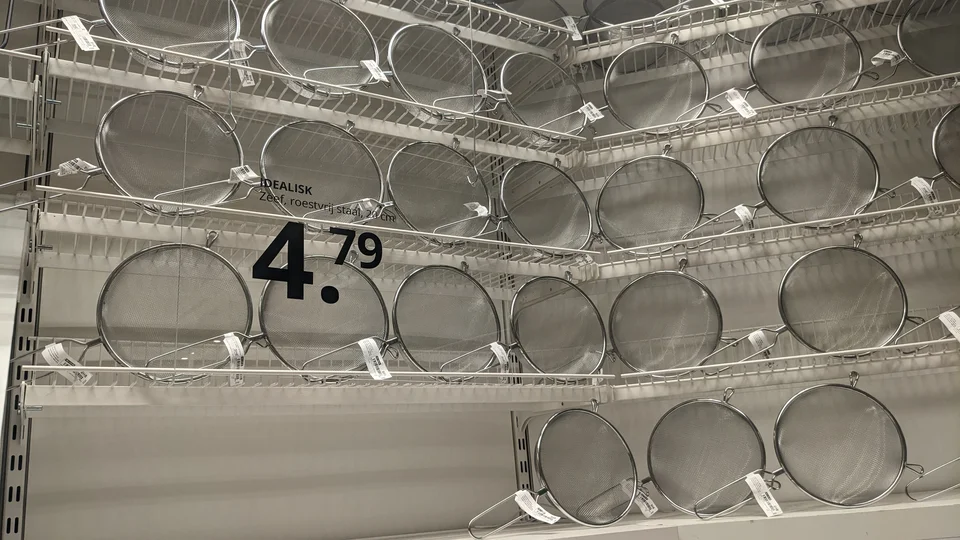
IDEALISK strainer 901.659.68 | 20 cm diameter | Stainless steel mesh design | Check receiving-vessel fit and intended food retention; no numeric aperture established |
_01.jpg)
This research guide compares four IKEA India examples to explain those decisions. We have not measured drainage speed, handle comfort, stability, grain loss or durability. The examples are a limited documentary comparison, not an overall ranking of the Indian market.
Start with the food and the draining position
Write down the preparations for which you need the tool. Whole vegetables, chopped vegetables and small grains present different retention questions. Do not assume that a product called a colander can rinse your smallest rice or dal without loss. Ask for the opening size or suitable evidence for the specific food before using that requirement to choose a model.
Next identify the intended support: held above a receiving vessel, standing in a sink, or spanning the sink opening on its handles. Keep those arrangements separate. A long handle does not by itself establish that a tool can be left resting across your particular sink. A model advertised for sink support still needs its actual adjustment range and contact requirements checked.
If the intended use involves hot food or water, obtain the exact use and handling instructions. A metal bowl is not evidence of a cool handle or a permitted lifting load. This comparison supplies no substitute procedure for draining a hot pan.
Choose the configuration for your task
These dimensions describe different shapes and cannot be ranked as though each were the same measurement. The diameter of a round bowl and the length of an adjustable basket do not reveal equal usable volumes. Nor does a nominal litre figure provide a recommended food weight.
Fixed round IDEALISK: establish the whole footprint
IKEA's 601.919.35 page lists a 25 cm diameter and dishwasher care, with washing required before first use. The product measurements do not provide a complete handle-inclusive footprint or hole size. Packaging figures should not fill those gaps.
Investigate this arrangement when you want a round colander and can confirm its support, grip and storage requirements. Prefer another configuration if those measurements fail your space or if the drainage openings cannot be shown to retain your intended food. We have no timed cleaning or drainage comparison for it.
Adjustable IDEALISK: check the sink rather than the slogan
The 901.919.34 page describes adjustable, plastic-covered handles and gives dishwasher care. Its listed length and width do not establish the maximum extension, minimum secure contact or load limit. It also contains plastic, so this is not an all-metal construction example.
Consider an adjustable design if keeping the basket above the sink is useful to your preparation. Reject it for that use when the actual support requirements cannot be matched to your sink. A general fit claim does not resolve a narrow ledge, rounded corner or obstruction from an existing accessory. These are questions to measure and document, not grounds for inventing a universal sink fit.
Mesh KLOCKREN: investigate retention and vessel fit
The 104.491.84 page identifies a steel frame and net, a 17 cm diameter and 2 L nominal volume. It permits dishwasher cleaning. Numeric mesh aperture, usable food load and an exact compatible-vessel list are not established by the reviewed specifications.
Investigate this configuration when a mesh design fits your task and you can obtain the missing retention and support information. Choose another tool if your batch cannot be accommodated within its documented limits. This guide does not establish that mesh always drains more slowly, traps more residue or retains every grain.
IDEALISK strainer: compare a 20 cm mesh design
The 901.659.68 strainer is a separate product from the two IDEALISK colanders above. IKEA lists stainless steel, a 20 cm diameter, dishwasher care and washing before first use. Its product measurements do not establish the mesh aperture or complete handle-inclusive dimensions, so neither grain retention nor fit over a particular bowl should be assumed.
Consider this design when a handled mesh strainer suits your preparation and receiving vessel. Compare the smaller 17 cm KLOCKREN separately; diameter alone does not establish equal bowl depth, supported food load or performance. The photograph illustrates the named 20 cm IDEALISK design in a historical store display, with the photo's limits explained in its caption.
Make a sink-fit worksheet
Measure the sink opening in the direction the proposed support would run. Record the usable ledges on each side separately. Note where the tap, draining rack and other fittings intrude. Do not subtract one outside sink measurement from another and treat the result as proof of usable support.
| Measurement | Your kitchen | Product evidence needed |
|---|---|---|
| Opening span | Clear distance between intended supports | Permitted extension and support arrangement |
| Contact area | Usable ledges at both ends | Required contact and surface conditions |
| Basket space | Available depth and clearance | Complete basket and handle geometry |
| Food retention | Your smallest intended ingredient | Opening size or relevant documented suitability |
| Handling | Intended filled batch and lifting route | Permitted load and handling instructions |
| Storage | Cupboard, drawer or hanging position | Overall dimensions, including handles |
Leave a field unresolved if the source provides only a photograph. Perspective and an unknown scale make a photograph unsuitable for extracting precise measurements. A product that looks close to fitting still needs an actual measurement before a tight-space purchase.
Include washing, drying and storage
Check the care instructions for the whole assembly, including handle coverings and moving parts. A dishwasher statement does not identify every cycle or rack arrangement; use the supplied directions where more specific restrictions apply. Avoid transferring care rules from another product simply because both contain steel.
Work through the space needed to rinse, dry and put away the tool. If it must nest inside a bowl, check the complete nested arrangement. If it will hang, confirm that the intended hanging point supports the product as specified. Packaging weight cannot establish bare-tool handling.
Questions to resolve before purchase
Can a vegetable colander double as a rice-washing bowl? Only if its food-retention and use evidence support that task. A bowl that holds water and a perforated draining tool have different functions; decide which step you need it to perform.
Does a larger diameter mean a larger batch? It describes one dimension. Depth, shape and permitted loading still matter. Do not calculate a food allowance from the outside diameter.
Is adjustable always better for a small kitchen? Adjustment is useful only if the allowed range matches the sink and the complete tool can be stored. A simpler arrangement may suit your preparation without occupying the sink for the whole task.
Which is the best performer? No common drainage, retention or handling test has been performed here. Use the worksheet to narrow the design, then confirm the exact article number, offer, instructions and current delivery terms. Read how we choose for the research method and report a correction if a source changes.
Sources
Read how we choose or report a correction.
Disclosure
Some product links are affiliate links. As an Amazon Associate I earn from qualifying purchases. This does not change the price you pay.
We compare published product specifications and instructions. We have not hands-on tested these products. Prices, stock and delivery can change; check the selected model and current terms before buying.