Food Storage and Kitchen Organisation
Round vs Rectangular Pantry Containers for Indian Kitchens
Choose pantry-container shapes by placing their complete footprints on a plan of your shelf, then checking how you will retrieve and open them. Straight sides can make a layout convenient, but the dimensions of actual containers and your shelf determine what fits.
2 products · Compare before you buy
Product comparison at a glance
| Product | Shape and intended comparison | Buying consideration |
|---|---|---|
IKEA 365+ round plastic, 105.079.61 | 750 ml each; 14 cm diameter × 9 cm high; three-pack | Compare the complete diameter with shelf space; empty nesting does not establish loaded stacking limits |
IKEA 365+ rectangular plastic, 505.079.64 | 1 L each; 21 × 15 × 6 cm; three-pack | Shallow rectangular layout; different capacity from the round example, so this is not an equal-volume efficiency test |
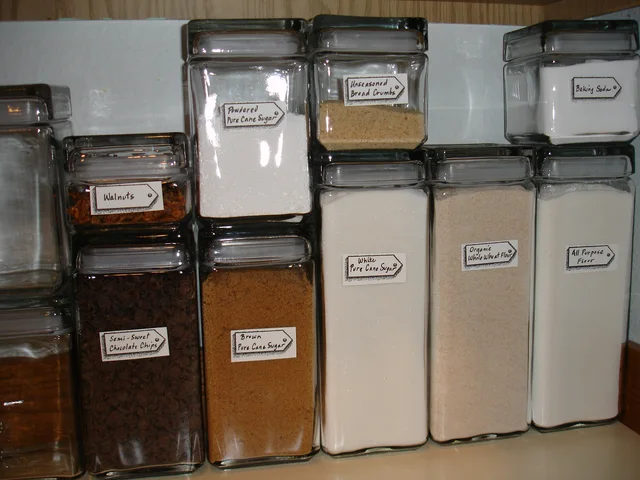

Consider the round example for a smaller 750 ml portion and a stated 14 cm diameter. Consider the rectangular example when a shallower, larger-volume container suits the shelf. Compare their actual dimensions and access, not a general claim that one shape saves more space. The later layout example illustrates fit; it does not rank equal-capacity products.
Measure the shelf before choosing the shape
Record usable width, depth and height. Account for hinges, shelf supports and the door opening. Check whether a container near the back can be removed without moving everything in front of it.
Next, list what each container should hold. A row of attractive matching boxes is not useful if the quantities you normally buy do not fit. Use the food-storage inventory worksheet to record actual ingredients and quantities before selecting a set.
Keep nominal capacity separate from external size. Containers with the same stated volume may have different heights, openings and footprints. Containers of different volumes are not an equal-capacity comparison simply because one is round and the other rectangular.
Use complete dimensions rather than package dimensions
For a round container, ask for its widest complete diameter, including any projecting closure. For a rectangular container, ask for overall length and width with the lid and clips closed. Record height separately and confirm whether it includes the lid.
IKEA India's round 365+ listing separates container measurements from packaging measurements and identifies nesting of empty containers. Its rectangular listing does the same. These are useful examples of documentation categories; the two products have different stated volumes and are not used here to rank shelf efficiency. Neither page establishes a maximum loaded-stack height or load limit. Round documentation, rectangular documentation.
Do not use a package width as the container's footprint or a package mass as its individual mass. Where a measurement does not clearly include a clip or handle, keep that clearance unresolved.
Try a layout with paper outlines
Draw your usable shelf at a convenient scale. Make outlines using each candidate's confirmed complete footprint. Include a separate allowance for gripping and retrieving it. Test a layout with your most frequently used ingredients at accessible positions.
For illustration only, imagine a shelf 40 cm wide and 20 cm deep. Three hypothetical round containers of 12 cm diameter can sit in one row across it: their combined width is 36 cm. Two hypothetical rectangular containers, each 18 cm wide and 16 cm deep, also occupy 36 cm across one row. Both arrangements fit before access allowances are added.
The round layout holds three containers and the rectangular layout two. This does not prove greater food capacity or better efficiency for round containers: their capacities and heights have not been specified. It shows why counting shapes or repeating a universal percentage cannot replace a comparison of actual products and storage needs.
Now add the space your hands and closures need. Check whether the front containers block access to anything behind them. A layout that fits tightly on paper may still be inconvenient in use.
Separate stacking from empty nesting
Nesting describes storing empty bodies inside one another. Filled containers stacked with lids are a different arrangement. Read the exact product's guidance and check which combinations are intended to stack.
Do not infer stability from a rectangular outline, a flat-looking lid or a photograph. Confirm that the proposed arrangement suits the shelf and that you can remove the required container comfortably. Leave stacking performance unverified where the instructions do not establish it.
Check ingredient access and cleanup
Consider how you use the stored ingredient: scooping flour, pouring dal or removing a snack portion. Ask for opening dimensions as well as the external footprint. Check whether your usual scoop can reach the areas you need without guessing from a product photograph.
Review cleaning instructions for the body, lid and seal. Shape alone does not establish that corners are accessible, that a gasket is removable or that a container is dishwasher-safe. Our glass-versus-steel container guide explains component-specific permission checks.
Keep a comparison note
| Check | Round option | Rectangular option |
|---|---|---|
| Quantity to store | Your actual ingredient amount | The same storage need |
| Complete footprint | Diameter and projections | Length, width and projections |
| Shelf access | Retrieval and opening space | Retrieval and opening space |
| Ingredient access | Opening and scoop clearance | Opening and scoop clearance |
| Stacking | Exact-product guidance | Exact-product guidance |
| Cleaning | Body, lid and seal instructions | Body, lid and seal instructions |
| Unknowns | Keep missing facts visible | Keep missing facts visible |
Choose round containers when their confirmed size, access and care fit your arrangement. Choose rectangular containers on the same basis. A mixed layout may also meet your needs. Neither shape establishes a universal advantage for sealing, shelf life, hygiene or stacking safety.
Manufacturer specifications rechecked on 11 October 2026. No hands-on ingredient-fit or loaded-stack test was performed.
Sources
Read how we choose or report a correction.
Disclosure
Some product links are affiliate links. As an Amazon Associate I earn from qualifying purchases. This does not change the price you pay.
We compare published product specifications and instructions. We have not hands-on tested these products. Prices, stock and delivery can change; check the selected model and current terms before buying.