Cast Iron vs Non-Stick Dosa Tawas for Indian Homes
Choose a cast-iron or nonstick dosa tawa by comparing the care you will perform, the pan you can handle and the instructions for your stove. Neither material name guarantees a crisp dosa or establishes a universal winner for Indian homes.
2 products · Compare before you buy
Product comparison at a glance
| Product example | Surface | Listed size | Main buying consideration |
|---|---|---|---|
Hawkins CIDT27 | Reinforced cast iron | 27 cm | Allow for the cast-iron care routine; confirm usable span and stove fit |
Hawkins INDT28 | Nonstick | 28 cm | Select the exact base variant and follow its coating-care instructions |
A useful first question is practical: what do you want to change about your present dosa routine? Write down whether the problem is spreading room, sticking, lifting the pan, cleaning or storage. Compare candidates against that problem rather than replacing the tawa solely because another material is promoted as an upgrade.
This research-based comparison uses manufacturer documentation. No dosa was cooked, no pan was weighed and no coating or temperature was tested for this article.
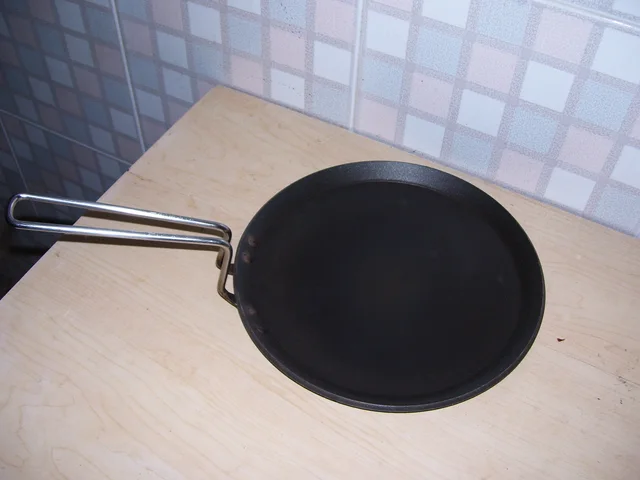

Establish the actual surface and family
For cast iron, identify the exact product family and its seasoning instructions. A pre-seasoned label does not remove the need to read first-use and ongoing care directions. Hawkins' combined manual distinguishes Heavy Gauge Cast Iron from Slim Cast Iron Ironman; the care permissions should not be transferred between them.
For a nonstick tawa, identify the body, cooking surface and exact variant. A finish name such as granite does not provide a complete coating declaration. Read the manufacturer's product and care documents together. See how to read cookware coating claims for the documentation checks.
Compare care commitments
Hawkins describes seasoning, prompt drying and storage care for its cast-iron families. Its Futura nonstick guidance instead limits heat and refers owners to the supplied manual for preheating duration. These examples show different commitments; they do not provide one interchangeable procedure for all tawas.
For the Futura Nonstick family specifically, Hawkins calls for a mild-soap or detergent wash, rinse and dry before first use, prohibits dishwasher washing and asks owners to protect the surface during storage. Routine seasoning is not required. Its limited first-use oil-wipe option is not permission to apply a cast-iron seasoning process. Check the supplied instructions for the selected model.
Decide whether you can perform the required routine after a normal breakfast. A pan needing care that is repeatedly postponed is a poor match for your household, whatever its material. Conversely, a routine you already follow may be a manageable part of using a different pan.
Do not copy a cast-iron seasoning procedure onto a nonstick coating. Do not infer that a coated tawa needs no care because it is described as convenient.
Match the tawa to the dosa and stove
Compare the intended dosa diameter with the usable cooking area, including any raised rim. Check the pan's base against the stove supports and the appliance's size requirements. The top diameter alone does not establish stable support or induction compatibility.
Make a cold layout plan for the handle, nearby vessels and counter space. A larger pan may give more spreading room but still be awkward on your burner or difficult to store. Check these issues before choosing a material.
Use the dosa-tawa diameter worksheet for fit planning. Check induction separately using the cookware compatibility guide.
Check handling with real measurements
Request the pan's mass, identifying whether it includes a detachable handle or any other part. Packed shipping weight cannot establish how the pan will feel when moved. Compare handle shape, grip instructions and where the cooled tawa will be washed and stored.
Do not assume every cast-iron tawa is harder to lift than every nonstick tawa. Size and construction matter, and the selected model needs its own measurements. When handling a candidate in person, inspect it cold on a stable surface. Do not experiment with moving a hot pan to assess a purchase.
If a pan cannot be handled comfortably according to its instructions, remove it from the shortlist. A claim about improved cooking cannot compensate for an unsuitable daily handling task.
Keep cooking expectations realistic
Read the tawa's heat and preheating directions before changing your routine. Prepare batter, utensils and the serving plate before heating. The Futura nonstick instructions specifically caution against excessive heat and delegate timing to the supplied model manual; a generic temperature or number of minutes should not replace that guidance.
If your current dosa sticks, first check whether you are following the applicable instructions. A replacement material does not by itself identify the cause. Batter preparation, the actual heat setting and the pan's condition are part of the cooking process, so this article does not award a crispiness or release-performance winner from documentation alone.
Ask for a demonstration using the model and task you are considering. Treat a brand's demonstration as evidence of that demonstration's scope, not proof that every user, batter and stove will produce identical results.
Decide whether either option solves your problem
Consider a cast-iron candidate when its documented care routine suits you and its actual handling and stove fit are acceptable. Consider a nonstick candidate when you can follow its coating-specific heat, utensil and cleaning limits and its physical layout suits your kitchen.
Choose neither when important instructions are missing, the pan does not fit your stove or the proposed change does not address your original problem. Keep a simple record: current problem, desired dosa size, exact surface/family, verified stove fit, pan mass, required care and reason to replace. Those answers support a purchase more clearly than a blanket material ranking.
Evidence and limitations
The sources describe Hawkins cookware families, not every Indian-market tawa. The exact nonstick dosa PDF was unavailable during research, so accessible family guidance supports only the limited discussion above; numerical operating instructions remain with the supplied model manual. No health benefit, expected lifespan, oil-saving percentage or hands-on cooking result is claimed.
Sources
Read how we choose or report a correction.
Disclosure
Some product links are affiliate links. As an Amazon Associate I earn from qualifying purchases. This does not change the price you pay.
We compare published product specifications and instructions. We have not hands-on tested these products. Prices, stock and delivery can change; check the selected model and current terms before buying.