How to Choose a Dosa Tawa Diameter for Your Stove
Choose a dosa tawa diameter by checking the dosa you want to spread, the cookware sizes your stove supports, and the space the whole pan occupies. Family size alone does not establish the right diameter. A larger cooking surface may suit a larger dosa, but it still needs to fit your stove, washing space and storage.
3 products · Compare before you buy
Product comparison at a glance
| Product | Listed diameter | Check before shortlisting |
|---|---|---|
Hawkins INDT28 | 28 cm | Exact model, usable span, base and appliance correspondence |
Hawkins INDT30 | 30 cm | The same checks, plus handle clearance and storage |
Hawkins NDT33 | 33 cm | Usable span, supported base and handling within your kitchen |
What to check before choosing
| Check | Information to record | Decision it supports |
|---|---|---|
| Cooking area | Usable diameter and shape | Room for your dosa and spatula |
| Contact base | Exact underside dimensions | Match to stove guidance |
| Overall footprint | Pan and handle dimensions | Adjacent pan and control access |
| Weight | Bare pan, not packed item | Handling comparison |
| Storage | Clear opening and shelf dimensions | Removal and return |
| Instructions | Stove and exact tawa model | Permitted combination and use |
This guide helps you make a shortlist. It does not recommend an exact model or claim that a particular diameter heats evenly on every burner.

Separate the measurements in a listing
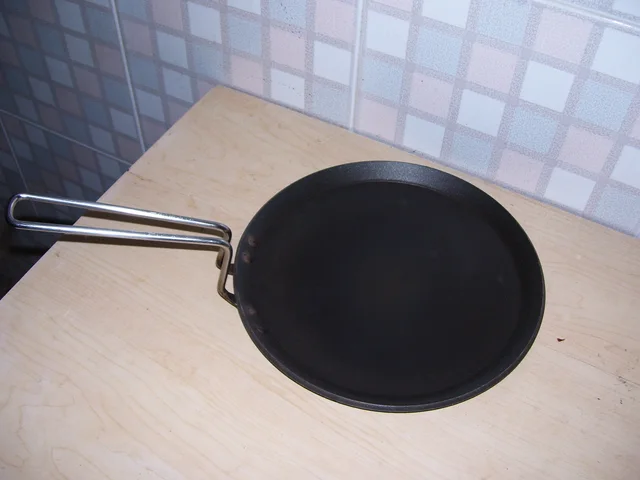
A tawa listing may give a nominal diameter, a base diameter, overall dimensions and carton dimensions. These answer different questions. Ask which measurement describes the usable surface for spreading batter and which describes the underside that contacts the stove.
Hawkins' Futura Dosa Tava page lists model diameters separately from carton dimensions and weight in the carton. The latter measurements describe the packaged item. They cannot establish the bare pan's weight or its full handle-to-edge footprint. Hawkins model specifications.
Save the exact model code alongside any measurement. If a title, specification table and drawing disagree, ask the manufacturer to clarify before choosing. Do not silently substitute a figure from another size in the same range.
Start with the dosa you actually make
Think about your usual dosa rather than the largest one shown in an advertisement. If you already cook dosas, measure the usable surface of your existing tawa when it is clean and cold. Record whether it gives you enough room to spread batter and work the spatula without reaching the edge.
If you are changing size, describe the problem first. Perhaps you want a wider dosa, more room for the spatula, or a pan that is easier to store. Each problem may lead to a different choice. A larger diameter does not automatically resolve sticking or uneven browning, and this sizing guide does not diagnose those cooking problems.
Avoid converting a desired dosa diameter directly into a purchase size without checking the pan's shape and usable area. A raised edge or handle attachment may affect where you can spread batter. Look for a manufacturer's dimension drawing or ask for a measurement of the cooking area.
Check the stove instructions
Find the cookware-size guidance for your exact stove or hob. Check the burner or zone you intend to use, not just the largest one on the appliance. Follow the stove's instructions for suitable supports, pan positioning and any minimum or maximum cookware dimensions.
For its Futura nonstick cookware, Hawkins advises using a burner suited to the pan and keeping gas flames from extending beyond it. That is useful model-family guidance, but it does not create a universal burner-to-tawa diameter formula. Hawkins use guidance.
For induction, check both the exact tawa's compatibility and the hob's cookware guidance. A cooking-surface diameter is not necessarily the magnetic base diameter. Use the induction compatibility checklist for that separate decision.
Do not compensate for an unsuitable combination by using a heat setting that the cookware instructions prohibit. If the stove and pan guidance do not establish a suitable match, ask their manufacturers before buying.
Map the whole stove footprint
With the stove off and completely cold, draw a plan of its burner positions and the surrounding space. Include the controls, nearby wall and the other pan you normally use at breakfast. On a separate sheet, draw the proposed tawa's outside footprint using confirmed dimensions, including its handle.
Move the paper shape around your drawing to compare positions. Check whether the handle would obstruct controls, interfere with another vessel or project into a route people use. This paper exercise is a space check; it does not test pan support, heat behaviour or safe clearance requirements.
Do not put paper on a warm or operating appliance. Where the manufacturer's required clearance is unclear, get that information rather than treating a drawing as permission to cook.
Check handling and storage before sizing up
Ask for the bare pan's weight when a listing gives only packaged weight. Consider how you will lift, wash and put it away. A weight figure alone does not describe how a particular handle feels in your hand.
Measure the cupboard opening and usable storage space, allowing for the handle. Check your washing area too. If a larger tawa is difficult to rinse or dry without knocking other objects, that inconvenience belongs in your comparison alongside cooking area.
An existing pan of similar dimensions can help you rehearse cold handling and storage. It cannot establish the grip, weight or balance of a product you have not used. Keep those points marked as unknown until you can assess them.
Use this diameter worksheet
When information is missing, send a specific enquiry: “For model [code], please confirm the usable cooking diameter, contact-base diameter, overall length including the handle, bare weight and compatible heat sources.” Fill in the real model code before sending it.
Choose among the sizes whose fit and instructions are established. Then compare how much cooking area you need against handling and storage convenience. Leave an unresolved measurement as a gap, rather than turning it into a confident recommendation.
Sources
Read how we choose or report a correction.
Disclosure
Some product links are affiliate links. As an Amazon Associate I earn from qualifying purchases. This does not change the price you pay.
We compare published product specifications and instructions. We have not hands-on tested these products. Prices, stock and delivery can change; check the selected model and current terms before buying.