Saucepans for Milk and Chai in Indian Homes: Capacity and Care Checks
Choose a saucepan around the batch you actually make, the space it occupies on your stove and how you pour through your strainer. A litre figure alone does not answer those questions. A compact pan that works for morning tea may be inconvenient for a larger evening batch; a larger one may be awkward at the sink or on a crowded hob.
2 products · Compare before you buy
Product comparison at a glance
| Product | What the maker page establishes | What still needs checking |
|---|---|---|
Borosil Cookfresh CFTSPWL16 | Nominal 16 cm, 1.7 L; full-body triply construction with an SS304 interior; gas and induction compatibility claimed | Working fill, actual contact-base size, lid package and conflicting warranty periods |
Vinod Platinum triply saucepan, 16 cm / 1.6 L | The size table lists this configuration; maker describes a saucepan with a steel lid and gas/induction compatibility | Exact SKU and offer mapping, working fill, base geometry and complete care conditions |
This is a research-based guide. We have not boiled milk, brewed chai, measured pouring drips or compared cleaning time in these pans. The examples below are candidates for further verification, rather than a ranked recommendation. Current offer availability and any unresolved model-specific checks should be confirmed before purchase.
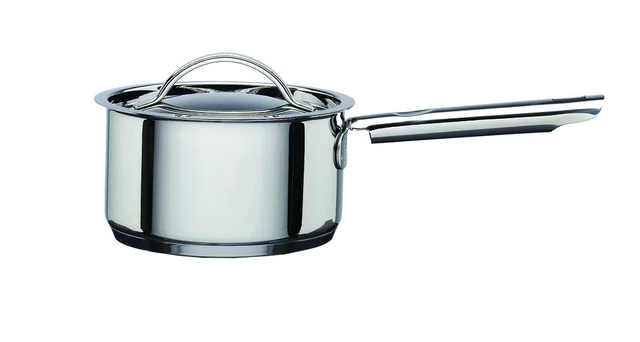

Start with your recipe, not a household-size label
Write down the water and milk you put into one batch. Count ingredients that occupy space as well, including tea leaves and spices. Then record how much prepared chai you usually serve. Input volume and finished drink volume need not be identical, so use your own recipe records rather than converting the pan's litre label directly into cups.
A pan's nominal capacity is not a verified instruction to fill it to that amount for boiling milk. Both example ranges list volumes, but neither page establishes a milk or chai working-fill limit. Leave that field unresolved until the exact instructions or manufacturer clarification provides it. There is no universal percentage adopted in this guide.
For a household with different weekday and guest batches, record both. Decide whether one suitable pan can cover them or whether retaining an existing smaller pan makes more sense. Buying the largest size in a range can create handling and storage costs even when it covers the largest recipe.
Two ranges worth checking further
These examples illustrate what to investigate. They do not establish equal usable capacities or performance. A 16 cm size label can describe a different part of the vessel from its induction contact area. Ask for the relevant measurement instead of assuming it matches your cooktop's accepted pan size.
Borosil: a useful reference for measuring your available space
The Borosil product page lists overall dimensions of 34.9 × 18.1 × 11.7 cm and a weight of 1 kg. The weight basis is not established here. Those figures help frame a space check; they are not an actual base measurement or proof that a filled pan will feel manageable.
Its title includes a lid, while the included-components field names only a saucepan. The warranty section states one year, but other sections state five. Resolve both points for the exact purchased pack. The care section prohibits oven use despite the steel handle, says to cool before washing and excludes abrasive cleaners. It also claims dishwasher compatibility. A household needing oven use should choose a model whose complete instructions explicitly support that task.
Vinod: compare sizes without turning litres into servings
The Vinod product page lists nominal capacities of 1.2, 1.6, 2.2 and 3 L. For the 16 cm / 1.6 L configuration, its table gives 33 × 17.8 × 14 cm and 0.990 kg, without establishing the weight basis. Dishwasher compatibility and a 60-month warranty are stated, but complete conditions were not retrieved.
The generic oven-safe badge does not supply a temperature limit or conditions for the handle and lid. Do not transfer that badge into an unrestricted oven instruction. This range belongs on a shortlist if its verified working capacity and handling suit your recipe. If exact instructions cannot be obtained, prefer a candidate with clearer documentation.
Check pouring as a separate task
Measure the mouth of your usual strainer and the cup or jug beneath it. Consider where the handle, rim and receiving vessel will sit together. Product photographs can suggest a shape, but they do not prove drip-free pouring or a comfortable grip under load.
Ask whether the pan has a specified pouring spout and whether any lid is intended to remain in place while pouring. Do not infer that permission from a photograph. A loose lid adds a separate handling step; it is not automatically a strainer or a secure pouring cover.
Also consider which hand you normally use and where the receiving cup sits. A pan that fits your burner can still be cumbersome when moving around an adjacent vessel. Confirm the instructions for handling hot cookware, including any required protection; a steel handle is not evidence that it remains cool.
Construction is not a no-scorch promise
Triply describes a construction approach. It does not prove that milk will never stick, that every stove will heat the pan uniformly or that the vessel can be left unattended. Neither candidate has been tested by TruePicks for those outcomes.
Use the exact model's heat and cleaning instructions. If your normal routine requires removing dried milk residue, check what cleaners and tools are permitted before choosing. Avoid assigning a cleaning-time advantage from a material name alone. A dishwasher-compatible claim also needs its model-specific conditions, including how the lid and handle should be treated.
A worksheet for the final shortlist
| Record | Your answer |
|---|---|
| Normal recipe inputs and finished servings | Measure your usual batch |
| Largest recurring batch | Record separately from occasional guests |
| Verified working fill for this recipe | Obtain exact instructions or clarification |
| Cooktop accepted base sizes | Compare with the actual contact base |
| Total space with handle | Check adjacent burners, sink and cupboard |
| Strainer and receiving-vessel fit | Measure your existing utensils |
| Lid, handle and pouring instructions | Confirm for the supplied configuration |
| Cleaning and warranty conditions | Resolve conflicting page claims |
Keep any answer marked unknown until evidence resolves it. An apparently suitable pan can remain a candidate without becoming an approved recommendation.
Common questions
Does a 1.7 L pan make 1.7 L of chai?
The nominal label does not establish that working quantity. Recipe inputs, finished yield and permitted fill are separate measurements.
Can I use a steel-handled saucepan in an oven?
Check the exact instructions. Borosil's page explicitly excludes oven use for this candidate. Vinod's badge lacks the limits needed for an actionable instruction.
Which candidate is best for daily milk?
Current evidence does not support a winner. Choose only after checking working capacity, pouring, heat-source fit and care for the exact model. See our guides on stainless steel frying-pan checks, induction compatibility and appliance warranties for related purchasing questions.
Sources
Read how we choose or report a correction.
Disclosure
Some product links are affiliate links. As an Amazon Associate I earn from qualifying purchases. This does not change the price you pay.
We compare published product specifications and instructions. We have not hands-on tested these products. Prices, stock and delivery can change; check the selected model and current terms before buying.