Kitchen Tools and Food Preparation
Kitchen Scissors for Everyday Food Prep: Tasks, Handle Fit and Cleaning
Choose kitchen scissors for the food tasks you actually need, then check handle fit, cleaning access and storage. A pair documented for herbs or vegetables is not automatically suitable for bones, hard shells or every material in a kitchen. Extra functions matter only when the manufacturer explains their use and they address a real need.
2 products · Compare before you buy
Product comparison at a glance
| Product | Documented tasks and features | Care | Main purchase consideration |
|---|---|---|---|
IKEA MÅNÖGA 805.634.30 | Packages, oregano and pickled tomatoes; intended for right- and left-handed users | Dishwasher permission; wash before first use | 14 cm overall length, not cutting length; handle-opening size and blade separation unverified |
OXO Kitchen and Herb Scissors 1072121 | Meat, vegetables and twine; micro-serrated separable blades, cushioned handles and herb stripper | Same-SKU Japanese page excludes bleach and dishwasher; local listing says handwash | Regional thickness figures differ; obtain exact separation/reassembly instructions; bone-cutting permission not established |
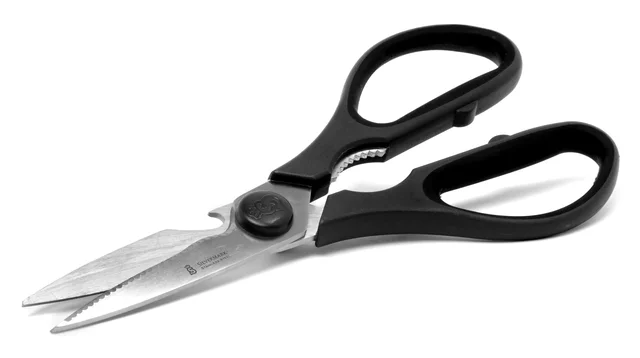

Choose MÅNÖGA for its documented small everyday tasks and dishwasher care if the handle fits you. Consider OXO when separable blades and a herb stripper matter more, with handwashing as part of ownership. Neither is established here as a bone-cutting tool. Cutting force, grip comfort and edge retention have not been independently tested.
Start with a task list
List the jobs that prompt the purchase: snipping herbs, dividing a particular soft food, cutting kitchen twine or opening a package. Keep each task specific. A description such as “heavy duty” does not tell you which foods or materials the tool is designed to cut.
For each job, find matching manufacturer guidance. Where only a broad category such as meat is named, do not extend it to bones or joints without explicit support. If that heavier task is your main purpose, investigate purpose-specific shears and their instructions before buying a general kitchen pair.
Also decide how the scissors fit into your food-preparation routine. A model may have both food and packaging uses, but that does not remove the need to follow its cleaning instructions between tasks. Choose a care routine you can actually maintain.
IKEA versus OXO: tasks, blade access and care
IKEA MÅNÖGA 805.634.30
The IKEA India product page lists a 14 cm overall length, stainless steel and polypropylene, dishwasher permission and washing before first use. Its examples include packages, oregano and pickled tomatoes. IKEA describes the design as intended for both right- and left-handed users.
That gives a documented example for smaller everyday tasks, but it does not establish personal comfort, a blade cutting length or the size of the handle openings. No separable-blade feature or bone-cutting permission was established from the reviewed page. Its package dimensions and weight should not be treated as working-blade measurements or net tool weight.
OXO Kitchen and Herb Scissors 1072121
The OXO manufacturer page names meat, vegetables and twine among its uses. It describes cushioned handle pads, a herb stripper and micro-serrated blades that separate for cleaning. The listed dimensions are 8.75 × 3.5 × 0.5 inches.
Blade separation is a specific feature worth comparing when cleaning access matters. It does not imply dishwasher permission. OXO Japan's official page for SKU 1072121 explicitly says not to use bleach or a dishwasher. The reviewed pages do not provide the complete separation and reassembly sequence, so obtain the instructions for the exact supplied version before taking it apart.
This gives a concrete care difference from the IKEA example: the cited IKEA page permits dishwasher cleaning, while the same-SKU OXO Japan page excludes it. If dishwasher care is essential in your household, do not count the OXO model as meeting that requirement. The documentation still does not establish a measured force requirement, bone-cutting suitability or current Indian availability.
An Indian AltVibes listing for item 1072121 names a one-scissor pack and specifies handwashing only. It provides a local correspondence lead, but the accessible availability field and delivery widget do not establish delivery to your PIN. Current delivery and offer correspondence remain unverified.
For tight storage, resolve the dimensions before ordering. OXO Japan lists approximately 22 × 9 × 2 cm and 115 g, while the US page's half-inch third dimension is approximately 1.27 cm. AltVibes lists 22.2 × 8.8 × 1.3 cm. These published figures do not establish why the thickness differs; do not average them or assume every regional package has an identical stored profile. The Japanese material list also includes polypropylene, ABS and thermoplastic elastomer alongside stainless steel, so the complete tool should not be described as all-metal.
Keep handle fit separate from overall length
An overall dimension helps with storage, but it cannot describe how the loops fit your fingers. Ask for handle-opening dimensions if that is important to you, and check whether the manufacturer makes a handedness statement for the model.
Treat an ambidextrous claim as a documented design intention. It does not prove that every user will find the grip comfortable or that cutting will require little effort. We have not evaluated the fit of either example in different hands.
If a retailer permits inspection of a display sample, assess the instructed hand position and control movement without treating that as a food-cutting trial. Do not infer performance under load from opening and closing an empty pair. When buying online, inspect the actual seller's applicable return conditions rather than assuming a brand's overseas policy applies.
Ask what the blade description establishes
A serrated or micro-serrated edge describes construction. It does not, on its own, provide a supported ranking for slippery foods, repeated use or hard ingredients. Similarly, a stainless-steel label does not identify every component, a specific alloy grade or a maintenance-free lifetime.
Record the cutting length only when it is explicitly supplied as such. A 14 cm overall tool is not a 14 cm blade. Do not measure an unscaled promotional image to fill a missing specification.
Use this task matrix before ordering:
| Requirement | Evidence to find | If it is missing |
|---|---|---|
| Named food or material | Manufacturer's intended-use statement | Keep the task unverified |
| Handedness | Exact-model design statement | Ask before assuming |
| Finger fit | Relevant dimensions or permitted in-person inspection | Treat personal comfort as unresolved |
| Blade separation | Written procedure for the model | Do not assume it comes apart |
| Washing | Instructions for blades, handles and joint | Obtain the care information |
| Storage | Complete closed dimensions and supplied cover, if any | Confirm the required space and contents |
Read separation and reassembly instructions together
If the blades are designed to separate, locate both the disassembly and reassembly procedure. The ability to take a joint apart does not explain the correct position for returning it to service. Follow the model's instructions rather than experimenting with a similar-looking mechanism.
For a fixed joint, read how the maker expects that area to be cleaned. A design that does not separate is not automatically unusable, but you need an adequate documented care method. Avoid assigning one construction an invented hygiene score from photographs alone.
Check sharpening and adjustment advice separately from cleaning. Do not assume cutting foil, turning a pivot screw or applying oil is approved maintenance for every pair. If the edge needs attention and the instructions do not explain what to do, ask the manufacturer about servicing or replacement.
Give every extra feature a reason to exist
A herb stripper, bottle opener or other attachment should have its own documented purpose. Count it as useful only if you expect to use it and can follow the cleaning requirements. More features do not demonstrate stronger blades or a better fit for your principal task.
The same applies to a two-pair bundle. Assign a job and storage place to each pair before treating the quantity as value. The multipack checklist provides a simple inventory method.
Finish the purchase decision with the exact model, intended jobs, unresolved questions and care routine written down. For component claims, see how to check kitchen-tool materials. Our evidence method explains the limits of documentation-based comparisons, and the corrections policy explains how to flag errors.
Sources
Read how we choose or report a correction.
Disclosure
Some product links are affiliate links. As an Amazon Associate I earn from qualifying purchases. This does not change the price you pay.
We compare published product specifications and instructions. We have not hands-on tested these products. Prices, stock and delivery can change; check the selected model and current terms before buying.