Kitchen Tools and Food Preparation
Dough Scrapers for Indian Home Bakers: Edges, Portions and Surface Fit
Choose a dough scraper for the job that currently causes difficulty: dividing dough on a board, lifting it from a work surface, or gathering it from a curved bowl. Match the working edge and permitted surface contact to that job before comparing material names or measurement markings.
3 products · Compare before you buy
Product comparison at a glance
| Product | Intended job and construction | Size and care | Main purchase consideration |
|---|---|---|---|
IKEA LÄTTBAKAD cutter 90485272 | Straight steel blade; acetal-plastic shaft | Dishwasher care; available dimensions are packaging measurements | Blade width and grip clearance unresolved; check work-surface permission for metal |
OXO Multi-Purpose Scraper & Chopper 73281 | Steel blade, soft handle and quarter-inch markings; dough portioning and scraping | 6 inches long × 1.5 inches wide × 4 inches high; dishwasher care | Imperial markings; India variant and package unverified |
IKEA LÄTTBAKAD bowl scraper 70488808 | Flexible curved silicone edge with polyamide plastic | 14 × 10 cm product dimensions; dishwasher care | Bowl fit depends on curve and reach; Swedish listing does not verify India availability |
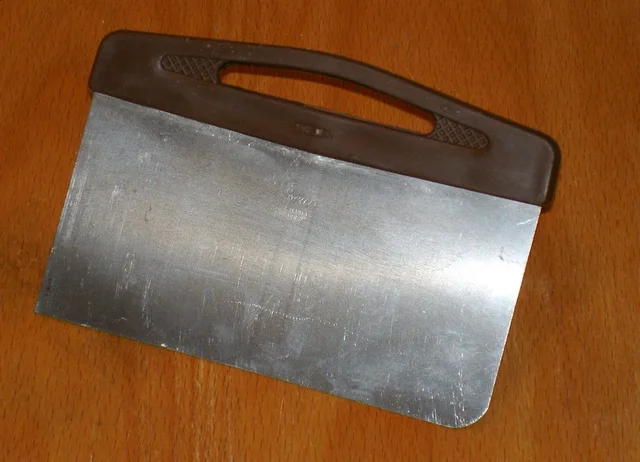

Consider either steel bench tool for dough division on a surface that permits metal contact. The OXO adds quarter-inch markings; the IKEA cutter leaves its working dimensions unresolved. Consider the separate curved IKEA bowl scraper when gathering dough from a vessel is the main task. Cutting force, grip and residue removal have not been independently compared.
Start with one preparation, not a multipack
Think through a normal batch of bread, pizza or another dough you make. Where does it stick or become awkward to move? A tool chosen for the flat work surface may not follow the inside of your mixing bowl. Conversely, a tool whose main advantage is a flexible curved edge may not be the division tool you prefer.
Write down the receiving bowl or tray as well as the starting surface. A wide blade needs enough room at both ends of a transfer. For dough prepared in a parat or another broad vessel, record its actual shape rather than assuming a scraper demonstrated in a deep round bowl will work the same way.
Use this short decision table to narrow the format. It identifies questions to investigate, not tested performance rankings.
| Main task | Feature to investigate | Detail that can rule a candidate out |
|---|---|---|
| Divide dough on a permitted board | Straight working edge and documented dough-cutting use | Unsuitable surface contact or insufficient working width |
| Gather dough from a bowl | Curved edge and documented flexibility | Curve or reach that does not suit the vessel |
| Lift and move a portion | Blade area, grip clearance and receiving opening | Transfer space too narrow for the tool |
| Clear residue from a work surface | Explicit scraping permission for tool and surface | A surface manufacturer excludes that edge or material |
| Mark a pastry length | Clearly labelled units and useful graduations | Markings in the wrong unit or no accuracy information for a critical measurement |
A steel cutter with component-specific materials
IKEA India's LÄTTBAKAD 90485272 lists an acetal-plastic shaft and stainless-steel rivet and blade. It permits dishwasher cleaning. This is a documented metal-edge dough-cutter example, not an all-steel tool.
Investigate it if a steel edge is permitted on your preparation surface and you want that cleaning method. Choose another documented design if your main need is to follow a curved bowl or your surface excludes metal scraping.
The reviewed page places its 10 × 3 × 12 cm measurements and 0.12 kg figure under packaging. They do not establish blade width, grip clearance or bare-tool handling weight. Those measurements need clarification before making a close drawer-fit or hand-fit decision.
A bench scraper with imperial markings
OXO's Multi-Purpose Scraper & Chopper page identifies SKU 73281. It describes a stainless-steel blade, a soft handle, quarter-inch markings and dishwasher permission. The stated dimensions are 6 inches long, 1.5 inches wide and 4 inches high. Dough portioning and scraping are among the named uses.
Consider it when you need a straight bench tool and can use imperial markings. They do not establish that it performs better than an unmarked cutter. Its US product page also does not prove the exact model, package or support available from an Indian seller.
The inch dimensions convert to 15.24 × 3.81 × 10.16 cm; these are mathematical conversions of the published figures, not new measurements. Avoid implying that the real tool has been checked to that precision. For a tight storage space, obtain the maker's applicable dimensions and allow for the complete handle arrangement.
A flexible edge for the bowl stage
IKEA Sweden's LÄTTBAKAD bowl scraper 70488808 provides a documented curved-edge alternative: silicone rubber and polyamide plastic, 14 cm long and 10 cm wide, with dishwasher permission and a first-use washing instruction. It is a different product from the steel LÄTTBAKAD cutter above despite sharing the range name.
Investigate this shape when gathering dough from a curved vessel is the main task. The maker describes a flexible silicone edge, but does not quantify stiffness or the edge curve. Overall dimensions let you check broad storage constraints; they cannot prove contact with your bowl's lower curve or access to its deepest point.
The packaging is 11 cm wide and weighs 0.05 kg. Neither is the working width or bare-tool weight. Keep the documented 10 cm product width separate when comparing the tool with a vessel opening.
This regional source does not establish an Indian offer or a matching supplied unit. Confirm article number 70488808 and local instructions before shortlisting it. Match any surface-use claim to your worktop's instructions; no scratch-resistance test or hot-surface permission is established here.
Equal lengths are not equal masses
Ruler markings can help you mark a dough strip or pastry sheet. They cannot weigh it. Pieces cut to the same length may still differ in thickness, width or filling, so their masses need not match.
For example, dividing a hypothetical 600 g dough batch into six equal portions gives a target of 100 g per portion. That calculation says nothing about how many centimetres each piece should measure. If equal mass matters to your recipe, use an appropriate scale within its documented range rather than treating a scraper's ruler as a weighing device.
You do not need markings merely because the tool is for baking. They are useful when your actual recipe calls for a dimension you can sensibly read on that edge. Otherwise, prioritise the working shape, grip arrangement and surface compatibility.
Check washing and storage together
Read care for the complete tool, including its handle and joins. Dishwasher permission for the three examples above is model-specific; it does not transfer to another scraper with a similar photograph. Neither a material label nor the absence of electronics establishes heat resistance or permission to leave a tool against hot cookware.
Plan where the clean, dry tool will go. Measure the whole handle and blade arrangement and check whether any supplied cover must remain attached. Keep package measurements separate from the tool dimensions. A small drawer is a good reason to verify thickness and retrieval space, not a reason to guess from a front-view photograph.
Make a task-based shortlist
Choose a documented straight-edge candidate if dough division on a compatible surface is the main problem. Choose a documented curved, flexible candidate if the bowl stage is the problem. Consider both only when the two tasks remain distinct in your kitchen; owning two tools is not a requirement for every baker.
Before buying, resolve the exact model, supplied parts, working dimensions and care. Our methodology explains the limits of comparisons based on manufacturer documentation. Use the corrections channel for updated instructions or measurements.
For weighing dough portions, see kitchen-scale specifications.
Sources
Read how we choose or report a correction.
Disclosure
Some product links are affiliate links. As an Amazon Associate I earn from qualifying purchases. This does not change the price you pay.
We compare published product specifications and instructions. We have not hands-on tested these products. Prices, stock and delivery can change; check the selected model and current terms before buying.