What Microwave-Safe Actually Means for Your Indian Kitchen
Treat “microwave-safe” as a starting point for checking a container's intended use. Match the container and each lid or accessory to the exact appliance mode, food and operating instructions. Do not assume the wording also establishes suitability for convection, grilling, freezing or dishwasher cleaning.
2 products · Compare before you buy
Product comparison at a glance
| Product | Material and form | Main purchase distinction |
|---|---|---|
Borosil IH22DH13216 | 1.6 L borosilicate-glass baking dish | Deeper dish; maker lists oven and microwave suitability, subject to exact instructions |
Meyer 47527-C | Nonstick carbon-steel pizza crisper | Shallow pizza vessel; microwave-appliance use is convection-only |
What to check before choosing
| Planned use | Information to verify |
|---|---|
| Microwave reheating | Container, lid and covering permission for the task |
| Convection cooking | Applicable heat and mode requirements |
| Grill operation | Exact cookware and accessory instructions |
| Combined programme | Instructions for that particular programme |
| Storage and later reheating | Separate storage and heating permissions |
This guide uses Samsung India general guidance and selected exact-model manual examples. It does not approve a particular container or replace your appliance's cookware chart. We have not tested containers, temperatures or cooking results.

Check both sets of instructions
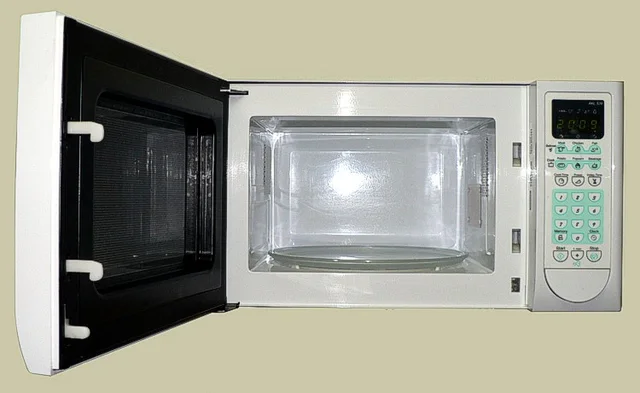
Samsung India's buying guide advises using cookware labelled microwave-safe, venting covered food and not starting an empty microwave. It directs readers to the manual for installation requirements. Samsung India buying guide.
For an actual dish, read the container manufacturer's instructions as well as the appliance manual. Record any stated food, duration, temperature or handling limits. A seller's generic description cannot resolve a missing instruction for the item you own.
If you cannot identify the container or establish its permitted use, leave it unresolved. Do not classify it by appearance, colour or a guess about its material. This article supplies a verification method, not a home test for unknown cookware.
Identify the actual cooking mode
Record the mode you intend to use, rather than writing only “microwave oven.” A multi-function appliance may offer several different operating arrangements. Obtain its exact cookware chart and instructions for the selected mode.
Do not transfer permission from microwave operation to convection, grill or a combined programme. Likewise, an oven-safe statement does not by itself establish microwave permission. The evidence must cover the actual arrangement you intend to use.
Keep unknown fields visible. A chart with an unsupported yes in every column is less useful than one showing which instructions you still need.
Samsung CE1041DSB3/TL provides a concrete example: its manual requires ovenproof cookware for convection and both microwave-safe and ovenproof cookware for microwave-plus-grill, microwave-plus-convection and Slim Fry. Slim Fry includes microwave energy alongside convection and a top heater. A plastic container approved only for microwave reheating therefore has no established permission for these other modes. Approved supplied racks have their own arrangements, separate from the microwave-plus-grill restriction on ordinary metal cookware. Samsung manual, pages 15–16, 48–51 and 61–62.
Check the lid separately
Identify the bowl, lid, seal and any removable components. Do not assume a statement for the main container covers the whole assembly. Obtain the instructions for whether a component stays in place, is removed or needs a specified venting arrangement.
Samsung's general venting advice is not an instruction to improvise a hole or modify a lid. Follow the product's applicable method. If that method is unavailable or unclear, resolve it before use.
The same principle applies to carry handles, clips and decorative elements. Record the actual supplied configuration rather than treating a similar-looking item as interchangeable.
Read material cautions in their proper scope
Samsung India's general FAQ advises avoiding metal dishes, aluminium foil, melamine plastic, freezer bags, twist ties and several paper materials in a microwave, and directs readers to the product manual for full guidance. Samsung India microwave FAQ.
That general FAQ is not a complete accessory chart for every convection or combined mode. A supplied rack or other accessory needs its own exact instructions. Do not treat an accessory's presence in the box as permission to leave it inside for every programme.
Equally, do not replace a missing model-specific instruction with an overseas manual or a discussion about another appliance. Preserve the full model code and the source of any permission you rely on.
A model-specific document can still contain a conflict
The LG-linked MS2043DB family manual, MFL72053101 Rev.05_012026, illustrates why the complete document matters. Its page 15 caution rejects stoneware, while pages 53–54 discuss stoneware as potentially suitable. That contradiction remains unresolved; this guide approves no stoneware item from those passages. The utensils section also distinguishes short plastic-container reheating from prolonged heating. Neither wording grants permission for every plastic box, lid or cooking mode. LG manufacturer-linked manual.
Keep container fit separate from material permission
Measure the intended container, including its lid and protruding parts, and check the appliance's applicable placement and clearance requirements. A microwave-safe statement does not establish that an oversized dish fits in a permitted arrangement.
A turntable diameter or cavity litre figure also does not automatically establish the maximum usable dish size. Obtain the exact model's guidance rather than choosing cookware just smaller than an advertised measurement.
If you plan to use the same container for several tasks, verify each separately. Convenience is meaningful only when those uses are documented.
Make a record for your regular meals
For a recurring reheating task, record the container identity, food, quantity, lid arrangement, appliance model and mode. Attach the applicable instructions. Repeat for a different task rather than expanding the first permission to cover every meal.
When markings or instructions are unclear, seek clarification from the appropriate manufacturer. Do not claim a food-safety guarantee from a symbol alone, and do not use this guide to diagnose a damaged container or appliance.
We have not established a universal material list, temperature threshold or safe duration for every Indian kitchen container. The useful conclusion is the verified pairing of a particular item and task with its applicable instructions.
Choose cookware with the task documented
Choose an identifiable container whose instructions cover your intended mode, food, components and fit. Keep microwave, oven, storage and cleaning permissions separate. If an essential requirement remains unknown, that container has not been verified for the task.
This article is an informational research guide without container recommendations. Current offer availability and any unresolved model-specific checks should be confirmed before purchase.
Sources
- Samsung India microwave buying guide
- Samsung India container FAQ
- LG linked manual utensil scope and internal stoneware conflict
- Samsung CE1041DSB3/TL manual: selected mode and installation instructions
- meyer mode and care evidence
- borosil mode and care evidence
- Dated Amazon offer correspondence check; unresolved permissions
- Dated Amazon offer correspondence check; unresolved permissions
Read how we choose or report a correction.
Disclosure
Some product links are affiliate links. As an Amazon Associate I earn from qualifying purchases. This does not change the price you pay.
We compare published product specifications and instructions. We have not hands-on tested these products. Prices, stock and delivery can change; check the selected model and current terms before buying.