Food Storage and Kitchen Organisation
Stackable vs Modular Storage Containers for Small Indian Kitchens
Choose storage containers around the shelf they occupy and the ingredients you reach for most often. Stackable and modular are overlapping descriptions: a coordinated container range may also stack. The useful comparison is between an arrangement that lets you reach everyday ingredients directly and one that uses spare height for less frequently opened containers.
2 products · Compare before you buy
Product comparison at a glance
| Product | Listed capacity and dimensions | Storage arrangement | Purchase consideration |
|---|---|---|---|
Sistema Ultra Square 51401ZS | 700 ml; 11.4 cm long × 10.2 cm wide × 9.6 cm high | Maker describes stackable containers and a modular family | Confirm the exact sizes that stack together; Indian offer remains unverified |
IKEA 365+ 101.340.23 | 1.3 L; 17 cm long × 8 cm wide × 18 cm high | Narrow dry-food jar with a partly opening pouring lid | Useful to compare for direct shelf access; the examined page does not establish stacking permission |
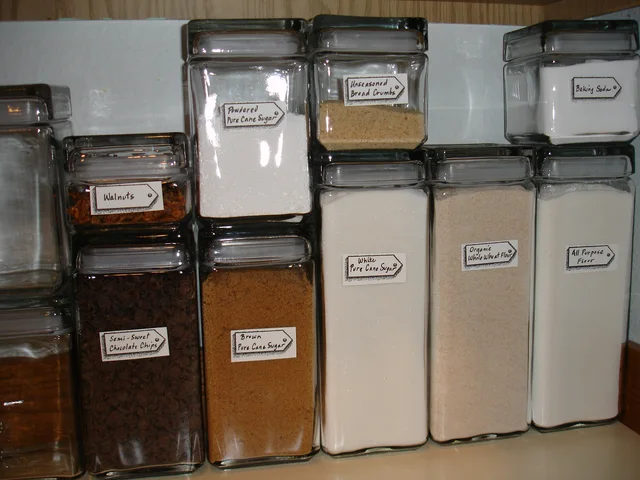

Choose by access before buying a matching set
For ingredients used at nearly every meal, start with a layout that lets you remove one container without shifting another. For occasional baking ingredients or spare portions, a documented stackable arrangement may make better use of the shelf above. These are layout choices, not claims that one container keeps food fresh longer.
List your working quantities for rice, dal, atta, sugar and snacks separately. A matching set can look tidy while including several sizes that do not suit those quantities. Capacity in litres does not establish how many kilograms of each ingredient will fit, so avoid assigning one mass conversion to the whole pantry.
Sistema Ultra: a low container within a stacking family
The official page identifies the 700 ml Square as style 51401ZS and describes locking clips, an airtight seal and stacking. The Ultra care sheet also describes the family's design as modular. This is a useful example of why the two labels should not be presented as competing technologies.
The listed height is 9.6 cm. Adding two individual heights gives a rough planning figure of 19.2 cm, but not a verified stacked height: lid engagement can change the result. Leave room to grip the top container, and obtain compatibility information before mixing sizes. Similar-looking lids from different ranges do not establish a supported stack.
Sistema's Ultra instructions require upright storage and do not recommend microwave or freezer use. They permit top-rack dishwasher washing or warm soapy water and exclude abrasive cleaning. This pantry range should not inherit the reheating permissions of Sistema's separate lunch-container ranges.
IKEA 365+: compare a pouring jar for daily ingredients
The India listing identifies 101.340.23 as a 1.3 L dry-food jar. Its lid can be removed for filling or partly opened for pouring. That makes the opening arrangement relevant when comparing ingredients you pour with those you usually scoop.
The maker lists upper-basket dishwasher cleaning and a 70°C temperature limit. Those statements do not establish microwave permission. The examined page also does not document a stacking arrangement, so treat this candidate as an individually accessed jar in your shelf plan.
Its narrow width may suit a row of containers, but check the actual grip space between them. A shelf drawing that fits every jar tightly against its neighbour can leave no convenient place for your fingers. For scooped ingredients, compare the opening with your scoop rather than relying on the pouring feature.
Measure usable shelf space
Measure between the real obstructions: hinges, shelf supports and projecting door fittings can reduce usable space. Record shelf depth with the door closed. Height needs to cover the container, its removal movement and any opening performed while it stays on the shelf.
As an arithmetic example, three 8 cm-wide jars occupy 24 cm before adding any gaps. That calculation can screen a proposed row; it does not prove that the row will be convenient to use. Similarly, dividing shelf height by container height does not establish a safe number of loaded containers to stack.
Build the set around your routine
Begin with the sizes needed for the ingredients already in your kitchen. Keep frequently used items accessible, then decide whether occasional items justify a compatible stack. Check that replacement units and lids can be identified by exact code before committing to a large coordinated set.
Choose the Sistema example when documented stacking is useful and the small portion fits the ingredient. Choose the IKEA example when a taller pouring jar better matches your daily access pattern. Neither choice establishes a general space-saving percentage or a measured seal-performance advantage. We have not tested loaded stacks, ingredient preservation or handling comfort.
Manufacturer specifications and the Sistema Ultra care sheet rechecked on 11 October 2026.
Sources
Read how we choose or report a correction.
Disclosure
Some product links are affiliate links. As an Amazon Associate I earn from qualifying purchases. This does not change the price you pay.
We compare published product specifications and instructions. We have not hands-on tested these products. Prices, stock and delivery can change; check the selected model and current terms before buying.