Food Storage and Kitchen Organisation
Open Baskets vs Closed Bins for Pantry Organisation in India
Choose an open basket for items you reach for repeatedly and a lidded bin when keeping a group of items covered matters more than immediate access. For pantry organisation, first separate outer storage from the container touching the food. The IKEA examples below are organisers, not vessels for pouring in loose rice, dal or flour: all three listings explicitly exclude food contact.
3 products · Compare before you buy
Product comparison at a glance
| Product | Listed size | Arrangement | Main purchase consideration |
|---|---|---|---|
IKEA RISATORP 604.805.44 | 25 × 26 × 18 cm | Open steel-mesh basket with a wooden handle | Direct access and carrying; not approved for food contact |
IKEA SAMLA 194.408.48 | 28 × 20 × 14 cm; 5 L | Transparent polypropylene box with matching lid | Covered grouping and documented stacking; not approved for food contact |
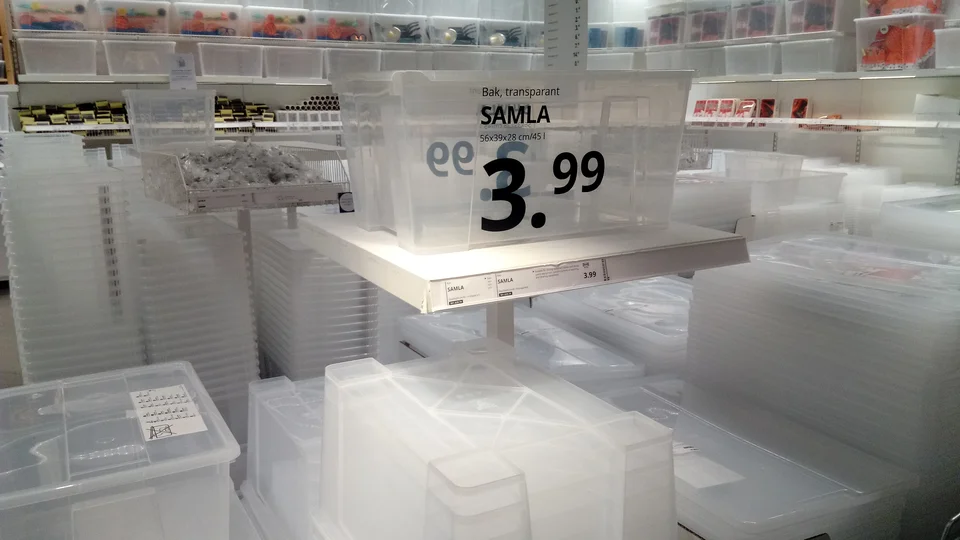
IKEA SAMLA 394.407.67 | 57 × 39 × 28 cm; 45 L with lid | Larger transparent bin for bulky groups | Much larger footprint; not approved for food contact; keep children out of the box |

Which belongs on your everyday shelf?
Consider the open basket for a group you take out regularly, such as sealed tea packets, packaged snacks or kitchen accessories. You can reach through the open top without finding somewhere to set a lid. The tradeoff is that the group remains uncovered; the basket does not provide a sealed storage environment.
Consider the lidded box for items that are less frequently accessed or need to stay together while the shelf is reorganised. Each use adds a lid-opening step. If you stack another box above it, count the extra movement required to reach the lower one. A neat-looking stack is not necessarily convenient for something used several times a day.
Keep food inside its suitable, intact primary packaging or a separate food-contact container. Neither organiser should become a substitute for that packaging. If the job is to store loose ingredients, choose a product explicitly intended for that use instead of adapting these examples.
RISATORP: open access with a carrying handle
IKEA lists a powder-coated steel basket, birch-veneer handle and aluminium rivet. The mesh lets you see the contents, and the handle can be lowered to reduce the vertical space it occupies. Confirm the handle's movement and the space needed to lift the basket from your particular shelf.
The listed dimensions identify the product's size, not a guaranteed interior rectangle. Packets have seams, folds and irregular shapes, so compare the items you want to group rather than dividing the outside footprint into exact packet counts. We have not measured the basket's internal base or tested its loaded carrying comfort.
The care directions call for wiping with a damp soft cloth and mild detergent if needed, then drying. They do not establish dishwasher or soaking permission. Its kitchen positioning also does not override the explicit food-contact restriction.
SAMLA: buy the complete box-and-lid combination
The selected combination includes box 601.808.85 and lid 604.550.83. Its overall listed depth is 20 cm, whereas the separately listed box is described as 19 cm deep. Use the complete combination dimensions when planning covered storage, rather than silently treating the bare box and lidded assembly as identical.
IKEA describes the lid's click-lock function as keeping it in place, protecting contents from dirt and dust, and making the box stackable. That does not establish an airtight food seal, pest-proof performance or a permissible loaded stacking height. This is an indoor organiser; no ingredient shelf-life claim follows from adding the lid.
Its transparent walls help identify the contents, although items can still hide behind one another. A front label can identify the group when the shelf is deep. Keep enough space to release and lift the lid, or plan to remove the box before opening it.
Larger SAMLA: choose capacity only when you need it
The 45-litre combination pairs box 701.809.41 with lid 804.550.82. Its complete listed width is 57 cm, compared with 56 cm for the bare box. Use the complete 57 × 39 × 28 cm outline when planning lidded storage. It takes substantially more shelf space than the 5-litre option; consider it for bulky accessories or a larger group of sealed packages, not merely because it holds more.
IKEA specifies polypropylene, indoor use and wiping with a soft damp cloth with mild soap if needed. It excludes food contact. The manufacturer recommends a maximum stack height of 90 cm with heavy items at the bottom and warns against young children playing inside the box because closing the lid makes it airtight. That warning does not make it an approved airtight food container.
The photograph shows the 45-litre SAMLA design in a 2020 Netherlands display. It does not show the small 5-litre option, and its old display price and lid version should not be treated as current Indian offer details.
Plan the shelf around retrieval
Measure the usable shelf width and depth between hinges or other obstructions. Then allow room for fingers, handle movement and the door closing. An organiser that fits only when pushed against every neighbouring item may be frustrating to remove.
Group by the task you perform: breakfast supplies, baking accessories or unopened snack packets, for example. Avoid a large miscellaneous bin that requires unpacking everything to locate one small item. Put the most frequently used group where it can be removed directly.
Choose the basket when immediate access and moving the group together justify an open top. Choose the lidded box when coverage and keeping a group together justify the extra opening step. Neither choice is a tested winner for preservation, dust exclusion or load capacity. The final fit depends on the actual items, shelf and access routine, rather than the basket-versus-bin label alone.
Sources
Read how we choose or report a correction.
Disclosure
Some product links are affiliate links. As an Amazon Associate I earn from qualifying purchases. This does not change the price you pay.
We compare published product specifications and instructions. We have not hands-on tested these products. Prices, stock and delivery can change; check the selected model and current terms before buying.