Non-Stick vs Stainless Steel Frying Pans for Indian Cooking
Choose a frying pan by its cooking surface, usable base, stove compatibility and care requirements. “Nonstick” describes a surface, while “stainless steel” may describe the body or an exposed cooking surface. A pan can have a steel body and a nonstick coating, so these labels are not always mutually exclusive.
2 products · Compare before you buy
Product comparison at a glance
| Product example | Surface | Listed size | Main purchase consideration |
|---|---|---|---|
Hawkins SSF22 | Stainless steel | 22 cm | Check usable base and exact care instructions; carton weight is not pan weight |
Borosil Granito NSFP24GR12 | Nonstick | 24 cm | Match its coating-care routine; empty-heating wording remains unresolved |
For Indian cooking, write down what you actually fry during a normal week: perhaps an omelette, alu tikki, paneer, fish or vegetables. Then compare exact variants against those dishes and your stove. A material label by itself cannot establish food release, a suitable batch size or cooking results.
This is a research comparison, not a hands-on test. The maker examples below have unresolved instructions and offer checks; they are not tested recommendations. Current offer availability and any unresolved model-specific checks should be confirmed before purchase.

Identify the surface and the body separately
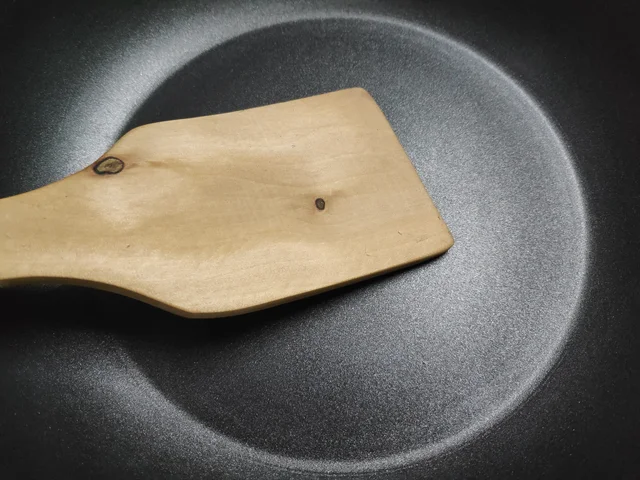
Ask two questions of each shortlisted pan. What touches the food? What is the pan constructed from beneath that surface? Record the coating declaration, if any, separately from the body construction.
The Hawkins SS Tri-ply Frying Pan page lists stainless-steel and shielded-nonstick products together. Its SSF22 row states a 22 cm diameter and 3 mm thickness. The quoted 1.13 kg is weight in the carton, not verified net pan weight. The family's handle description refers to rosewood handles on riveted steel brackets.
Those facts help identify a candidate, but they do not resolve every construction detail or establish its cooking performance. Obtain the exact variant's manual and specification before judging a steel pan against a coated one. Do not copy a nearby model's coating or lid details into the selected product record.
Match the full code rather than the family name
The same Hawkins page lists PSF18 as a stainless-steel PRO frying pan, PSF18S with a stainless-steel lid, and PSNF18G as shielded nonstick with a glass lid. Those are separate configurations, even though their names share several words. A care document, photograph or offer needs to match the complete code and supplied components.
PSNF18G is named as an 18 cm pan, while its table gives diameter 18.7 cm. The measurement boundary is not explained. Keep that discrepancy visible rather than rounding it away or treating it as a verified flat cooking diameter. Neither the shared family page nor a similar model number supplies the exact usable base or current operating instructions.
Record the complete code beside every source you use. If the body code matches but the lid differs, check the pack and lid permissions separately. Do not transfer the older Futura manual below to these newer tri-ply variants.
Make the care routine part of the choice
The Futura Nonstick Frying Pan manual states its scope as the 22 cm, 26 cm, rounded-side 26 cm and 30 cm pans. It directs low to medium heat except for boiling liquids, prohibits boiling dry, and excludes cutting or scraping with metal or sharp objects. It specifies mild soap and a cloth or sponge, with no abrasive cleaning, dishwasher, oven or broiler use. Storage should protect the coating.
These are directions for the manual's stated family, not universal nonstick rules or permission for a different pan. The older document does not establish correspondence with NF24, INF24 or newer PRO variants. Its preheating limits also must not be borrowed for those models.
Before buying, compare the applicable instructions with how your household cooks and cleans. If several people use the kitchen, everyone needs to follow the same product-specific routine. An item whose required care will regularly be missed is a poor practical match, even when its size looks suitable.
Obtain the corresponding stainless-steel manual too. Absence of a coating is not evidence that any utensil, scrubber, heat setting or appliance mode is permitted.
Use your weekly dishes to define the requirements
For an omelette or pancake recipe, record the recipe's pan size and preparation directions. Ask whether the shortlisted pan's instructions support that method. This guide does not promise effortless release on either surface.
For alu tikki or fish pieces, sketch the space needed for one intended batch. Compare it with the confirmed flat cooking area rather than the top diameter. Sloped or rounded sides can make a headline diameter an incomplete description of the space available.
For vegetables or paneer, check the depth and room needed for the recipe's intended stirring method. A shallow frying pan is not automatically a substitute for a deeper vessel. Resolve recipe and product correspondence before making the substitution.
If you use a particular recipe successfully in an existing pan, write down what the new purchase needs to improve. A different size, clearer care directions or a better fit on the stove is an assessable requirement. A broad claim that one material is “best for Indian cooking” is not.
Compare like sizes and complete arrangements
Confirm whether each quoted diameter is measured at the rim, inside opening or flat base. Record the inside depth and overall handle-inclusive envelope. Equal headline diameters do not prove equal usable cooking areas.
Check the exact hob's cookware requirements and the pan's declared compatibility. A steel name does not settle induction suitability. For a gas stove, use the manufacturer's burner and flame directions rather than judging compatibility from a photograph.
Include the lid in the assessment when your recipes need one. Verify pack contents, fit and component restrictions. A body that suits a process does not establish permission for its lid or handles to enter an oven.
For handling, seek net mass and overall dimensions. Carton mass cannot tell you how heavy the empty pan feels, and neither empty nor packaged mass establishes loaded handling comfort. We have not physically assessed balance or grip.
A comparison sheet to take shopping
Fill this with evidence for the two actual offers. Unknown fields should stay unresolved. Neither a manufacturer's durability claim nor a retailer's description substitutes for comparative testing.
Questions before buying
Does nonstick mean no oil is needed?
Do not infer a recipe method or an oil quantity from the label. Use the applicable recipe and exact pan instructions. This guide makes no quantified oil-saving claim.
Does stainless steel mean it is suitable for every heat setting?
The material name supplies no universal operating permission. Check the complete product, including handles and lid, against its instructions and the appliance.
Should I buy both types immediately?
First identify a task your existing cookware cannot meet and compare exact candidates for it. Owning two categories is not itself evidence that either purchase will improve your cooking.
Current offer availability and any unresolved model-specific checks should be confirmed before purchase.
Sources
Read how we choose or report a correction.
Disclosure
Some product links are affiliate links. As an Amazon Associate I earn from qualifying purchases. This does not change the price you pay.
We compare published product specifications and instructions. We have not hands-on tested these products. Prices, stock and delivery can change; check the selected model and current terms before buying.