Food Storage and Kitchen Organisation
How to Plan an Atta, Rice and Dal Storage Shelf
Plan a grocery shelf around three separate checks: the containers fit, you can use them comfortably, and the shelf is suitable for their filled weight. A neat arrangement on paper answers only the first check. Start with your existing cupboard and the atta, rice and dals you actually keep.
3 products · Compare before you buy
Product comparison at a glance
| Product | Listed capacity and dimensions | Storage arrangement | Purchase consideration |
|---|---|---|---|
Sistema Ultra Square 51401ZS | 700 ml; 11.4 cm long × 10.2 cm wide × 9.6 cm high | Maker describes stackable containers and a modular family | Confirm the exact sizes that stack together; Indian offer remains unverified |
IKEA 365+ 101.340.23 | 1.3 L; 17 cm long × 8 cm wide × 18 cm high | Narrow dry-food jar with a partly opening pouring lid | Useful to compare for direct shelf access; the examined page does not establish stacking permission |
IKEA VARIERA 501.777.27, optional shelf insert | 32 cm wide × 28 cm deep × 16 cm high; no storage volume | Adds a platform within an existing cupboard | Not a food container; no numerical load limit on the reviewed page, so not established for bulk grocery loads |

Compare the two container layouts below: a low stackable model and a taller pouring jar. The optional insert addresses cupboard layout rather than food containment. None of these options establishes the load capacity of your shelf. For ingredient quantities and the difference between kilograms and litres, use the grocery-container capacity guide .
Measure the usable space
Record the clear width, depth and height inside the cupboard. Measure around hinges, shelf supports, door hardware and any other obstruction. Also measure the opening through which a container must pass. A wide interior is less useful if the door opening prevents a large container from being removed.
Use actual measurements rather than the cabinet's name or advertised size. IKEA India's UTRUSTA 60 × 60 cm shelf page distinguishes system dimensions from the shelf's actual width of 56.4 cm and depth of 57.5 cm. This is a documentary example of why size labels need interpretation, not a recommendation for your cupboard. IKEA UTRUSTA measurements.
Draw the usable rectangle on paper. Mark the door opening and any areas that containers cannot occupy. Keep all measurements in one unit to avoid mixing centimetres with millimetres.
Map the container footprint
For each existing or proposed container, record external dimensions with its lid fitted. Include projecting handles and latches. Internal capacity does not describe the space it occupies on a shelf.
Cut paper rectangles representing those footprints at one consistent scale. Arrange them within your shelf drawing. For round containers, use their full outside diameter; do not assume the curved gaps between them will hold another full container.
Try rotating rectangular containers. A container may fit in both orientations but be easier to remove in only one. Keep labels facing the opening where practical. Treat a drawing as an early filter, then check access with the actual empty containers before committing to a new set.
Leave room for the action you perform
Decide whether you scoop an ingredient while its container stays on the shelf or remove it to a work surface first. These routines need different clearance. A lid that opens upward needs room above it; a removable lid needs somewhere to rest. A handle needs enough space for your hand.
Do not use a universal clearance allowance. Check your own lid, scoop and grip. With an empty container, rehearse opening, scooping, closing and returning it without forcing it past the door or another container.
If a rear row requires you to remove several front containers each time, reserve it for items you use less often or change the layout. An arrangement that requires repeated rearranging may be a poor match for your daily routine even when every footprint fits.
When an extra platform is worth considering
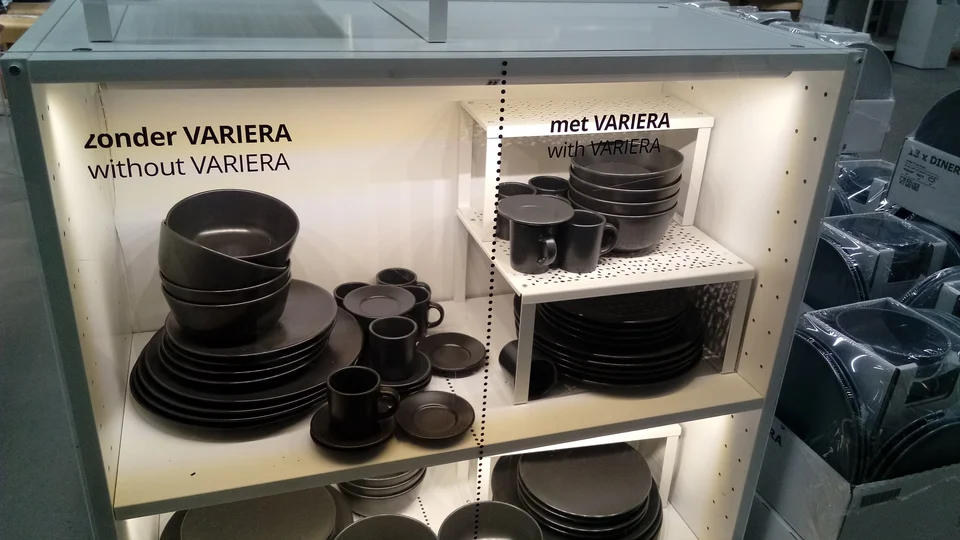
The VARIERA 501.777.27 insert has the dimensions shown in the comparison and uses coated steel. IKEA describes shelf storage for glasses, bowls and spice jars and specifies wiping with a damp cloth. Treat it as an optional way to divide unused cupboard height, after checking your intended arrangement.
Keep the bulk atta and rice decision separate. The reviewed page supplies no numerical load rating for the insert. Its steel construction and a photograph of stored objects do not establish a permitted filled-grocery mass. Obtain the applicable load guidance before planning that use; the supporting cupboard's limit must also be checked independently.
An extra level helps only when both spaces remain accessible. A tall pouring jar may need the uninterrupted shelf height, while shorter items might suit a divided area. Check the clear gap beneath the platform rather than assuming its 16 cm overall height is usable clearance. Leave room for lids and for lifting out the object you use most often.
The photograph shows a historical VARIERA display arrangement, not the two container models in the comparison. It illustrates the extra-level idea without proving the exact current insert size or any load capacity.
Separate daily access from reserve storage
Write down which ingredients you reach for most often. Keep those containers accessible to the people who use the kitchen. Consider whether one large container or a smaller daily container plus a reserve works better for you. Splitting supplies adds a refill task and another container to accommodate.
Choose a position where you can control a filled container when lifting it. Do not plan around lifting a heavy grocery container above your comfortable reach. Test the movement with an empty vessel first; this checks access, not the cupboard's strength.
Leave a deliberate place for the next unopened packet if that is part of your shopping routine. A layout that fits only immediately after refilling may not fit at the time your groceries arrive.
Check the shelf and its supports
Record the filled mass of each container, including its own weight, and other objects sharing that shelf. Obtain the cabinet or shelf manufacturer's load and installation instructions for the exact system. IKEA's example page lists a model-specific maximum load per shelf; that figure cannot establish the capacity of another cupboard.
If the shelf's rating, supports or installation are unknown, ask the supplier or a competent installer to assess them before adding bulk groceries. Do not infer a rating from board thickness, appearance or the fact that the shelf has held items before. A paper layout and an empty-container rehearsal do not verify load capacity.
Use this shelf worksheet
| Item | Record before arranging | Check in the cupboard |
|---|---|---|
| Usable shelf | Clear width, depth and height | Hinges and supports excluded |
| Opening | Narrowest removal route | Container passes without force |
| Atta | External size, filled mass, access routine | Lid, scoop and grip usable |
| Rice | External size, filled mass, access routine | Controlled removal and return |
| Each dal | Individual footprint and frequency | Label and contents identifiable |
| Reserve packets | Space needed when shopping arrives | Daily containers still accessible |
| Shelf system | Exact rating and installation guidance | Supplier confirms suitability |
Review the arrangement after using it through your normal shopping and refill routine. Change positions where access is awkward before buying matching extras. The useful result is a shelf whose contents fit your space and habits, with its load suitability checked separately.
Sources
Read how we choose or report a correction.
Disclosure
Some product links are affiliate links. As an Amazon Associate I earn from qualifying purchases. This does not change the price you pay.
We compare published product specifications and instructions. We have not hands-on tested these products. Prices, stock and delivery can change; check the selected model and current terms before buying.