How to Match Baking Tin Sizes to Your OTG
A baking tin needs to fit both your OTG and your recipe. Check the complete outside envelope against the oven's permitted support and clearance requirements. Separately, check the inside baking space against the recipe's pan specification. Neither the OTG's litre capacity nor the tin's nominal capacity answers both questions.
2 products · Compare before you buy
Product comparison at a glance
| Product | Purchase consideration | Important limitation |
|---|---|---|
Wonderchef Ambrosia 63153622 | Six cups; listed tray size 28 × 18 cm | Cavity depth and diameter basis remain unresolved; confirm rack fit |
Meyer Bakemaster 47527-C | Shallow carbon-steel pizza crisper for a different baking task | Match complete pan dimensions and permitted mode; microwave-appliance use is convection-only |
What to check before choosing
| Check | Record |
|---|---|
| OTG | Exact model, revision and applicable manual |
| Programme | Intended mode and permitted rack/accessories |
| Support | Usable area and manufacturer clearance requirements |
| Tin envelope | Overall dimensions, including projections |
| Loaded arrangement | Permitted covering, food height and access |
| Recipe space | Internal shape, dimensions, depth and intended fill |
| Product permission | Materials, components, heat and care instructions |
| Offer identity | Matching code, variant, pack and warranty |
This is a measurement guide based on maker specifications, not a physical fit test. We have not placed the examples in an OTG. Current offer availability and any unresolved model-specific checks should be confirmed before purchase.

Identify the oven and permitted arrangement
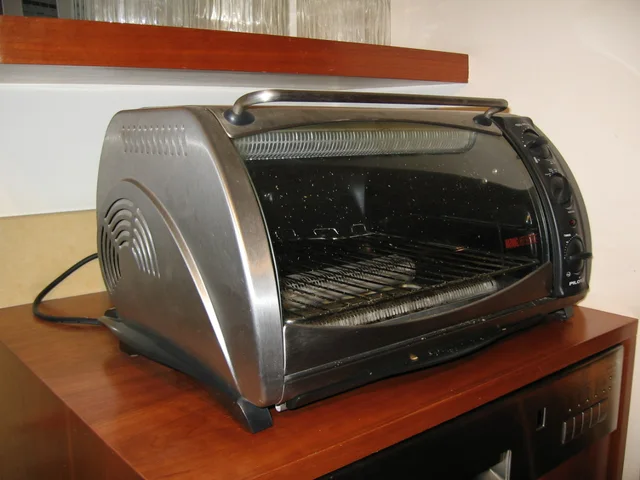
Start with the exact OTG model and any relevant revision, then obtain its manual. Find the permitted cookware arrangement, rack positions, supplied accessories and clearance requirements for the intended programme.
Record the usable support rather than only the cavity's widest point. A vessel might pass through the door yet fail to sit in the permitted arrangement. Check the intended support and access path, with the appliance cold and off, using the maker's measurement or inspection directions.
This article gives no universal clearance distance. If the manual leaves an important measurement or support question unclear, obtain the maker's answer for your oven before approving the tin.
Keep two sets of tin dimensions
For oven fit, you need confirmed overall length, width and height, including rims, handles or other projections that enter the appliance. For recipe fit, you need the inside dimensions and usable depth relevant to the specified pan.
Where a product page gives one unexplained set of dimensions, ask what boundary it measures. Do not silently treat the numbers as internal dimensions for batter calculations and external dimensions for oven fit.
Shape also matters. An oval pan's longest dimension, a round tin's outside diameter and a rectangular tray's rim envelope are different measurements. Record each explicitly rather than translating them into a generic “size”.
Three maker examples show the missing questions
The Wonderchef Baking Tray – OTG 28L page identifies WCOTG28L015 and a one-piece tray pack. The examined sections did not establish its dimensions or exact compatible oven model and revision. Its “28L” name does not prove that it fits every 28 L OTG.
The Wonderchef Ambrosia Metal Muffin Pan page lists code 63153622, six cavities and 28 × 18 cm tray dimensions. It does not resolve the full measurement boundary or loaded height. The listed cavity diameter alone does not establish depth or working batter quantity.
The same Wonderchef page states an oven limit of 450°F / 232°C for this SKU. Record that separately from the dimensions: a temperature claim does not establish supported fit, loaded height or permission for every OTG programme. A planned temperature above the stated limit fails this documentary check even if the tray fits geometrically. A temperature below it still leaves the appliance arrangement and complete product instructions to verify.
The Meyer Bakemaster Pizza Crisper page lists 47527-C as oval, with 29.4 × 24 × 2.4 cm dimensions, and claims suitability for ovens of 16 litres and above. The dimension basis is unspecified. That broad capacity claim is not an exact fit measurement for your appliance.
These are research examples of questions to resolve, not a ranked shortlist. Their different shapes also prevent treating one as a direct recipe replacement for another.
Use measurements to rule out a candidate
Consider a fictional example: an oven manual identifies a 30 × 25 cm permitted support area, while a candidate's confirmed overall envelope is 31 × 24 cm. The candidate exceeds one support dimension in the stated orientation. A smaller area calculated by multiplying its dimensions would not solve that mismatch.
This example is arithmetic, not a fit approval for any real oven. Rotating a pan, using another rack or adding a support would require permission for that exact arrangement. Do not invent an orientation or accessory workaround.
A candidate smaller than the support dimensions is still only a preliminary match. Height, required clearances, door access, support stability and operating permissions remain to be checked. Passing a width-and-depth comparison is not the complete decision.
Include the loaded height and handling path
Record any lid or covering that the recipe and product instructions permit. Account for the food's intended height where it affects the required arrangement. The empty tin's height alone may leave that question unresolved.
Check how the permitted arrangement can be inserted and removed in accordance with the appliance instructions. A tray that fits when empty still needs appropriate access during use. We have not assessed grip, balance or loaded handling for the examples.
Do not bend a tray, trim a rim or modify handles to make an unresolved fit appear acceptable. This guide supplies no permission to alter any product.
Match the recipe after the oven check
Obtain the recipe's required shape, inside dimensions and intended fill. If you change the tin, use an adaptation covering that change rather than assuming that equal nominal volume means an equal bake.
Keep the oven-fit and recipe-fit results separate. A large tray can fit the OTG but offer the wrong depth for a loaf. A recipe-sized dish can fail the permitted oven arrangement. Both decisions need evidence.
Temperature and component permissions are additional checks. Physical fit does not establish that the body, lid, coating or handles are permitted in the selected programme.
A worksheet for the actual purchase
Leave unknown measurements unresolved and obtain the maker's clarification.
Questions before ordering
Is “for 28 L OTG” sufficient evidence?
Confirm the exact compatible oven model or complete dimensional and instruction correspondence. Capacity labels alone are incomplete.
Can I use the product's shipping-box dimensions?
Packaging measurements describe another object. Obtain the tin's actual overall dimensions.
Does fitting through the door prove suitability?
It resolves only part of the access question. The permitted support, clearances, loaded arrangement and operating instructions still matter.
Sources
- Wonderchef OTG28L tray
- Wonderchef63153622 muffin pan
- Meyer47527-C pizza crisper
- Wonderchef Ambrosia muffin pan: temperature and dimension recheck
- Meyer Bakemaster 47536-C product and care information
- Meyer India warranty claim procedure and exclusions
- borosil mode and care evidence
- Dated Amazon offer correspondence check; unresolved permissions
- Dated Amazon offer correspondence check; unresolved permissions
Read how we choose or report a correction.
Disclosure
Some product links are affiliate links. As an Amazon Associate I earn from qualifying purchases. This does not change the price you pay.
We compare published product specifications and instructions. We have not hands-on tested these products. Prices, stock and delivery can change; check the selected model and current terms before buying.