How to Choose Mixer Grinder Jars for Indian Recipes
Choose mixer-grinder jars by matching your essential recipes to the exact model's permitted jar, working quantity and operating cycle. Nominal volume and jar count are useful identification details, but they do not establish how much food you may process or how well a small batch will work.
3 products · Compare before you buy
Product comparison at a glance
| Product | Relevant documented arrangement | Why consider it | Limitation affecting this task |
|---|---|---|---|
Philips HL7756/00 | Nominal 0.3 L chutney jar; linked manual gives 0.17 L rated wet capacity | Assess a small wet batch against a stated limit | Older datasheet gives 0.2 L; match supplied manual and suffix |
Atomberg Zenova, Red Wine, four jars with chopper | Nominal 0.5 L chutney/spice jar and dedicated coarse mode | Compare a coarse preparation setting with your preferred result | Working limits and comparative coconut texture are not established |
Sujata Dynamix 900W | Separate dry and chutney jars; manual addresses coconut and spices | Compare task-specific preparation instructions | Current page lists 0.5 L chutney jar; linked manual lists 0.4 L |
What to check before choosing
| Jar in the linked manual | Nominal capacity | Rated maximum in the table |
|---|---|---|
| Wet jar | 1.5 L | 0.6 L |
| Dry jar | 1 L | 0.5 L |
| Chutney jar | 0.3 L | 0.17 L for wet use |
This guide uses the official Philips HL7756/00 and /02 manual as a documented example. We have read the capacity table and care instructions but have not tested recipes, texture or small-batch performance. Verify that the manual applies to the actual unit and accessories you intend to buy.
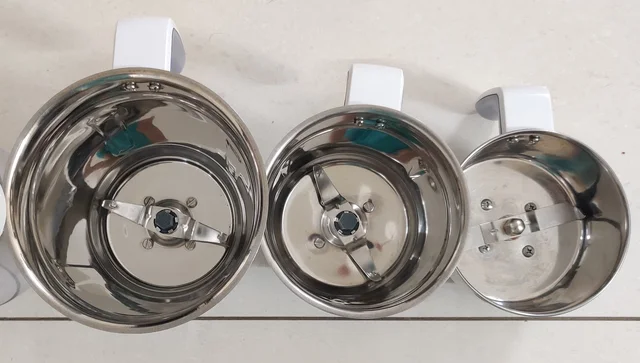

Separate nominal volume from the working limit
A jar's advertised size should not automatically become your recipe fill level. The Philips example makes the distinction explicit:
These are model-specific figures, not rules for every mixer grinder. They also do not establish ingredient-specific rice weights or a universal minimum batch. Use the applicable recipe and task instructions alongside the table. Philips linked HL7756 manual.
For another model, obtain its own table and look for what each number means. If a seller gives only nominal litres, leave the working limit unresolved rather than calculating it as a fixed fraction of jar size.
Resolve conflicting documents before planning a batch
The Philips historical datasheet dated 7 March 2023 lists a 0.2 L working figure for the chutney jar, while the linked manual specifies 0.17 L for wet use. We have preserved that discrepancy rather than selecting the larger number. Philips historical datasheet.
Confirm the supplied model, revision and applicable instructions. Keep the document title and model suffix with the capacity entry in your notes. A familiar product name is insufficient when instructions differ across documents or variants.
This is also why a retailer's simplified comparison table should not be your only source. It may omit the distinction between nominal and working quantities, or combine information from different versions. Ask for the documentation that resolves the actual unit you will receive.
Build a recipe list before comparing bundles
List the tasks that would make the purchase worthwhile: a small chutney, a supported dry-spice task, a wet mixture or another recipe documented for the appliance. Record ingredients and quantities separately. A general label such as “Indian cooking” hides the details needed for jar selection.
| Recipe detail | Evidence to collect |
|---|---|
| Ingredients and preparation | Permitted ingredients and required preparation |
| Normal quantity | Applicable working range or recipe limit |
| Smallest regular batch | Documented minimum or suitably scoped evidence |
| Intended jar | Exact jar and blade instructions |
| Processing routine | Speed, cycle and rest requirements |
| Desired finish | Relevant recipe evidence or an honestly described test |
Do not convert a litre limit into a rice, dal or spice weight without supporting instructions. Ingredients and preparations differ, and the reviewed capacity table alone does not provide those conversions. A jar's nominal size also does not prove that your batter quantity fits one cycle.
Check whether an extra jar solves a real task
The Philips HL7756/00 maker page documents three jars and a 750 W appliance. Neither figure establishes that a different four-jar bundle would be more useful for your recipes. Philips HL7756/00 page.
For every additional jar, identify its exact intended task, working limits and supplied components. If it is a juicer or another specialised attachment, obtain its own operating and cleaning instructions. Do not treat every container as an interchangeable blending jar.
Then compare that documented task with your recipe list. An attachment that duplicates a task you already cover may matter less than a jar that supports your most frequent permitted quantity. This is a usefulness assessment, not a claim about superior performance.
Assess small and large batches separately
Write down your smallest regular chutney or other supported recipe rather than assessing only the largest batch. Maximum capacity does not establish effective processing at a much smaller quantity. We have not tested a minimum usable batch for the Philips example.
For a larger meal, calculate the number of batches only after the recipe's permitted quantity is verified. Include assembly, loading, processing, required rests and unloading. Do not divide the ingredient total by nominal jar litres and call the result a supported batch plan.
If evidence for your recipe is missing, mark it unresolved. A photo of a full jar or an unspecific owner comment does not establish the loading method or a safe operating range. Seek documentation or a properly described test within the applicable instructions.
Keep the operating cycle with the capacity record
The inspected Philips manual specifies an ordinary three-minutes-on, one-minute-off cycle. Its separate 30-minute ceiling followed by 20 minutes of continuous rest is not a replacement for that ordinary cycle. The manual also requires cooling hot ingredients before loading and prohibits leaving the operating appliance unattended.
These instructions belong to the documented example. Do not copy them to another model or infer permission for an ingredient from the cycle alone. A task needs both an applicable recipe/load instruction and an operating routine.
Avoid turning a continuous-grinding headline into unrestricted use. When a headline and the applicable instructions seem inconsistent, resolve the scope before relying on it. A motor rating does not remove jar limits or required pauses.
Compare care and replacement compatibility
The same inspected manual requires unplugging before cleaning, prohibits immersing the base and dishwasher washing, and says to wash the other disassembled parts in soapy water, rinse and dry thoroughly. It also says not to use jars as storage containers.
Obtain the exact care instructions for another candidate rather than assuming similar-looking jars share a washing method. Consider how you will clean and dry the parts you regularly use, especially when a recipe creates more than one batch.
Before buying a replacement jar or lid, verify compatibility through the appropriate model and part information. Visual similarity, a matching advertised litre size or the same brand does not establish fit. Record the exact accessory identity with your appliance details.
Use the worksheet to make the shortlist
A useful jar bundle covers your essential permitted recipes, normal quantities and operating routine with manageable care. Keep unverified minimum batches, ingredient limits and document discrepancies visible. Do not turn missing evidence into an optimistic capacity claim.
This guide establishes an instruction-based selection method rather than a tested ranking. Current offer availability and any unresolved model-specific checks should be confirmed before purchase.
Sources
Read how we choose or report a correction.
Disclosure
Some product links are affiliate links. As an Amazon Associate I earn from qualifying purchases. This does not change the price you pay.
We compare published product specifications and instructions. We have not hands-on tested these products. Prices, stock and delivery can change; check the selected model and current terms before buying.