Flat-Bottom vs Round-Bottom Kadais for Indian Stoves
Choose between flat-bottom and round-bottom kadais by matching the actual contact base and support arrangement to your exact stove. Then compare the interior geometry with the recipe you intend to cook. A round mouth, curved interior and curved exterior base describe different features; a seller's shape label may not explain all three.
2 products · Compare before you buy
Product comparison at a glance
| Product | Bottom and surface | Nominal capacity | Listed diameter |
|---|---|---|---|
Hawkins INSK25G | Flat bottom, nonstick; glass lid | 2.5 L | 26 cm |
Hawkins AK15 | Round bottom, hard-anodised | 1.5 L | 22 cm |
This research guide uses a Hawkins flat-bottom candidate and a specific induction-hob manual to explain the checks. We have not tested stability, cooking speed or heat distribution. Current offer availability and any unresolved model-specific checks should be confirmed before purchase. No ranked winner is established.
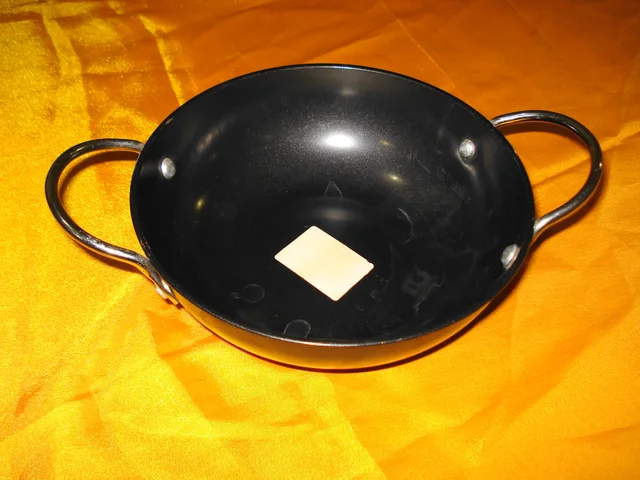

Identify the stove before choosing the shape
Record the stove's model and read its cookware requirements. Check permitted materials, base shape, dimensions, support and placement. Gas, flat electric surfaces and induction appliances should not be treated as having interchangeable requirements.
For gas, obtain the stove's directions for the intended vessel and pan support. A round-bottom label does not establish that the kadai will sit securely on your existing support. Do not improvise a ring or adapter based on a marketplace photograph.
For induction, check both the cookware's permission and the hob's requirements. A flat aluminium vessel without a suitable induction base has not been established as compatible merely by its shape. Conversely, a magnetic material claim leaves the base geometry and size questions unanswered.
Separate top diameter from contact diameter
Ask for the diameter of the opening, the flat contact area where present, the depth and the overall handle-inclusive dimensions. These measurements answer different questions. The opening affects recipe and utensil space; the contact base affects the match to the stove.
A 26 cm pan description does not by itself identify a 26 cm contact base. Obtain the measurement boundary rather than comparing a mouth diameter with the stove's required base size.
The curved cooking surface inside a pan also does not prove that its outside contact surface is curved. Request exact construction information when the listing uses round, flat or wok loosely.
What the flat-bottom candidate establishes
The Hawkins maker-store page identifies INSK25G as an induction-compatible nonstick shallow kadhai with a flat bottom and glass lid. It lists diameter 26 cm, nominal capacity 2.5 L and thickness 3.25 mm. A two-year guarantee is stated; full terms remain unresolved.
Product dimensions are blank in the examined section. The 384 × 270 × 119 mm dimensions and 2 kg weight refer to the carton, not the assembled pan or net handling mass. Contact-base diameter, working fill and full pan-and-lid instructions remain unverified.
The maker describes straight walls and a flat base. That description is not a comparative cooking test against a round-bottom model, nor does it establish compatibility with every induction appliance.
What the round-bottom candidate establishes
The Hawkins maker-store AK15 page identifies a hard-anodised round-bottom deep-fry pan with nominal capacity 1.5 L, diameter 22 cm and listed thickness 3.25 mm. It describes rosewood handles attached through riveted steel brackets. A five-year guarantee is stated, but its complete terms were not established.
The table separates product dimensions of 307 × 215 × 103 mm from carton dimensions of 314 × 228 × 112 mm. The product measurement boundaries are not explained; in particular, the 215 mm dimension should not silently replace the nominal 22 cm diameter. The 1 kg figure is weight in carton, not bare pan mass. Exact support geometry, permitted stove arrangement, usable interior and working fill remain unresolved.
AK15 and INSK25G are documentation examples of different bottom descriptions. They also differ in capacity, surface and lid configuration, so this is not a matched performance comparison that isolates bottom shape. Check each model's instructions before selecting either for a particular stove or recipe.
What one hob manual requires
The Hawkins Futura Single Hob Induction manual, in its suitable-cookware section, requires a magnetic or ferromagnetic base and a flat base of at least 120 mm diameter. It requires direct contact and says curved bases can hinder or prevent heating; uneven gaps may cause overheating and affect the temperature sensor.
That numerical minimum applies to the appliance covered by that manual. It is an example of a model-specific check, not a universal size rule for all induction stoves. The INSK25G page's top-diameter figure does not close its contact-base measurement gap.
Use your own hob's matching manual before deciding whether a candidate fits. Do not infer a supported arrangement from a forum report that a curved vessel heated on another appliance.
Compare the cooking task independently
Record the recipe's vessel requirements, food quantity, utensil movement and permitted heat setting. A nominal litre capacity does not establish a working frying or stirring allowance. This guide supplies no universal oil depth, fill fraction or family serving count.
If your recipe depends on a particular curved interior or flat cooking area, obtain confirmed internal dimensions. A name such as kadai, wok or deep-fry pan is not a complete geometry specification.
Changing shape may also change the space available for the recipe's arrangement. Use a supported recipe adaptation instead of inventing time or temperature changes. No claim of faster cooking, better flavour or more even heating is established here.
Plan handling and care
Check the assembled footprint, grip arrangement and net mass where handling or cupboard fit matters. Include handles and the supplied lid in the appropriate measurements rather than using packaging figures.
Read the pan and lid instructions separately for permitted modes and heat limits. A glass lid in the pack does not automatically share every permission of the pan body. A shape comparison also cannot substitute for coating-specific care.
Before choosing, establish how you will place, lift, clean and store the exact item as instructed. This guide recommends no support modification, surface adjustment or improvised adapter.
Comparison worksheet
Leave gaps blank instead of borrowing from another size. AK15 now has maker evidence for its round-bottom description, but its support and operating permissions still need exact instructions. Current Indian stock, delivery and genuine affiliate-link checks remain necessary.
Questions before choosing
Does a flat bottom guarantee induction compatibility?
No. The exact cookware permission and hob requirements must both be satisfied, including the base material and dimensions.
Is a round-bottom kadai automatically right for gas?
Its permitted use and support on the exact stove need verification. The shape label alone does not establish that arrangement.
Is there a winner yet?
No. Current offer availability and any unresolved model-specific checks should be confirmed before purchase.
Sources
Read how we choose or report a correction.
Disclosure
Some product links are affiliate links. As an Amazon Associate I earn from qualifying purchases. This does not change the price you pay.
We compare published product specifications and instructions. We have not hands-on tested these products. Prices, stock and delivery can change; check the selected model and current terms before buying.