Kitchen Tools and Food Preparation
Box Grater vs Flat Grater for Small Indian Kitchens
Choose a box grater when several documented surfaces match tasks you regularly perform and you have room for the complete tool. Choose a flat grater when its particular surface covers your main task and its covered dimensions suit your storage. Neither format earns a place in the kitchen merely because it has more blades or looks smaller.
2 products · Compare before you buy
Product comparison at a glance
| Product | Surfaces and supplied features | Size or care information | Main purchase consideration |
|---|---|---|---|
OXO Box Grater 1057961 | Coarse, medium, fine and slicing surfaces; attaching marked container and lid | 7.3 × 11.4 × 29.9 cm with axes unclear; listed 408 g is packaged weight | Confirm complete Indian pack and component care; four surfaces do not establish four useful tasks for every kitchen |
OXO Etched Coarse Grater 11216100 | Steel coarse surface, handle, foot and snap-on cover; named uses include semi-soft cheese, apples, cabbage and potatoes | UK page states dishwasher care; partial dimensions 34.5 × 12 cm | Third dimension and covered measurement scope unresolved; no measured storage-volume or cutting-performance advantage |
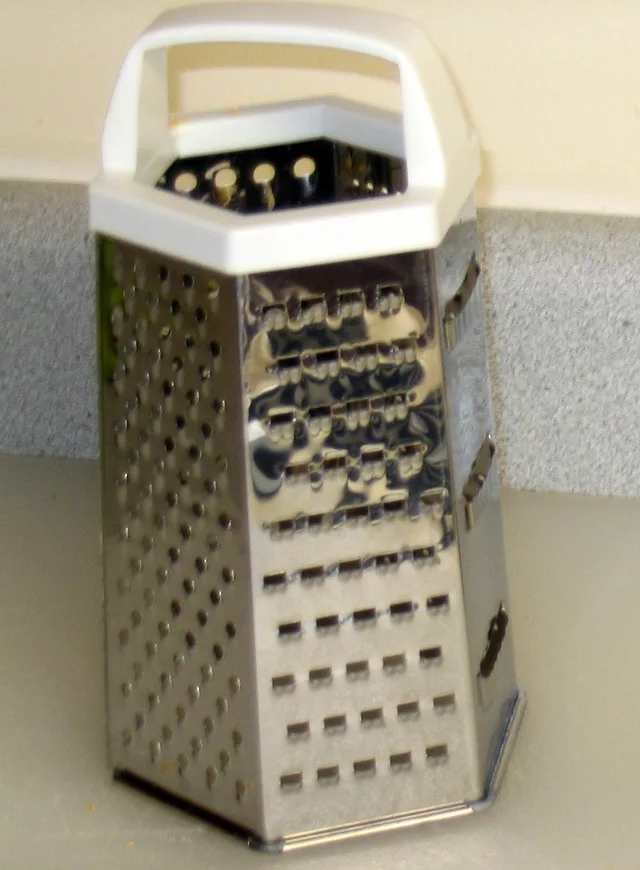

The OXO box model combines four surfaces and collection in one tool. The flat coarse grater focuses on one cut and includes a cover. Choose by the functions you use and the complete storage arrangement; cutting speed and grip have not been independently tested.
List the cuts you actually use
Write three columns: ingredient, required texture and frequency. A recipe asking for coarse shreds is a different task from one needing a fine paste. Cheese for a topping, vegetables for a filling and ginger for a paste should not be assigned to the same surface just because each task is described as grating.
Next, identify the exact surface and ingredient permission documented for each candidate. Keep an empty box where the information is missing. This stops the number of sides from becoming a substitute for suitability. A box with four surfaces may cover only one of your jobs; one flat tool may cover that job without replacing the others.
Do not automatically relabel a fine surface as a zester or assume a general vegetable grater covers coconut. Our box-grater guide examines individual surface and package distinctions. The format comparison here asks whether those functions belong in one tool or separate tools for your household.
Compare the two OXO designs
OXO's UK Box Grater page identifies SKU 1057961 with coarse, medium, fine and slicing surfaces. It describes an attaching collection container with markings and a lid. These features illustrate how one box design combines cutting surfaces and collection. They do not prove that every box grater includes a container or that every Indian package contains these accessories.
The OXO Etched Coarse Grater page describes a steel grating surface, handle, foot and snap-on cover. Its named ingredients include semi-soft cheese, apples, cabbage and potatoes. This illustrates a single-purpose surface with a separate storage cover. A corresponding OXO UK listing identifies SKU 11216100 and states dishwasher-safe care. It does not establish which variant or accessories an Indian seller will supply.
The examples therefore support a feature comparison, not a verdict on equivalent output. Two surfaces called coarse need not produce identical shreds. We have no measured results that would justify calling either example faster, easier or more comfortable.
Compare the whole arrangement
| Question | Box format | Flat format |
|---|---|---|
| Which tasks are covered? | Map each documented surface to a real task | Map the surface to its task; count any additional tools needed |
| Where does food collect? | Check whether a separate container is supplied and how it attaches | Check the maker's supported working arrangement and receiving vessel |
| What needs storing? | Body, container, lid and any removable elements | Tool, cover and any separate graters required for other cuts |
| What needs washing? | Each permitted component, including container and lid if used | The tool and cover under their own instructions |
| What must fit? | Complete stored dimensions and room to retrieve it | Covered length, width, thickness and room to retrieve it |
A flat tool's smaller-looking profile is not a measured saving until the entire replacement set fits the proposed space. Equally, do not reserve cupboard space for several unused box surfaces when one appropriate surface would serve your cooking.
Measure the drawer, not the photograph
Record the inside drawer length and width, then its usable closed height. Include anything that hangs into the opening. Compare these with dimensions whose axes and assembled state are clear. A long handle can make a flat tool unsuitable for a short compartment even if its blade is thin.
For a box design, measure the intended shelf or compartment and the route used to remove it. Check whether the collection container stays attached in storage. For separate flat tools, lay out paper outlines at their documented covered sizes. Include every tool needed to replace the functions you use.
The OXO box page lists 7.3 × 11.4 × 29.9 cm without clear axis labels; its 408 g figure is expressly packaged weight. Neither field establishes a bare-tool handling weight or guarantees a particular drawer orientation. Ask for clarified dimensions when fit is close.
The UK coarse-grater listing gives 34.5 × 12 cm, but does not label the axes, provide a third dimension or specify whether the cover is included in that measurement. Treat this as a partial specification. It is not enough to calculate an exact storage-volume saving against the box grater.
A storage photograph can help identify covers and components, but it is not permission to stack other utensils against exposed cutting surfaces. Use the product's supplied storage instructions.
Collection can change the decision
Think about the destination of the grated ingredient. If you use a mixing bowl immediately, compare the documented working arrangement with that bowl. If a product includes a collection container, check its attachment, removal and emptying directions as part of the same task.
Do not equate markings with a tested usable batch size. A container with a lid also does not establish airtightness, leak resistance or food-storage duration. These are separate claims requiring their own evidence.
For frequent small quantities, having the desired surface available may matter more than collecting a whole batch in one container. For several cuts in one preparation session, a suitable multi-surface tool may reduce the number of separate tools you retrieve. These are workflow considerations; they do not establish a measured time saving.
Cleaning and handling need exact instructions
Compare care requirements before buying. Check whether each component may go in a dishwasher, whether parts detach and how the maker directs cleaning around the cutting surfaces. Do not transfer care permission from another model in the same brand.
We have not established that either format is safer, more stable or better for a particular grip. A foot or handle is a design feature, not proof of injury prevention. Follow the supplied directions, and do not invent a blade-contact cleaning method from a generic shopping article.
Make the choice from your worksheet
A box design is worth investigating if multiple verified surfaces match recurring tasks and its full arrangement fits your kitchen. A flat design is worth investigating if the required surface is clear and the complete covered tool fits a better storage position. Keep an existing suitable tool if a replacement would simply duplicate the same job.
Choose neither candidate when ingredient permission, care or fit remains unresolved. For ginger and garlic preparation, read the mechanism-specific guide. See how we choose for our evidence standard and corrections for factual updates.
Sources
Read how we choose or report a correction.
Disclosure
Some product links are affiliate links. As an Amazon Associate I earn from qualifying purchases. This does not change the price you pay.
We compare published product specifications and instructions. We have not hands-on tested these products. Prices, stock and delivery can change; check the selected model and current terms before buying.