Kitchen Tools and Food Preparation
Slotted Spoons for Indian Cooking: Food Retention and Serving Checks
Choose a slotted spoon when your task is to lift food while allowing some surrounding liquid to pass through. Start with the size and condition of the food, the opening of the vessel and the cookware's utensil instructions. A tool described as stainless steel does not establish slot size, draining speed or suitability for frying.
2 products · Compare before you buy
Product comparison at a glance
| Product | Documented use and contact | Care | Main purchase consideration |
|---|---|---|---|
OXO Silicone Slotted Spoon 11281600 | Pasta, vegetables, beans and peas; non-stick suitability stated | Dishwasher suitability | Dimensions and numeric heat limit missing; India offer unverified |
OXO Steel Slotted Cooking Spoon 3120200 | Straining vegetables and lifting meatballs from sauce; steel construction | Dishwasher suitability | Dimension units and axes missing; non-stick compatibility and India offer unverified |
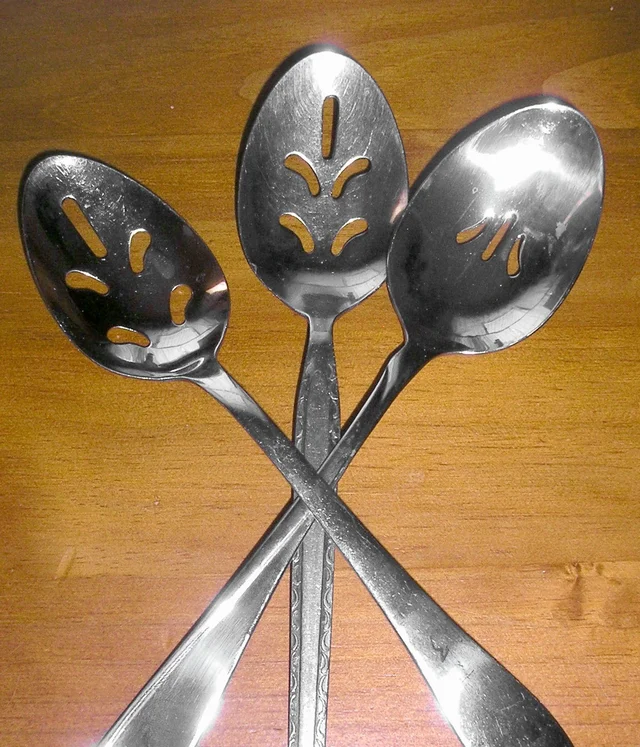

Choose the silicone model when non-stick compatibility is the deciding requirement; consider the steel model for the documented vegetable and meatball serving tasks where your cookware permits metal utensils. Neither has verified slot measurements or an established Indian offer. Dripping, grip and food retention have not been independently tested.
Define what you want to leave in the vessel
Name the preparation and what you want on the plate. A serving task might require lifting vegetables while leaving broth behind, or transferring pieces with some sauce retained. Those are different desired results. A slotted spoon is not automatically better than a solid serving spoon for both.
Write down the smallest pieces you need to retain and any larger or delicate pieces that must fit the head. Keep those requirements attached to the food as prepared, not its uncut size. The slot layout needs to be evaluated against that actual task.
Do not assume that narrow-looking openings in a photograph have a particular measured size. Perspective, lighting and the absence of scale make that an unreliable way to specify a tool.
Two identified models to compare
OXO's UK Silicone Slotted Spoon page identifies SKU 11281600. It describes a rounded head with flexible edges, use with non-stick cookware and dishwasher cleaning. OXO names pasta, vegetables, beans and peas as uses. Those are manufacturer descriptions, not evidence that we measured retention or draining speed.
Consider this design when your cookware requires a compatible non-metal contact surface. However, the accessible page leaves its dimensions blank and supplies no numerical temperature limit or contact duration. Obtain the supplied model's instructions before choosing it for hot-oil work; the general heat-resistance wording does not settle that decision.
OXO Steel Slotted Cooking Spoon 3120200 is a separately identified model. Its US page describes stainless-steel construction, a non-slip handle touchpoint, vegetable straining and lifting meatballs from sauce. It also states dishwasher suitability. The dimensions field reads 2.75 × 2.15 × 14.8, but the accessible field supplies neither units nor axis labels. We therefore do not convert those numbers or present them as measured head width or reach.
The Steel page does not establish non-stick compatibility, a supported load or slot measurements.
Distinguish head size from slot size
The head must enter the vessel and accommodate the food. The slots determine which pieces can pass through and form part of the draining arrangement. Handle reach and angle determine a different part of the complete working geometry.
| Requirement | Evidence to request |
|---|---|
| Vessel access | Head width, length and depth |
| Food retention | Actual opening dimensions and layout |
| Larger pieces | Supported load and intended use |
| Cookware contact | Compatibility stated for the tool and cookware |
| Handling | Full length, grip and instructions |
| Storage | Overall footprint, including curved head |
Do not treat the number of slots as a performance score. More openings could be differently sized or positioned. Without a comparable test, this research cannot rank how quickly two spoons drain or how much sauce remains on food.
Plan the serving route
Inspect your proposed layout with empty, cool vessels. Note where the source dish, receiving plate and utensil rest would be. Allow for the actual head and handle dimensions rather than only the length printed in a listing.
This exercise checks space, not loaded safety or spill performance. Follow the exact use instructions for hot food and liquids. Do not improvise a draining technique from a product photograph.
A shallow serving dish and a deep pot can create different reach requirements. If you use both regularly, compare whether one documented tool covers both before buying a multipack. Two similar-looking spoons may still solve different access problems, but their differences need to be real and relevant.
Read the whole material declaration
Identify the head, shaft and grip materials separately where possible. A metal head can be combined with a polymer handle. The tool's care and heat-use conditions need to cover that assembly, not just the metal portion.
Check the cookware maker's permitted utensils. Do not assume that rounded edges make every metal spoon suitable for a non-stick surface. If the required compatibility is not established, choose a documented alternative rather than treating gentle use as a substitute for permission.
No alloy grade, corrosion lifetime or chemical-safety assurance is inferred here from a stainless-steel description. Those claims need their own appropriate evidence.
Include care and storage in the decision
Read cleaning directions for the exact supplied revision, including restrictions on soaking, dishwasher use or removable parts. Consider whether you can reach and rinse the openings according to those instructions. We have not timed cleaning or compared residue removal.
Check the drying and storage position, including the full head shape. Hanging convenience and drawer fit are separate questions. A tool that fits a drawer's length may still obstruct closing because its head is deeper than the available space.
Keep the existing spoon if it already performs the required documented task and remains in suitable condition. Add another tool to address a specific food-retention, vessel-access or care problem rather than an unsupported promise of a universal upgrade.
For wire-basket selection, see the skimmer guide. For carrying liquid, see the ladle guide. Read how we choose or report a correction with updated manufacturer information.
Sources
Read how we choose or report a correction.
Disclosure
Some product links are affiliate links. As an Amazon Associate I earn from qualifying purchases. This does not change the price you pay.
We compare published product specifications and instructions. We have not hands-on tested these products. Prices, stock and delivery can change; check the selected model and current terms before buying.