Kitchen Tools and Food Preparation
Salad Spinners for Indian Kitchens: Capacity, Cleaning and Storage Fit
Choose a salad spinner when removing water from washed greens is a recurring preparation task and the complete tool fits your kitchen and cleaning routine. Compare the basket, operating mechanism and lid access before relying on a large capacity number. Bowl volume alone does not establish how much leafy food can be spun in one suitable batch.
2 products · Compare before you buy
Product comparison at a glance
| Product | Mechanism and components | Size or capacity | Care and purchase consideration |
|---|---|---|---|
IKEA UPPFYLLD 405.219.51 | Turn-handle operation; rinsing basket and outer serving bowl | 23 cm diameter × 16.5 cm height | Handwash only; litre capacity and working food batch not established |
OXO Salad Spinner 32480V2B | Press knob, brake, non-slip base and lid that disassembles for cleaning; basket can serve as colander | 6.22-quart bowl, 4.95-quart basket; 10.5 × 10.5 × 6 inches | Dishwasher care stated; confirm component instructions; capacities do not establish working batch; India offer unverified |
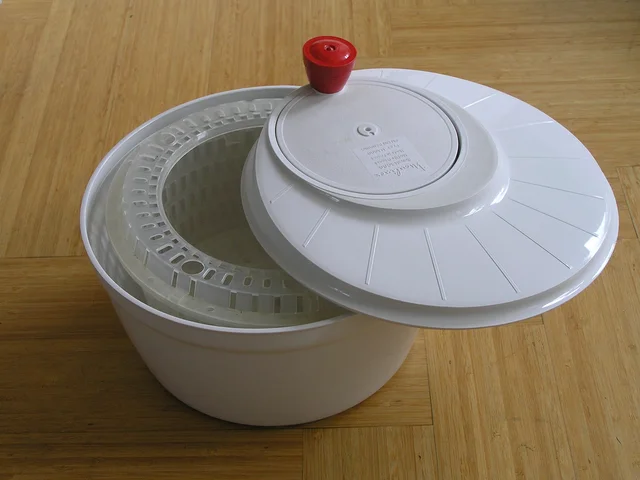

Consider UPPFYLLD for its turn-handle design and documented India-market dimensions if handwashing suits your routine. Consider the OXO for its push control, brake and separate bowl and basket capacity figures, subject to the supplied model’s instructions and Indian availability. Drying speed, leaf damage and operating effort have not been independently compared.
Identify the greens and the task
Write down what you prepare repeatedly: a bowl of lettuce, a small quantity of herbs, or another ingredient covered by the spinner's instructions. Include whether you prepare it daily or only for an occasional meal. Do not assume that permission to spin salad covers every fruit, vegetable or other food.
Record your usual quantity in a way you can reproduce. A weighed quantity is useful when asking a manufacturer about its guidance, but do not convert that weight into a required basket volume using an invented formula. Leaf shape, preparation and the model's loading instructions remain relevant.
Separate washing, draining and spinning in your notes. If your present problem is only finding a vessel to rinse and drain produce, compare a suitable colander as well. If residual water after that step is the recurring issue, a spinner addresses a different part of the workflow. Keep food-preparation instructions and any package directions alongside the tool's manual.
Keep three capacity fields separate
The outer bowl volume describes the container around the basket. The basket volume describes the inner component. The working batch is the amount and arrangement of food permitted by the operating instructions. These are different entries on a comparison sheet.
An advertised litre or quart figure may identify only one of them. Ask which component it describes before comparing two listings. If one maker gives basket capacity and another gives only outer dimensions, leave the missing values blank rather than presenting them as equivalent specifications.
There is no verified rule in this research that a certain number of litres serves a particular family size. Use your actual preparation needs to frame questions about loading, not a generic people-per-litre label.
IKEA versus OXO: controls, capacity and care
IKEA UPPFYLLD 405.219.51
The IKEA India product page lists a 23 cm diameter and 16.5 cm height, polypropylene and synthetic rubber, and handwashing only. It describes rinsing salad in the basket, then turning the handle to spin it, with the outer bowl also suitable for serving.
Those details provide an India-market example with documented external dimensions and a handwashing requirement. The page does not establish a litre capacity or a tested mass of greens per batch. Its packaging diameter is 24 cm and packaging height is 16 cm; use the product measurements for initial fit planning, and clarify any detail critical to your space. The package weight is not a verified net utensil weight.
OXO Salad Spinner 32480V2B
The OXO US page distinguishes a 6.22-quart bowl from a 4.95-quart basket. It lists 10.5 × 10.5 × 6 inch dimensions, a press-operated knob, a brake button, a non-slip base and a lid that comes apart for cleaning. The basket is described as usable as a colander, and the page indicates dishwasher care.
This gives more capacity detail, but neither volume establishes a measured drying batch or water-removal result. Confirm the full care instructions for the supplied version, including component placement, before depending on dishwasher use. The overseas page does not establish Indian stock, delivery or support.
Compare the whole operating sequence
Imagine the tool's documented routine from the sink to unloading: rinse, load, secure the lid, operate the control, stop and empty the collected water. Identify the movements required by the exact model, rather than deciding that a crank or pump is inherently easier.
A brake is a documented control to compare, not proof of a particular stopping time. Similarly, a non-slip feature does not prove the tool cannot move on your counter. We have not measured either result. Read the maker's setup instructions and consider whether the operating space is practical for you.
If a supplier demonstrates a model, look at the complete sequence, including taking the lid apart where permitted and putting it back together. A short clip showing only rotation leaves much of the ownership routine unanswered.
Check three places before ordering
| Place | Measure or record | Question to resolve |
|---|---|---|
| Sink | Clear opening and available washing space | Can the components be washed as instructed? |
| Counter | Clear footprint and overhead working space | Is there room for the documented control movement and unloading? |
| Storage | Usable shelf opening, depth and height | Does the complete stored arrangement fit and remain retrievable? |
For a hypothetical shelf with 17 cm of clear height, a product listed at 16.5 cm leaves only 0.5 cm by subtraction. That arithmetic does not establish convenient access or confirm whether every projection is included in the stated height. Check the stored configuration and the route into the shelf before treating it as a fit.
If you intend to store parts separately, measure that arrangement too. A bowl fitting inside another bowl does not tell you where the basket and lid will go.
Read the lid-cleaning instructions closely
“Removable lid” may mean the lid lifts off the bowl, while “disassembles for cleaning” describes a different feature. Find the actual steps before treating those descriptions as interchangeable.
Ask for the manual if a listing simply says “easy cleaning.” Check where the parts are supposed to dry and whether your available washing arrangement matches the instructions. Avoid making cleaning convenience a deciding advantage while the mechanism remains undocumented.
Decide whether it earns its space
Choose after you can name the recurring task, understand the loading guidance and accommodate the complete cleaning and storage routine. If your need is occasional and your existing method meets it, another bulky tool may not be necessary. Use the multipack buying checklist for the same inventory approach before adding several preparation gadgets.
The linked manufacturer sources support the stated features and care examples. The worksheets and hypothetical shelf calculation are editorial planning aids, not performance tests. See how we choose for our evidence method and corrections policy to report an error.
Sources
Read how we choose or report a correction.
Disclosure
Some product links are affiliate links. As an Amazon Associate I earn from qualifying purchases. This does not change the price you pay.
We compare published product specifications and instructions. We have not hands-on tested these products. Prices, stock and delivery can change; check the selected model and current terms before buying.