Mixer Grinders for Coconut Chutney and Masala: Batch and Texture Checks
Choose a mixer grinder for coconut chutney and masala by the batch you make and the texture you want. A small wet chutney, a coarse coconut mixture and a fine dry spice powder need separate checks. This research comparison examines Philips HL7756/00, Atomberg Zenova with four jars and Sujata Dynamix 900W. We have not tested their finished textures, and no best grinding result is established.
3 products · Compare before you buy
Product comparison at a glance
| Product | Relevant documented arrangement | Why consider it | Limitation affecting this task |
|---|---|---|---|
Philips HL7756/00 | Nominal 0.3 L chutney jar; linked manual gives 0.17 L rated wet capacity | Assess a small wet batch against a stated limit | Older datasheet gives 0.2 L; match supplied manual and suffix |
Atomberg Zenova, Red Wine, four jars with chopper | Nominal 0.5 L chutney/spice jar and dedicated coarse mode | Compare a coarse preparation setting with your preferred result | Working limits and comparative coconut texture are not established |
Sujata Dynamix 900W | Separate dry and chutney jars; manual addresses coconut and spices | Compare task-specific preparation instructions | Current page lists 0.5 L chutney jar; linked manual lists 0.4 L |
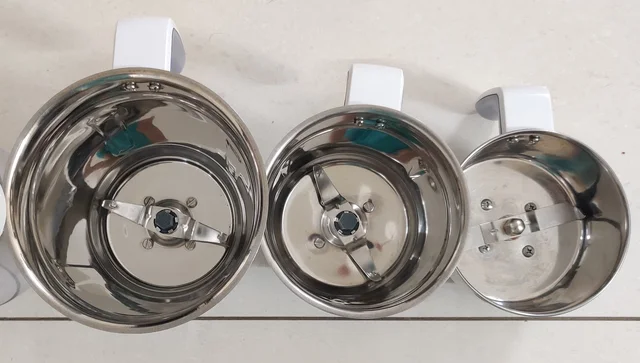

Choose by your preparation
Write down whether you want smooth coconut chutney, a deliberately coarse mixture or a dry masala powder. Then record your usual ingredient amount and the jar and instructions intended for that preparation. Do not treat the advertised jar volume as permission to fill it completely.
- Small wet chutney: consider the Philips configuration's documented chutney filling limit and check whether it covers your actual batch.
- A deliberate coarse texture: consider the Atomberg Zenova's dedicated coarse setting. Its purpose is relevant, but it is not independent proof of a preferred taste or texture.
- Both coconut preparation and dry-spice work: consider the Sujata Dynamix's task-specific manual. Resolve the documented chutney-jar size difference before choosing the precise offer.
If a model's permitted minimum batch is unknown, keep it unknown. Maximum filling is only one boundary. A larger jar is not automatically an improvement for a spoonful-sized preparation, and this comparison does not invent minimum quantities for any candidate.
Compare what is documented
These configurations do not establish a market-wide ranking. Input wattage, jar volume and the presence of a mode describe different things. None is substituted for a common recipe test measuring the result readers care about.
Philips: work from the wet-capacity row
The Philips support-linked manual covers HL7756/00 and /02. It gives the 0.3 L chutney jar a rated wet preparation maximum of 0.17 L. The older HL7756/00 datasheet lists 0.2 L working capacity. Do not silently choose the larger figure; establish the instructions applicable to your supplied unit.
Consider this candidate if your regular wet preparation falls within the applicable limits. Measure the actual mixture instead of equating an ingredient's weight with a jar's litre volume. A recipe with water added can occupy a different volume from the chopped ingredients alone.
The manual gives an ordinary duty cycle of three minutes on and one minute off, requires cooling hot ingredients before loading, and prohibits dishwasher washing. That is useful ownership information when you prepare wet chutney and dry masala in the same session. It does not provide a measured coconut-texture comparison or establish a minimum effective chutney batch.
Choose another configuration if the verified filling limit creates an inconvenient number of batches or the cleaning instructions do not suit your routine. A small jar can be worth considering without claiming it makes every small recipe successfully.
Atomberg: separate a coarse-setting feature from a tested result
The official Zenova page describes a coarse mode and a nominal 0.5 L chutney-and-spice jar in the Red Wine four-jar configuration. That makes it a relevant candidate when you deliberately want some texture rather than an entirely smooth mixture.
Decide what “coarse” means for your recipe before comparing machines. You might want visible coconut pieces in one preparation and no obvious pieces in another. A named setting cannot decide which result you prefer. We do not adopt the maker's taste, flavour or grinding-stone equivalence claims as our own test findings.
Ask for the exact permitted preparation quantities, speeds and running intervals. The nominal jar volume does not show a safe filling level or a reliable minimum batch. A separate chopper in the bundle is also not proof that its bowl is the appropriate jar for coconut chutney or dry spice powder.
Consider this version if the dedicated setting answers a regular cooking need. Choose another configuration if you mainly want a smooth result and other verified requirements favour it. Complete component-care evidence remains open for this candidate; the guide does not assume dishwasher permission or interchangeable instructions from Zenova Fresh or Flex.
Sujata: useful task instructions, unresolved jar identity
The current Dynamix page identifies a 900 W model with separate blender, dry and chutney jars. It specifically mentions coconut chutney and dry masala uses. The linked Dynamix operating manual contains sections for dry grinding and chutney preparation, making it more useful than a general claim that a mixer handles every ingredient.
However, the current page lists the chutney jar as 500 ml, while the downloaded manual's specification table lists 400 ml. The manual's publication date and exact supplied-unit revision were not established. This discrepancy prevents a confirmed jar-size comparison and is kept visible instead of being dismissed as rounding.
The manual gives coconut-cutting guidance and warns against overgrating copra. Its dry-grinding section distinguishes dry ingredients and warns against overgrinding. These are model-specific instructions, not advice to transfer to the other candidates. Read the complete applicable manual before use.
Consider the Dynamix only after the seller and manufacturer documentation identify the included jars and applicable instructions. We do not translate the motor's 90-minute rating into a promise that every recipe, load or accessory can run continuously for that period. No comparative smoothness, noise or durability result is established here.
Record a texture target before comparing features
Make separate notes for your wet chutney and dry masala. Use familiar descriptions that someone else could understand: smooth spoonable paste, visibly coarse coconut mixture, or spice powder for a particular recipe. Keep the intended result distinct from the appliance's marketing label.
Record the ingredients, their preparation and the amount normally used. If you regularly change the amount of added liquid, note that variation. Do not assume that two mixtures are comparable just because both are called coconut chutney. A thin accompaniment and a thick paste may pose different practical requirements.
When you seek a demonstration, ask for the exact recipe and model configuration used. A video showing a large batch does not establish success with your much smaller quantity. Nor does a photograph of a smooth-looking result disclose running time, added water or the amount left on the jar walls.
Keep wet and dry preparation checks separate
Use the instructions for the relevant jar and preparation. Do not borrow a wet filling limit for dry spice grinding. Ask whether the maker permits your intended ingredients, how they must be prepared and what blade or attachment belongs with them.
For each task, note the need to stop, unplug, scrape or change an attachment according to the applicable instructions. Do not reach into an energised jar. A recipe routine should account for these operations rather than treating every pause as evidence that a motor is inadequate.
If an instruction sheet gives a general appliance limit alongside a recipe-specific method, keep both in view. Do not select the longest visible running time and ignore the limits relevant to the task. Where two official documents disagree, obtain the applicable supplied-unit instructions before using the conflicting value.
A chutney-and-masala purchase worksheet
- Name two actual preparations, including the texture you want for each.
- Record the usual and smallest routine batch separately.
- Identify the exact recommended jar and blade for each task.
- Find the permitted quantity and ingredient-preparation guidance; mark missing values unknown.
- Check running intervals, cooling requirements and the procedure for scraping or changing parts.
- Record cleaning instructions for the base, jar, lid, gasket and removable blade where applicable.
- Match the model, suffix and included jars to the current offer and supplied manual.
Use the worksheet to rule out unresolved fits, rather than assigning a numerical performance score to untested models. A clear reason to consider a candidate is different from a verified recommendation to buy it.
Questions that affect this decision
Does the biggest chutney jar make the best small batch? Its nominal volume does not answer that question. You need permitted batch information and a demonstrated result relevant to your amount.
Does coarse mode mean better coconut chutney? It gives a particular control option. Whether its result is preferable depends on your recipe and texture preference; no common recipe test is available here.
Can one jar handle both wet chutney and dry masala? Use the exact maker's instructions for each preparation and component. Do not infer permission from a general multifunction claim.
Which candidate has the finest powder or smoothest paste? This research does not include a comparable grinding test, so it does not award that result to any model.
Check the wider cooking routine
Read the everyday mixer-grinder comparison for batch planning across routine recipes, and the compact-kitchen guide for operating and storage fit.
Sources
Read how we choose or report a correction.
Disclosure
Some product links are affiliate links. As an Amazon Associate I earn from qualifying purchases. This does not change the price you pay.
We compare published product specifications and instructions. We have not hands-on tested these products. Prices, stock and delivery can change; check the selected model and current terms before buying.