500W vs 750W Mixer Grinders: What Indian Buyers Should Compare
Compare 500 W and 750 W mixer grinders by the exact model’s supported recipes, working loads and operating routine. Wattage is a specification to check, but it does not establish which appliance produces finer chutney, handles your batter better or lasts longer. Avoid assigning recipes to a power band without model-specific instructions.
2 products · Compare before you buy
Product comparison at a glance
| Product | Documented nominal jars | Working-load evidence | Ordinary duty instructions | Supplied variant check |
|---|---|---|---|---|
Bajaj Rex 500 W | 1.2 L, 0.8 L, 0.4 L | Not established here | Not established here | Exact colour/configuration correspondence unresolved |
Philips HL7756/00 750 W | 1.5 L, 1 L, 0.3 L | Manual distinguishes jar volume from rated preparation capacity | Inspected manual specifies three minutes on, one minute off | Confirm full suffix on the offered unit |
This research comparison uses Bajaj Rex 500 W and Philips HL7756/00 750 W as documented examples. They do not represent every appliance in either power band. We have not tested them against each other, measured grinding results or verified current eligible Amazon offers. The Bajaj working-load and duty instructions remain incomplete in this research.
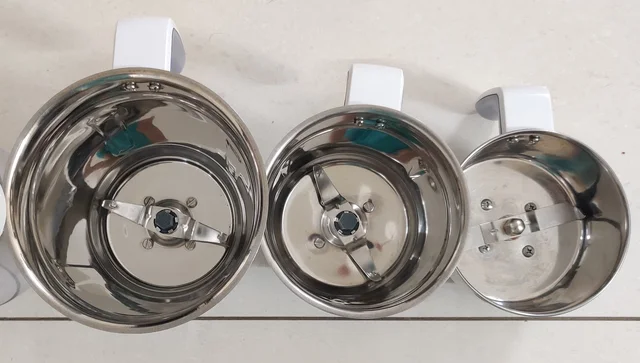

What the exact examples show
This table exposes an evidence difference, not a measured performance advantage. Missing instructions for one candidate cannot be filled by using the other model’s limits.
Bajaj Rex: jar size is a starting point
The saved Bajaj maker page lists a 500 W Rex with stainless-steel jars of the nominal sizes shown above. The research has not established working filling limits or complete operating and cleaning instructions for the exact supplied variant. Bajaj Rex page.
Obtain the applicable manual before deciding whether your regular recipe fits in one batch. A 1.2-litre jar does not establish permission to process 1.2 litres of every mixture. Likewise, the smallest jar’s volume does not tell you the minimum quantity needed for a particular recipe to work as intended.
Check the complete product name when matching an offer. Bajaj separately lists the Rex Neo 4 Jar 500 W, which adds a 1.5 L blender jar to the three other listed jar sizes. The three-jar Rex page advertises one year of product warranty; the Rex Neo page advertises two years. Those are different bundles and warranty headlines, even at the same wattage. Full terms and working loads still need verification.
A 500 W label alone is not evidence that a grinder can only perform light tasks. The exact instructions, attachment and supported load need to answer that question.
Philips HL7756: nominal and working capacities differ
The Philips page identifies HL7756/00 as a 750 W model with three jars. Confirm the offered unit’s full suffix, because a listing that says only HL7756 leaves that correspondence unresolved. Philips model page.
The inspected manual covers HL7756/00 and HL7756/02. Its capacity table lists 1.5 L nominal for the wet jar with 0.6 L rated maximum preparation capacity, 1 L nominal for the dry jar with 0.5 L rated maximum, and 0.3 L nominal for the chutney jar with 0.17 L wet rated maximum. Its ordinary duty cycle is three minutes on followed by one minute off. Philips manual.
A historical datasheet gives a different chutney working figure. Confirm the applicable supplied-unit instructions rather than choosing whichever value accommodates a larger batch. We have not treated an asterisked continuous-grinding headline as unrestricted operating permission.
Compare the same recipe and quantity
Choose three regular tasks and describe each precisely: ingredients, their preparation, quantity, intended texture and the jar required by the exact manual. “Indian cooking” is too broad to establish the load you need.
Use a worksheet like this:
| Your task | Information to obtain for each model |
|---|---|
| Small chutney batch | Permitted ingredient quantity, suitable jar and minimum working load |
| A dry preparation | Supported ingredients, preparation requirements and rated load |
| A wet mixture | Applicable recipe, permitted filling and duty/rest routine |
Do not treat the examples as instructions to process those foods in either appliance. The manual must support the task. If a model requires more than one batch, record that rather than exceeding the load to make the comparison appear convenient.
For a demonstration, keep the intended recipe and finished result comparable while respecting each model’s own instructions. Record loading, processing, required rests and cleanup separately. A comparison that stops when the motor stops may omit a meaningful part of the routine.
Wattage does not establish texture or speed
The power figure alone cannot prove which model reaches your desired texture sooner. A useful comparison needs a defined endpoint and a relevant recipe. We have not measured that here, so this guide does not claim that the 750 W example is faster or that the 500 W example needs longer processing.
Ask for evidence about the complete task rather than a motor spinning without a load. Note the recipe and quantity used in any demonstration. Its result supports an observation about that session, not every ingredient or batch size.
Noise also needs its own evidence. We have not measured either model’s sound level under a comparable load. Do not infer quietness from the power band, jar size or an unqualified marketing description.
Allow for the operating routine
Compare documented run and rest instructions before planning consecutive batches. A larger jar may still require batch splits according to its working limit. A higher power rating does not remove that requirement or the model’s duty restrictions.
Keep the Philips three-minute-on, one-minute-off instruction specific to its inspected manual. It does not establish a general rule for all 750 W grinders, and it should not be applied to Rex as a substitute for missing instructions.
If you regularly prepare several dishes in sequence, map the sequence against the exact manual. Include jar changes, unloading and any required rest. Leave the comparison unresolved where a candidate’s instructions are missing.
Energy, durability and maintenance need separate checks
Rated watts do not establish the energy used to complete a recipe. An energy comparison would need the same suitable quantity and comparable finished result, with consumption measured across the relevant session. We have not made that comparison, so neither power band is presented as cheaper to operate.
Durability is also unmeasured here. Confirm warranty scope, exact jar compatibility and replacement-part availability rather than treating power as a lifespan indicator. A warranty period is not a test of how long a grinder will last in your kitchen.
For cleaning, use component-specific instructions. The inspected Philips manual requires unplugging, prohibits base immersion and dishwasher washing, and describes washing the other disassembled parts in soapy water before rinsing and drying. Those permissions have not been transferred to Bajaj. Philips manual.
Choose the documented fit for your routine
Prefer a candidate whose exact instructions support your regular quantities and tasks, whose supplied jar set is verified and whose operating routine fits your meal preparation. A power band can narrow a search, but it should not replace those checks.
Current offer availability and any unresolved model-specific checks should be confirmed before purchase. This guide does not name a tested winner between 500 W and 750 W grinders; it gives a method for comparing actual models without mistaking wattage for proof of performance.
Sources
Read how we choose or report a correction.
Disclosure
Some product links are affiliate links. As an Amazon Associate I earn from qualifying purchases. This does not change the price you pay.
We compare published product specifications and instructions. We have not hands-on tested these products. Prices, stock and delivery can change; check the selected model and current terms before buying.